


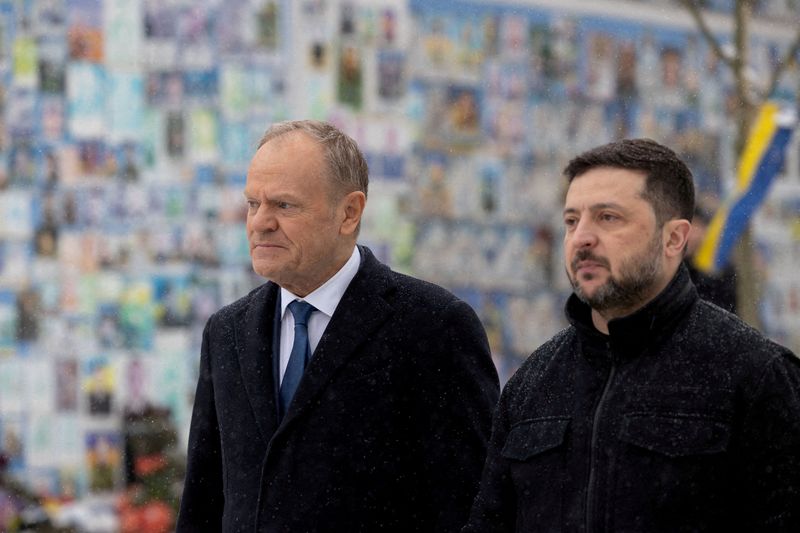
Tusk’s Gambit: History Tests Ukraine-Poland Alliance
Poland's Tusk presses Ukraine on historical accountability, straining a critical alliance on Europe's eastern flank. Discover the geopolitical impact.

POLICY WIRE — Warsaw, Poland — It’s a dance as old as diplomacy itself: the former occupier instructing the newly independent how best to secure their future. Yet, when Donald Tusk, Poland’s current prime minister, addresses Kyiv, it’s rarely about troop movements or NATO specifics. Not directly, anyway. His recent pronouncements have pivoted, unceremoniously, from geopolitical solidarity to the long-simmering embers of historical accountability—a stark shift for a region often focused on tomorrow’s threats.
It seems Tusk believes Ukraine is, in fact, prepared to [QUOTE_PLACEHOLDER]. That’s his read on things, anyhow. An intriguing thought, especially given the ongoing conflagration tearing through its eastern territories. But he doesn’t stop there. The Polish leader also made it abundantly clear, according to reports, that Kyiv absolutely needs to [QUOTE_PLACEHOLDER]. It’s a sentiment loaded with decades of contentious memory, particularly concerning events like the Volhynia massacres during World War II.
And so, we watch, as one of Ukraine’s most steadfast allies seemingly nudges it towards a reckoning. This isn’t just about some distant, dusty past. It’s about leveraging moral debts in the present geopolitical bazaar, where a perceived weakening of Ukrainian resolve—or a softening stance on historical atrocities—could influence crucial support. But how does one confront history when the present feels like a historical crisis unto itself? Ukraine’s leadership certainly has its hands full, what with, you know, fighting a full-scale invasion.
It’s a peculiar thing, seeing a strategic partnership laced with such heavy demands. One might wonder if this public prompting serves Kyiv or Warsaw’s domestic constituencies more. We’ve seen similar patterns play out in other complex, historically burdened regions. Consider, for instance, the perpetual demands placed upon Pakistan to reconcile its internal contradictions and external narratives—a state often caught between historical aspirations and the stark realities of regional power plays, struggling to forge a consistent identity while its neighbors like India exert considerable influence. It’s a relentless grind, balancing the urgent present with the insistent ghosts of yesteryear. Such a dance impacts alliances profoundly, creating friction where solidarity is most needed.
You can’t help but note the contrast. On one side, a nation bleeding to maintain its sovereignty; on the other, an ally seemingly intent on airing dirty laundry right now. It suggests an underlying frustration in Warsaw, perhaps an expectation that Ukraine, in its dire need, might be more amenable to these sorts of ‘suggestions.’ Or maybe, it’s just the raw, unsentimental truth of international relations: favors always come with strings attached. Policy decisions are never made in a vacuum, after all; they’re the product of countless inputs, including the specter of history.
For some context, Pew Research Center’s 2023 survey data indicated that among European Union members, Poland maintains one of the highest levels of positive sentiment towards Ukraine’s refugees, with 70% saying their country has handled the influx well. It’s an immense show of public goodwill—a reservoir Tusk might feel gives him license to press other, more uncomfortable issues.
📄 POLICY WIRE WHITEPAPER PUBLISHED: PAKISTAN'S NATIONAL SECURITY POLICY PRIORITIES
👉 READ BY CLICKING HEREBut demanding a nation confront a brutal past while fighting for its future is like asking a surgeon to philosophize during open-heart surgery. There’s a time and place for everything. This sort of high-stakes historical negotiation often comes when one party perceives an asymmetry of leverage—a temporary advantage in a longer, grinding contest. It certainly makes you wonder about the long game, doesn’t it?
What This Means
This isn’t merely about old grievances resurfacing; it’s a recalibration of a key strategic alliance on NATO’s eastern flank. Economically, any perceived destabilization or prolonged public friction between Warsaw and Kyiv could give pause to potential investors looking at reconstruction efforts or supply chain relocation post-conflict. If Tusk’s words aren’t just rhetoric—if they precede concrete demands tied to future aid packages or political support within the EU and NATO—it could force Ukraine into an agonizing dilemma: compromise its narrative of nation-building for immediate strategic advantage, or stand firm and risk alienating a vital neighbor.
Politically, the timing hints at Warsaw’s awareness of its strengthened regional position. With Germany still wrestling with its post-Cold War identity and France preoccupied with internal dissent, Poland sees an opening to assert leadership. For Kyiv, however, this public call to action isn’t a simple history lesson; it’s a political minefield. Managing the narratives of both heroic defense and historical accountability simultaneously, particularly when many of the historical actors involved were fighting *against* Soviet dominance, presents an almost impossible task. And it risks fragmenting an already fragile pan-European unity just when it’s needed most to counter Russia’s relentless aggression. It really shows how entangled diplomacy can get.