


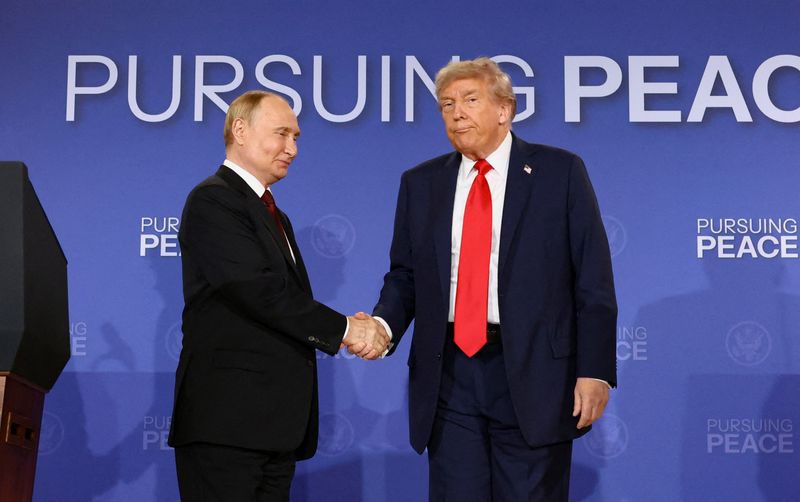
Trump’s Solo Diplomacy Strains Global Order
Trump's unofficial diplomacy on the Russia-Ukraine conflict sparks global friction. Discover how this solo act undermines US foreign policy and destabilizes international order.

POLICY WIRE — Washington, D.C. — The diplomatic stage has, lately, felt a bit like a tempest in a teapot—or, more accurately, a geopolitical storm without a clear captain. Into this swirling vortex steps former President Donald Trump, not as an official envoy, but as an erstwhile disruptor. His recent overtures to both Russian President Vladimir Putin and Ukrainian leader Volodymyr Zelenskiy, offering to broker a resolution to a conflict that has destabilized a continent, isn’t just an intervention; it’s an assertion of a personal foreign policy parallel to the sitting administration’s.
It’s the kind of move that sends seasoned diplomats to reach for the nearest strong drink, if they aren’t already polishing their memoirs. You see, the intricacies of international relations, particularly when war rages, aren’t typically handled via telephone calls from private residences. Yet, Trump reportedly put himself forward to President Putin with an offer to [QUOTE_PLACEHOLDER], according to statements emerging from the former president’s orbit. At virtually the same time, a conversation with President Zelenskiy confirmed his unusual diplomatic presence.
But this isn’t simply a matter of a former leader feeling chatty. It’s about perception, — and that matters profoundly on the global stage. When a figure of Trump’s stature volunteers as a peacemaker outside the established channels, it creates immediate friction. Allies eye the U.S. with a collective shrug, perhaps wondering who, precisely, speaks for America this week. Adversaries, conversely, might smell an opening—a potential weakening of resolve, a fracturing of Western unity that could be exploited. It’s a dynamic that breeds instability, not resolution.
And let’s be frank: the offer itself, delivered in a distinctly Trumpian manner, suggests a simplification of a deeply entrenched conflict. The Russia-Ukraine war isn’t just a squabble over land; it’s a battle for spheres of influence, national identity, and the very architecture of European security. The notion of a quick deal, brokered over a phone line, doesn’t quite capture the grim realities on the ground, where lives are lost daily and cities are rendered to rubble. This isn’t selling a condo; it’s attempting to re-engineer a geopolitical fault line.
Because, domestically, this serves multiple masters. It allows Trump to present himself as a dealmaker, a problem-solver unconstrained by conventional diplomatic norms—a narrative he’s cultivated for years. It feeds into the idea that he, uniquely, can cut through bureaucratic red tape to achieve results where others falter. For his supporters, it’s proof of his continued relevance — and capacity for leadership, even from afar. For his detractors, it’s a chaotic exhibition of an ego unmoored from the realities of his previous office.
Such unorthodox moves aren’t without their precedents in various conflict zones globally. But the sheer scale of the players involved here—nuclear-armed states and the fate of European security—elevates this situation beyond mere political posturing. The international community, after all, needs consistency, not capriciousness. We’ve seen similar diplomatic overtures, often less publicized, from nations striving to assert their own global agency. But rarely from a former head of state still deeply entwined in the domestic political fabric.
📄 POLICY WIRE WHITEPAPER PUBLISHED: PAKISTAN'S NATIONAL SECURITY POLICY PRIORITIES
👉 READ BY CLICKING HEREFrom the perspective of Islamabad or Jakarta, for instance, such a high-profile, non-sanctioned intervention from a past U.S. President paints a perplexing picture. Nations like Pakistan, navigating complex relationships with both Western powers and a resurgent Russia, watch carefully. They wonder about the cohesion of Western policy. They might see the U.S. (or at least its public political sphere) as less predictable, potentially nudging them towards alternative alliances. Indeed, India’s purchases of discounted Russian oil increased by nearly tenfold following the 2022 invasion, hitting 1.95 million barrels per day in July 2023, according to Kpler data, demonstrating how nations adjust their geopolitical and economic calculus amid global flux.
This episode, messy and unconventional as it’s, speaks volumes about the splintered nature of global leadership in an age of populist politics. It’s a reminder that lines once considered sacrosanct—like the division between past and present administration foreign policy—can, in the Trump era, become rather blurry. One might even call it a kind of permanent campaign, playing out not just on the hustings, but on the world stage.
What This Means
This isn’t a mere headline filler; it’s a tremor across the already shaky edifice of international relations. Politically, Trump’s gambit, whether genuine or performative, undermines the Biden administration’s diplomatic efforts by introducing a conflicting narrative. It signals to both Kyiv — and Moscow that U.S. policy isn’t monolithic, potentially emboldening Russia or confusing Ukraine’s allies. Any future official negotiation could become entangled by Trump’s prior (and unofficial) positioning. Economically, while not directly impactful in the short term, prolonged uncertainty about U.S. foreign policy, particularly concerning the Ukraine conflict, could chill investment and disrupt commodity markets sensitive to geopolitical stability. the stunt forces other major players—from the EU to emerging powers in South Asia—to re-evaluate their strategies, wondering which U.S. they’re dealing with. It encourages a multipolar world where the traditional roles of superpowers are less clear-cut, as illustrated by recent discussions around alternative payment systems like those explored at the SCO or BRICS summits, signaling a shift away from traditional Western financial dominance. We’re witnessing the normalization of independent, even rogue, diplomatic initiatives from former heads of state, and it’s unsettling to anyone who values a coherent global strategy. It’s essentially a diplomatic wild card, played on the highest stakes imaginable, and everyone’s holding their breath for the consequences. And who wouldn’t be concerned? This is big.