


FIFA’s World Cup Heat: Profits Over Player Welfare
FIFA's World Cup scheduling ignores extreme US heat, prioritizing European TV profits over player and fan welfare. Uncover how commercialism trumps common sense.

POLICY WIRE — Washington D.C., USA — There’s a certain grim irony when the world’s most popular sport, ostensibly built on the passion of its fans and the peak performance of its athletes, bows before the altar of global television schedules—even if that altar sits smack in the middle of a blazing North American summer.
It’s not the sweltering heat itself that shocks, really. Anyone who’s spent a July afternoon in Philadelphia, where temperatures soared to nearly 100 degrees Fahrenheit for a World Cup Round of 16 match recently, can attest to nature’s stubbornness. But when that kickoff happens at 5 p.m. Eastern, precisely when the heat index reportedly peaks, one has to wonder: just whose game is this, anyway?
Fifteen days later, the final. New Jersey. 3 p.m. Eastern. Two days shy of what’s statistically its hottest average day of the year. FIFA’s brass, it seems, has decided European primetime trumps human biology. It’s a stark, almost cartoonish, display of commercial calculation overriding common sense. Forget player welfare; never mind the baked fans in uncovered stadiums. The European audience, snugly tucked into their air-conditioned living rooms, that’s what truly matters.
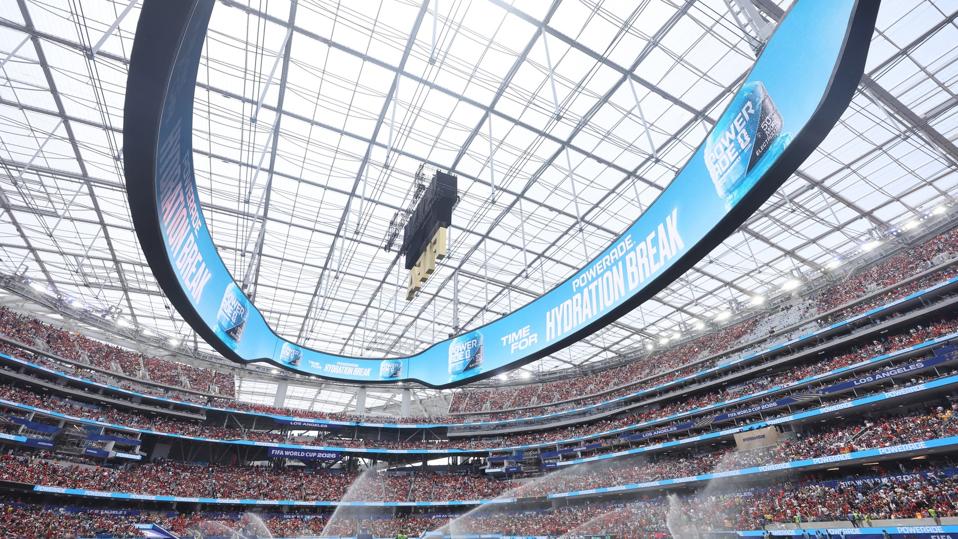
Many of America’s most capable indoor venues—marvels of climate control and modern engineering—could’ve hosted these matches without breaking a sweat. Yet, of the sixteen chosen stadiums for the 2026 spectacle, only four are truly climate-controlled, according to tournament organizers. It’s an almost baffling oversight for an organization that touts its global reach — and inclusivity. Because you’d think they’d care about optics, right? Or just, you know, basic comfort.
Many major American cities with suitable indoor arenas simply bowed out. They looked at the escalating cost projections, the amorphous demands, and quite reasonably, said “No, thank you.” Take Detroit, for instance. A city rebuilding, certainly. It boasts Ford Field, an entirely plausible option with its downtown vibrancy — and indoor comfort. But city leaders saw the red flags. “We simply couldn’t justify saddling our taxpayers with open-ended bills for an event that offered questionable returns. Local priorities—education, infrastructure—they’ve got to come first,” explained former Mayoral aide Michael Chen, who was part of the exploratory committee that eventually walked away from FIFA’s demands.
But FIFA, seemingly indifferent to such local fiscal prudences, sailed onward, secure in its global appeal. “Our scheduling reflects a commitment to global broadcast partnerships that ensure maximum viewership, balancing athletic performance with unparalleled accessibility for our worldwide fanbase,” offered Jürgen Schmidt, FIFA Head of Commercial Operations, in an official statement that seemed to ignore the obvious implications of 100-degree heat on ‘athletic performance’ in America. It’s a statement that rings hollow, a polished defense of a decidedly un-global approach to local realities.
📄 POLICY WIRE WHITEPAPER PUBLISHED: PAKISTAN'S NATIONAL SECURITY POLICY PRIORITIES
👉 READ BY CLICKING HEREThis selective blindness to geography — and climate isn’t just an American problem. Consider a World Cup bid from Pakistan or other parts of South Asia. Summers there aren’t just hot; they’re brutal, life-threatening. What kind of demands would FIFA make then? Would the ‘global broadcast partnership’ argument still hold sway when players are wilting, and fans are risking heatstroke in Lahore or Dhaka? Or is this, perhaps, a tacit message that certain regions, regardless of their football fervor, remain marginal until they can somehow manipulate the elements to suit a European broadcast schedule? It’s not just a commercial strategy; it’s a commentary on who gets prioritized in the global football hierarchy.
Las Vegas, America’s glitzy entertainment capital with Allegiant Stadium’s magnificent indoor pitch, even considered backing out because its movable field tray couldn’t precisely meet FIFA’s esoteric pitch width requirements without massive, costly modification. That’s a classic FIFA move: inflexibility in the face of local ingenuity. The decision-makers in Zurich appear to operate in a vacuum, a hermetically sealed world where logistics are dictated by abstract rules rather than the very real environments where their show unfolds.
What This Means
This isn’t just about hot soccer games; it’s a chilling exposé of how large international bodies like FIFA prioritize profits over people, and global markets over local conditions. Politically, it signals a disturbing precedent for future hosting bids. Countries in already climate-vulnerable regions, like many parts of South Asia, might find themselves economically disadvantaged or simply overlooked, should they ever seriously consider a World Cup. The costs of climate mitigation – think massive, power-hungry cooling systems – could become an insurmountable barrier. Economically, cities are learning a harsh lesson: the prestige of hosting a mega-event like the World Cup often comes with strings attached, and those strings can turn into chains of debt and unfulfilled promises. It also prompts deeper questions about athlete welfare in an era of accelerating climate change; surely, player health ought to dictate schedules more than European primetime.