


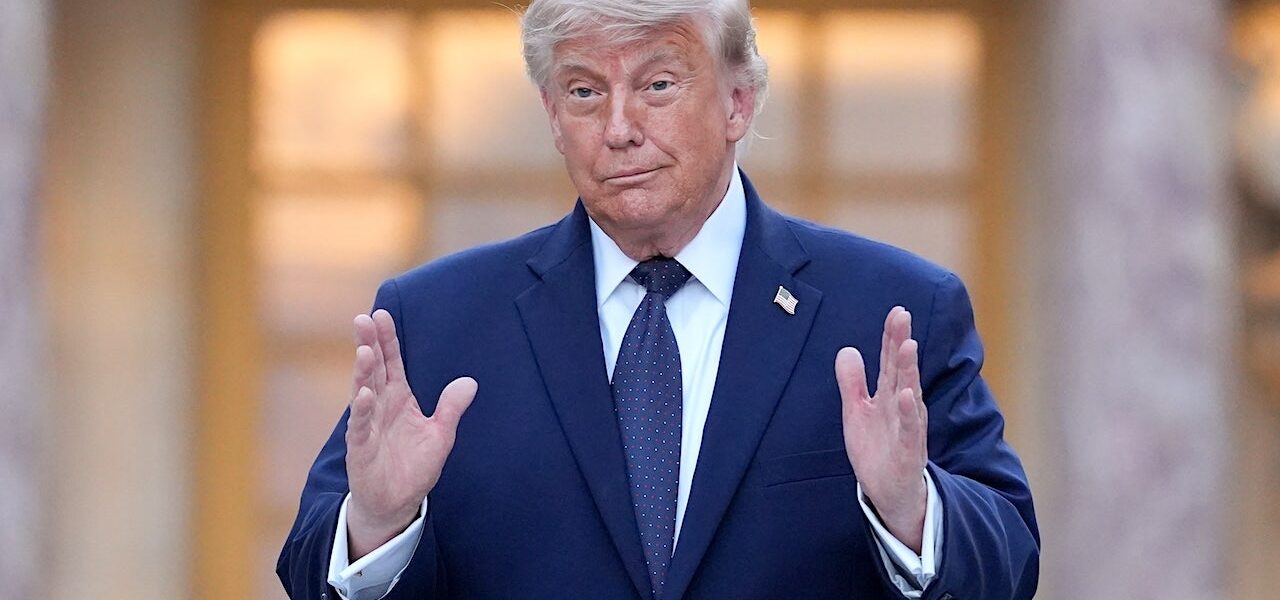
Trump’s Football Invite: Unity or Political Play?
Donald Trump proposes a White House football viewing with Bush, Obama, and Biden. Is this a genuine unity bid or a calculated political spectacle?

POLICY WIRE — Washington, D.C. — Imagine it: a plush seat in a West Wing viewing room, high-definition screens blazing, maybe a tray of White House sliders passing ’round. In the seats, arguably the most powerful men of the last three decades – all sharing popcorn, ostensibly enjoying some Sunday afternoon football. It sounds like a premise for a forgotten late-night skit, doesn’t it?
But this isn’t a spoof. It’s the latest, undeniably strange, proposal to emerge from the gilded halls of Mar-a-Lago: Donald J. Trump, the former president, openly contemplating an invitation to his predecessors, George W. Bush — and Barack Obama, alongside current Oval Office occupant Joe Biden, to watch a game together at the White House. The notion is so spectacularly detached from the bruising realities of modern American political combat it almost deserves its own category in the pantheon of Beltway peculiar.
It’s pure, unadulterated political theater, though for what end remains murkier than D.C. swamp water after a downpour. Trump himself, always keen on playing impresario, seems to relish the sheer spectacle. “It’d be tremendous. We’d all sit down, hash it out over a few touchdowns,” Trump reportedly mused to a confidant. “Show the world we can still talk. Big ratings, too, believe me.” He doesn’t just suggest, he produces – — and he expects an audience, a big one.
And that’s the thing, isn’t it? The invitation, if it ever materialized, would carry the kind of freight a super-PAC spends millions to conjure: an image of statesmanship, of bridging divides, of national unity, however fleeting or fabricated. Because deep down, everyone knows America’s current political divisions aren’t some trifling disagreement a Hail Mary pass can heal. Pew Research data from late 2023, for instance, showed a staggering 88% of registered voters feel that Americans’ political disagreements are about basic values, not just policy, marking historic levels of ideological polarization that aren’t going to vanish because of a red zone scramble. And don’t think for a minute these guys forget that.
It begs the question: What’s the catch? Is it a genuine, if misguided, stab at civility? Or a sly rhetorical trap, set with gridiron bait? A high-stakes PR stunt designed to make whoever declines look like the uncompromising one? This isn’t golf with Bill Clinton; this is a public performance under the harshest scrutiny. But what if it’s neither—just another spontaneous musing, a casual lob into the perpetually churned waters of political discourse, designed solely to get a rise?
The Biden administration, predictably, doesn’t seem to be losing sleep over it. One veteran insider, speaking on background — and clearly tickled by the idea’s sheer audacity, just scoffed. “Look, the President’s pretty busy dealing with, you know, actual governing. He’s not really one for reality TV pitches from Palm Beach. And, honestly, who’s making the popcorn at 1600 Pennsylvania now? Last I checked, President Trump wasn’t known for his hospitable handovers.” A polite, but firm, cold shoulder.
What This Means
📄 POLICY WIRE WHITEPAPER PUBLISHED: PAKISTAN'S NATIONAL SECURITY POLICY PRIORITIES
👉 READ BY CLICKING HEREThe casualness with which a former leader proposes such a wildly incongruous gathering speaks volumes about the performative nature of today’s American politics. It isn’t just about policy disagreements; it’s a personality-driven landscape where optics often overshadow outcomes. The possibility—however remote—of this televised kumbaya also highlights a peculiar feature of the American political system: the sometimes jarring tension between cutthroat campaigns and a supposed post-presidency fraternity. In many corners of the globe, particularly in developing democracies or states grappling with deep-seated conflicts, such an arrangement might seem fantastical. In countries like Pakistan, for instance, where political leaders frequently find themselves locked in existential power struggles or battling deep societal rifts, the idea of bitterly opposed former rivals casually sharing a convivial moment, even for sport, might be viewed with a mix of bewilderment and perhaps, a touch of aspiration – or cynicism regarding America’s own deep-seated problems.
But the broader implication is one of narrative control. If this football summit somehow came off, Trump could momentarily cast himself as the unifier, even as his political machine works overtime on other, far more divisive fronts. And for Biden, appearing might offer a chance to project magnanimity, but also risk dignifying a proposal clearly designed to center his predecessor. Decline, and he’s the partisan. There’s no easy play here. This isn’t a strategy for genuine reconciliation; it’s a strategy for winning the news cycle—which, let’s be frank, is its own kind of American game.
Consider the very real political turmoil elsewhere. Across the Atlantic, European nations face their own fault lines widening as populist movements gain traction, straining democratic institutions. Geopolitical chess is a serious business. Then we have ongoing skirmishes like the shadow play on the Baltic, where nations are battling for dominance without the luxury of symbolic football diplomacy. American politicians often indulge in a kind of public political spectacle that’s utterly foreign—and frankly, a bit bewildering—to leaders grappling with life-and-death decisions. It just is.
Ultimately, this ‘football summit’ isn’t about bridging divides or celebrating the sport; it’s about defining the terms of engagement in a perpetually polarized America, a theatrical bid for public perception more than actual policy or partnership. And it makes you wonder what’s next: a White House cook-off between Pelosi — and McConnell?