


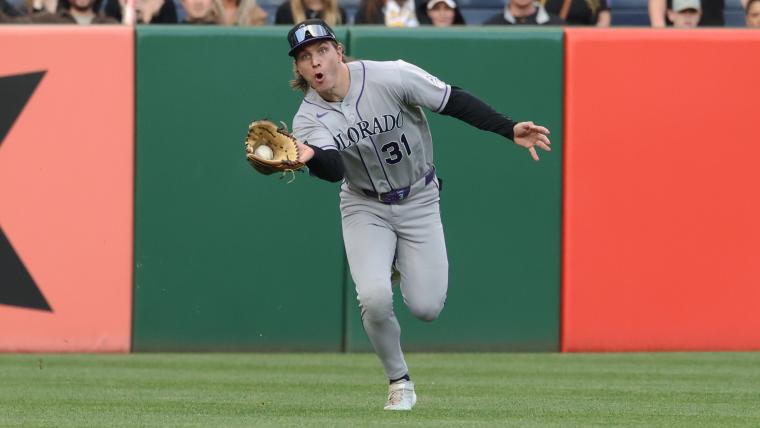
McCarthy’s Triple-Crown: Trade Deadline Valuation Shock
Jake McCarthy's historic 'triple-crown' game devastated Logan Webb's trade value. This single MLB performance reveals the brutal, fickle economics of professional sports valuation.

POLICY WIRE — Denver, United States — It wasn’t just a bad night at Coors Field; it was a market correction, a public dismantling of perceived value in real-time. For San Francisco Giants ace Logan Webb, lauded just hours earlier as the National League Pitcher of the Week, Friday’s outing wasn’t merely a statistical anomaly. It was, rather, a fiscal assassination performed with surgical precision by the bat of Jake McCarthy.
Before the first pitch, the industry was abuzz with Webb’s name. Five strong starts, a glistening ERA—he was the hot commodity, the coveted piece many desperate teams eyed as the July trade deadline loomed. He was currency, liquid gold in a tight market. But one fateful evening against the lowly Colorado Rockies, McCarthy didn’t just beat Webb; he utterly reshaped the pitcher’s portfolio, arguably shaving millions off his future earnings with every swing. The 15-3 final score hardly captures the raw brutality of what transpired. It’s never just about runs; it’s about perception. And perceptions, dear reader, dictate markets.
McCarthy, of all people—a decent player, sure, but hardly a household name—wrought this damage, etching his own name into baseball’s niche records while simultaneously obliterating Webb’s ascendant trade stock. He became the first player in Major League Baseball history to smash a leadoff home run, hit a grand slam, and steal a base all in the same game. That’s a bizarre, almost comical, combination of power, precision, and opportunistic speed that simply hasn’t happened in 150 years of professional baseball.
And he did it all against a pitcher who’d surrendered only three runs in the entire month of June. Webb faced the Rockies that night, — and then? He coughed up seven earned runs on eleven hits in a mere three innings. Three innings! “Look, I had a good run going,” a clearly exasperated Logan Webb was reported to have muttered after the game, shaking his head. “Things happen, but this… this wasn’t just a tough outing. It feels like someone dropped an anvil on my negotiation table, you know? My agent’s gonna have some fun with this.”
That kind of performance doesn’t just lose you a game; it makes front offices across the league – from San Diego to New York – recalculate their entire trade strategy. Suddenly, Webb wasn’t the unhittable marvel; he was a pitcher who could be catastrophically exploited under pressure, even by an ostensibly weaker club like the Rockies. You see how that impacts a prospective deal? It’s not about talent sometimes; it’s about recent memory, that fresh data point. That’s how capital gets reallocated.
The Rockies’ General Manager, Michael Burke, though unlikely to ever say it aloud about another team’s asset, must have felt a quiet satisfaction. “Jake’s performance wasn’t just about runs; it’s about signaling intent,” Burke could have reflected privately to an aide. “In this league, unexpected surges like this can reframe a season, or at least how a player’s perceived by everyone—especially other clubs keeping tabs. He just raised our team’s profile and, perhaps, changed the conversation about our next five games.” It’s an economy of attention, after all.
This individual display, as singular as it was savage, also holds a subtle but significant resonance beyond North American shores. Baseball, an increasingly global enterprise, leverages such outlier performances to capture imaginations in new markets. Consider regions like South Asia, where cricket remains king, but the spectacle of individual heroism, of defying insurmountable odds, possesses universal appeal. An analysis by Statista, for example, reveals that while cricket dominates media consumption in countries like Pakistan, the global surge in digitally distributed sports content has led to a steady, albeit slow, growth in viewership for Major League Baseball by nearly 2% year-over-year in such regions since 2019. It’s the David-versus-Goliath narratives, the unexpected eruptions of talent, that bridge cultural divides and make baseball digestible—even compelling—for audiences accustomed to a different rhythm of sport.
📄 POLICY WIRE WHITEPAPER PUBLISHED: PAKISTAN'S NATIONAL SECURITY POLICY PRIORITIES
👉 READ BY CLICKING HEREBecause ultimately, everyone appreciates a dramatic upset. McCarthy’s night, for instance, wasn’t merely a footnote in the box score. It was a potent example of how quickly established hierarchies can crumble, whether on a baseball diamond or in, say, nascent economic sectors halfway across the world, where an unexpected startup can suddenly upend entrenched corporations.
What This Means
The economic ramifications of McCarthy’s unprecedented outing extend well beyond Logan Webb’s now-dampened trade prospects. This single game highlights the brutal, often fickle, nature of market valuation in professional sports. A player’s trade value, his next contract, even his endorsement potential—all can pivot on a handful of at-bats or innings. For teams on the selling block, this means constantly weighing risk; waiting too long for that extra dazzling performance could, ironically, backfire spectacularly. Think of it as a miniature stock market, highly sensitive to volatility and immediate, verifiable data points, regardless of previous, sustained performance. It’s a cruel reminder that reputation is fleeting when data—especially disastrous data—emerges. The ripples aren’t just confined to baseball, either. Every industry that relies on assessing individual performance and potential for investment—from tech startups vying for venture capital to geopolitical maneuvering for resource contracts—grapples with similar dynamics of perceived value. A single, spectacular failure can often erase months of diligent, quiet success.
In the broader sports diplomacy sense, such unexpected bursts of athletic prowess become compelling content, a vital tool in expanding a sport’s global footprint. It’s how leagues, including MLB, hope to crack markets like South Asia. The narrative of an underdog delivering a historic, industry-shaking blow translates universally. These moments, amplified by social media and global broadcasting, aren’t just about athletic achievement; they’re marketing gold, providing accessible stories of drama and individual triumph that can ignite new fan bases and, perhaps, even influence future economic engagements.