Military Dissent: Capitol Arrest Jolts US Politics
A service member's Capitol arrest for political protest sparks debate on military neutrality and US institutional stability. This incident reveals deep polarization within America's ranks.

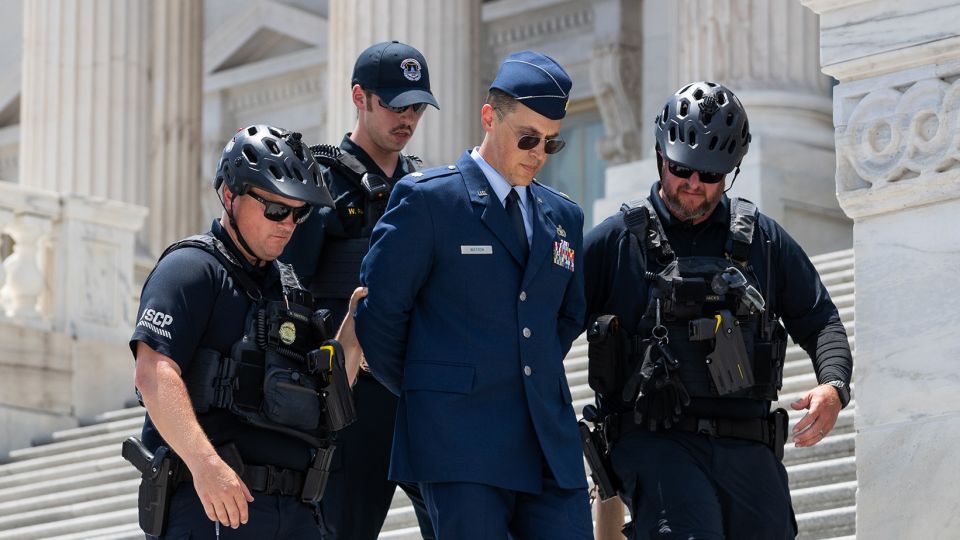
POLICY WIRE — Washington D.C., United States — The iconic dome of the U.S. Capitol building, typically a monument to ordered democratic process, recently served as an unlikely backdrop for an impromptu solo performance of political dissent, unsettling in its very nature. It wasn’t the usual throngs of activists or ideologues, but a uniformed service member, their duty ostensibly apolitical, who broke rank and, apparently, decorum to publicly demand the impeachment of a former president. The incident, quiet as it was in the grand scheme of Washington’s daily churn, reverberates with implications far beyond a single arrest—it’s a stark reflection of the seismic tremors running through American institutions.
It’s not every day that a person sworn to uphold the Constitution through military service chooses that very uniform as the stage for a protest of this sort. Such an act blurs lines many believe must remain indelible. The service member was arrested at the Capitol, as simple as that sounds, but the act itself wasn’t simple at all. Capitol Police took them into custody, removing them from the very symbol of legislative power that, for so many, embodies American ideals—the same ideals military personnel ostensibly protect. And that’s the rub, isn’t it? [QUOTE_PLACEHOLDER]
They weren’t, it seems, there to cause widespread mayhem, just to vocalize a very pointed political position: calling for Trump’s impeachment. You’d think the Capitol had seen it all—occupations, protests, even insurrections—but this, a direct challenge from within the ranks of those tasked with national security, felt different. It begs the question of what compels a person, part of an institution famously demanding neutrality, to such a public display of partisanship. The military’s chain of command, its strict uniform regulations, its prohibitions against political activity while on duty or in uniform—all seemingly disregarded in this singular, defiant moment. It’s an anomaly, certainly, but an anomaly that reveals uncomfortable truths about America’s internal state. Political polarization isn’t just external; it’s crept into the very fibers of our established orders.
This incident—one service member taking a stand—isn’t an isolated flare. No, it’s a tiny spark, maybe, but sparks can indicate something deeper smoldering beneath the surface. It’s a crack in the façade of an institution designed for steadfast discipline — and loyalty. What this individual’s particular grievances were, exactly, hasn’t been made entirely clear to the public yet. But the message itself, clear — and direct, was heard. It doesn’t take much imagination to picture the unease it might cause within military brass, who work tirelessly to keep politics out of uniform.
And let’s be real, the implications of military personnel engaging in overt political action resonate differently in various parts of the world. Think about the delicate civil-military relations in countries like Pakistan, for instance. The military there holds immense, historically outsized influence, occasionally intervening directly in political affairs. A service member in Islamabad, or even Rawalpindi—the headquarters of the army—openly calling for a civilian leader’s removal, particularly in uniform, would be far from a minor arrest. It would signal profound instability, potentially escalating into a constitutional crisis, or even a coup. This comparison might seem extreme to an American sensibility, where civilian control of the military is a foundational tenet. But it helps illustrate why such an event, even if an outlier in Washington, represents a challenge to deeply held norms of institutional impartiality and cohesion.
But how deep does this sentiment go within the U.S. military? A 2022 poll by Military Times, a reputable source of service member opinion, indicated that 46 percent of active-duty troops identified as Republican, with 16 percent identifying as Democrat, and 28 percent as independent. These numbers show a definite lean, a partisan landscape within the ranks. And while a political leaning doesn’t equal insubordination, it certainly shapes how service members interpret the actions of their Commander-in-Chief. This isn’t a suggestion of widespread disloyalty, not at all, but rather a reflection of the national political divide mirrored within the services themselves, which, at some level, should give policymakers pause.
The Capitol Police, performing their duties, handled the immediate situation, just as they would any breach of order on federal grounds. It wasn’t a revolution; it was an individual choice, fraught with personal — and professional consequences. Yet, the choice itself speaks volumes. It speaks to a belief, perhaps misguided, perhaps deeply felt, that the gravity of the political moment transcended the duty of uniform silence. It points to a fracturing consensus, even among those trained to operate as a singular, disciplined force.
What This Means
This episode, though seemingly minor, functions as a political seismograph, registering subtle but significant shifts in America’s public life. Economically, prolonged political instability and deepening ideological divides, especially if they begin to show cracks in institutions like the military, don’t exactly inspire confidence in global markets. Domestic chaos can rattle foreign investment and alter geopolitical standing, undermining a sense of reliable governance crucial for stable economic growth. Internally, the incident poses a subtle challenge to military leadership: how do you enforce strict non-partisanship while respecting the free speech rights of individual service members off-duty, and how do you prevent on-duty expressions that might seem to blur those lines? This isn’t about one individual’s future—it’s about the broader perception of the U.S. military’s internal cohesion. For Washington policymakers, it serves as another unpleasant reminder of the raw nerves and enduring partisan rage that continues to animate America. It’s not just a sign; it’s a symptom, demanding attention. We’re in a period where even institutions thought impervious to partisan capture are showing hairline fractures. It isn’t just about an arrest; it’s about the volatility of empires, and the quiet internal pressures that can build up, sometimes, in the least expected places. We’re seeing political energy manifest in places it hasn’t before—it’s unpredictable, to say the least.