

Israel’s Deepening Crisis: 1,000 Days Post-Oct 7
Israel faces a deepening crisis as Jerusalem erupts in protests 1,000 days after October 7. Citizens clash with police, demanding change amidst government instability and public dissatisfaction.

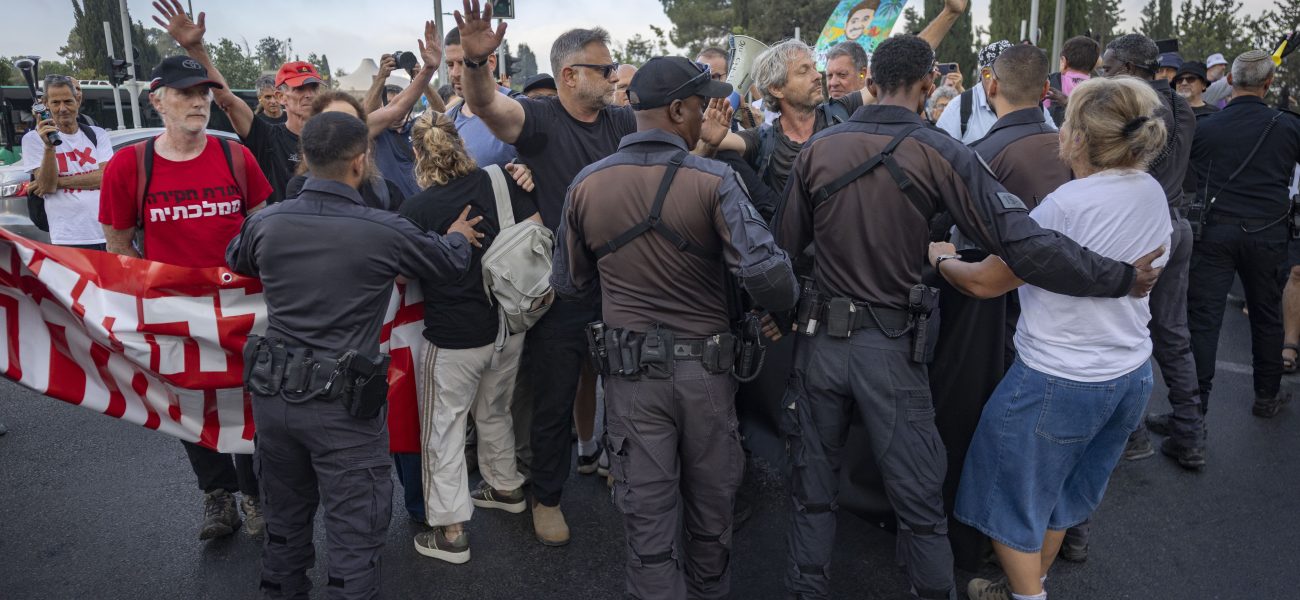
POLICY WIRE — Jerusalem — The scent of pepper spray often cuts through Jerusalem’s arid air these days. It’s become a grim staple, a brutal olfactory bookmark in a narrative that just keeps unspooling. Monday night, the air filled with it again, mixed with the acrid fumes of flares and the raw shouts of citizens—a fresh spasm of dissent against a government seemingly locked in a perpetual cycle of internal strife and external conflict. This wasn’t just another protest; it marked 1,000 excruciating days since October 7, a grim milestone observed with rage and sorrow directly outside the Knesset.
It wasn’t quite a spontaneous eruption. We’re talking thousands here—families of hostages, reservists tired of fighting, everyday folks exhausted by the ceaseless war and the prime minister’s tenacity in clinging to power. They’d gathered, as they so often do, demanding change, demanding the return of those still held captive in Gaza, and, for a significant contingent, demanding early elections. But this time, the symbolism of 1,000 days felt heavier, the despair more potent, pushing the line between organized demonstration and outright confrontation. Things quickly escalated, don’t you know. Police, often adopting tactics that appear—how do I put this delicately—less than subtle, deployed water cannons and mounted units against the surging crowd. Multiple arrests were made, because of course they were.
Prime Minister Benjamin Netanyahu’s administration, for its part, dismisses such demonstrations as mere political machinations designed to destabilize the government during a critical war. “These protests aren’t about national unity or bringing our people home; they’re about toppling a legitimate government, plain and simple,” said a spokesperson for the Prime Minister’s office, channeling Netanyahu’s consistent line on dissent. It’s a convenient deflection, ignoring the profound anguish that fuels these gatherings.
But opposition leader Yair Lapid saw things differently, predictably. “A thousand days and our hostages are still in tunnels, while our government fights its own citizens,” he stated in a sharply worded social media post late Monday night. “This isn’t strength; it’s a failure of leadership, plain — and simple. We can’t just pretend away the suffering that drives people to the streets. It’s a wound that festers.” He’s not wrong, you know, the wounds are pretty visible. And they’re deep.
The numbers don’t lie, either. Polling from the Israel Democracy Institute in May indicated that a staggering 62% of the Jewish Israeli public is dissatisfied with the government’s performance concerning the Gaza conflict. That’s a serious chunk of people, signaling widespread unease that extends far beyond the dedicated protest camps. You can’t just wish away that level of public disaffection with a water cannon, can you?
This internal turmoil doesn’t happen in a vacuum. It reverberates far beyond Jerusalem’s ancient walls, especially across the Muslim world. Countries like Pakistan, for instance, which maintains no diplomatic ties with Israel but consistently voices strong support for Palestinian rights, watches these developments with keen interest. The clashes—the image of Israeli citizens fighting their own state security over the ongoing conflict—tend to bolster narratives critical of Israeli policy. It’s often interpreted there, and elsewhere, as yet another sign of internal fractures arising from policies perceived as oppressive or disproportionate. Such events only complicate any faint whispers of future regional normalization, pushing public sentiment in Islamabad and beyond further into skepticism.
📄 POLICY WIRE WHITEPAPER PUBLISHED: PAKISTAN'S NATIONAL SECURITY POLICY PRIORITIES
👉 READ BY CLICKING HEREAnd it also shows the deepening cracks in Israel’s own self-perception, a nation that prided itself on resilience, but now finds itself besieged from within and without. The current conflict, which began with the Hamas attacks that day in October, has led to a protracted war in Gaza, immense casualties, and an agonizing hostage crisis that continues to drain the nation’s morale. What makes this 1,000-day marker so bleak isn’t just the sheer duration of the horror, but the apparent lack of resolution, or even a clear path to it. It’s an endless loop.
Because, really, when you have your own populace, many of them close to the victims of the initial attacks or actively involved in the war effort, resorting to nightly skirmishes with the police, it indicates something profoundly broken at the core. The frustration isn’t just with the specific decisions; it’s with the overall trajectory. They want their lives back. They want their people back. They want an end to this cycle.
What This Means
The nightly skirmishes outside the Knesset are more than just street brawls; they’re a potent barometer of Israel’s profound political and social fracturing. Economically, this relentless instability creates a climate of uncertainty that frightens off investment and delays any post-war recovery planning. It diverts resources—human and financial—away from long-term national objectives towards short-term crisis management, which is a disastrous path for any economy. And for a country reliant on innovation and a sense of collective security, this internal dissent erodes trust in leadership and state institutions. Politically, the repeated clashes make it harder for the government to project an image of national unity to its allies, or even its adversaries. It provides fodder for international criticism — and weakens diplomatic leverage. The longer the stalemate on hostages and the war persists, the more likely these protests are to escalate, potentially leading to increased radicalization on all sides. It paints a picture of a nation at a crossroads, where the current leadership’s stubbornness meets its citizenry’s boiling frustration, with no obvious off-ramp. Much like Kyiv endures barrages, but with internal actors this time around. It’s a tragedy unfolding in real-time, broadcast for the world to see — and analyze.