


Taiwan Strait’s Sacred Stand: One Officer’s Spiritual Bastion Against Beijing’s Might
POLICY WIRE — Taipei, Taiwan — The sea, they say, gives no quarter. But for Captain Liang Kuo-hsiung of Taiwan’s Coast Guard, the Strait isn’t just an expanse of unforgiving blue; it’s a...

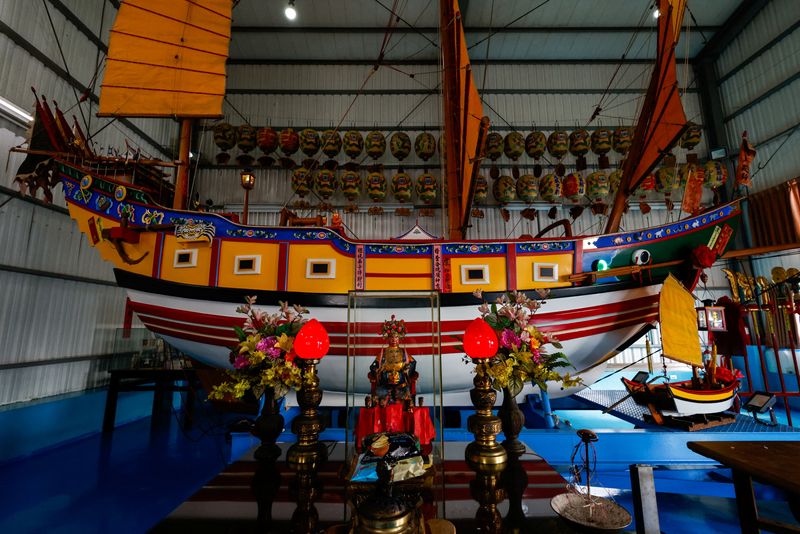
POLICY WIRE — Taipei, Taiwan — The sea, they say, gives no quarter. But for Captain Liang Kuo-hsiung of Taiwan’s Coast Guard, the Strait isn’t just an expanse of unforgiving blue; it’s a domain where the modern realities of geopolitical jostling meet the ancient comforts of the divine. You won’t find him leading a rousing pre-patrol sermon, not in any official capacity anyway. Yet, every dawn, before the crisp uniform is donned and the radar screens flicker to life, Liang performs a quiet ritual. He’ll light three joss sticks—a small gesture, a whisper, really—offering them to the framed image of Mazu, the revered Goddess of the Sea, tucked away in a corner of his sparse quarters. This isn’t some ancient, forgotten practice; it’s a living, breathing part of the fabric that girds a modern force bracing against a colossal adversary—a dynamic that echoes, often unseen, across similar geopolitical flashpoints worldwide.
It’s a peculiar kind of psychological warfare playing out daily, one where state-of-the-art surveillance might struggle to pierce the quiet resolve born from centuries-old belief. The tension in the Taiwan Strait isn’t just economic or military; it’s deeply, jarringly human. Beijing’s claim over Taiwan is uncompromising, a drumbeat of rhetoric that constantly threatens to shatter the fragile status quo. And Captain Liang? He’s the thin blue line in all that noise, a veteran who’s seen decades of this back-and-forth—the polite warnings, the not-so-polite maneuvers, the near-misses. But when the spray kicks up and a hulking Chinese vessel looms, the textbooks on naval doctrine suddenly seem rather thin. He often muses, [QUOTE_PLACEHOLDER]. That sort of thing really sticks with you.
The numbers don’t lie; they tell a story of escalating pressure. In the last year alone, reports indicate a nearly 40% surge in Chinese coast guard and naval patrols in the Taiwan Strait, according to data compiled by Taiwan’s Ministry of National Defense. It’s a relentless chess match, with every move from Beijing a challenge to Taipei’s sovereignty. Taiwan’s Coast Guard, while capable, is numerically dwarfed. They’re outnumbered, outsized, — and operate under a perpetual threat matrix that’s just…exhausting. Imagine being a civil servant whose daily commute could very well involve an international incident.
But the spiritual resilience isn’t unique to this corner of East Asia. Think of the Indian Ocean, a crucial maritime artery, where coastal communities across South Asia—from fishing villages in Sri Lanka to bustling ports in Pakistan—navigate their own complex relationships with powerful naval neighbors, including an increasingly assertive China. The faith that provides solace to a Taiwanese sailor facing Beijing’s flotilla isn’t so different from the deep religious convictions that often anchor communities feeling the brunt of geopolitical maneuvers in the Arabian Sea or the Bay of Bengal. They’ve got their own struggles, their own ways of coping, of finding peace amidst external pressures. The strategic importance of the Taiwan Strait mirrors, in many ways, the geopolitical weight placed on places like the Malacca Strait or the chokepoints of the Gulf, all critical veins of global trade and military projection.
Captain Liang often thinks about what keeps his crew going, what makes them brave the inherent danger, day in and day out. It’s not just patriotism, he understands that. It’s the simple desire for peace, the hope that tomorrow won’t bring an unfixable mess. And it’s that deep-seated, often quiet, connection to something bigger—call it tradition, call it faith, call it collective unconscious—that sustains them. He told a junior officer recently, [QUOTE_PLACEHOLDER]. Because when you’re out there, in that vast, indifferent ocean, with another country’s might bearing down on you, sometimes the most comforting thing is a prayer.
They’re not seeking a miracle, not exactly. More like a steady hand, a bit of ancient guidance, in an arena dominated by drones and sophisticated electronic warfare. His Mazu figurine doesn’t carry a walkie-talkie, but her presence, for Liang, carries immense weight. He’s seen too much to discount it. The very tangible threat of naval skirmishes, fishing boat disputes that escalate into diplomatic rows, all happen against the backdrop of this intangible, deeply personal conviction. It makes you wonder what subtle forces are at play—the kind that analysts rarely account for in their geopolitical prognoses. And they’re forces that can shape the actions of individuals, if not entire nations.
What This Means
This reliance on spiritual fortification by Taiwan’s frontline personnel—like Captain Liang—isn’t just a quirky anecdote; it reflects a broader phenomenon within states facing persistent, asymmetric threats. It underscores how conventional military and diplomatic tools alone often fail to capture the full spectrum of a nation’s resilience. For Taiwan, where national identity and a sense of shared heritage are powerful bulwarks against Beijing’s assimilation efforts, the personal spiritual practices of its citizens, especially those in high-stress roles, become extensions of national resolve.
Economically, this implies a subtle but enduring cost to the perpetual tension. The psychological burden on the Coast Guard translates to recruitment and retention challenges, requiring substantial investment in morale and welfare beyond equipment upgrades. Geopolitically, it highlights how China’s strategy of constant, low-level harassment, aimed at exhausting Taiwan, may inadvertently strengthen internal bonds and unique forms of resistance. It forces a unique synthesis of ancient belief systems and modern deterrence, making the struggle less about brute force and more about the endurance of the human spirit in a high-stakes standoff. This blend of ancient faith and modern confrontation provides a compelling lens through which to view similar struggles for autonomy and identity across the Indo-Pacific, where local cultures and spiritual practices often become quiet sources of strength against encroaching powers.