


The Collateral Damage of Carousels: How One Man’s Cartilage Shakes a Franchise
POLICY WIRE — Charlotte, USA — It’s a cruel alchemy, isn’t it? The entire superstructure of a multi-million-dollar athletic enterprise, meticulously built, hyped to high heaven, and...

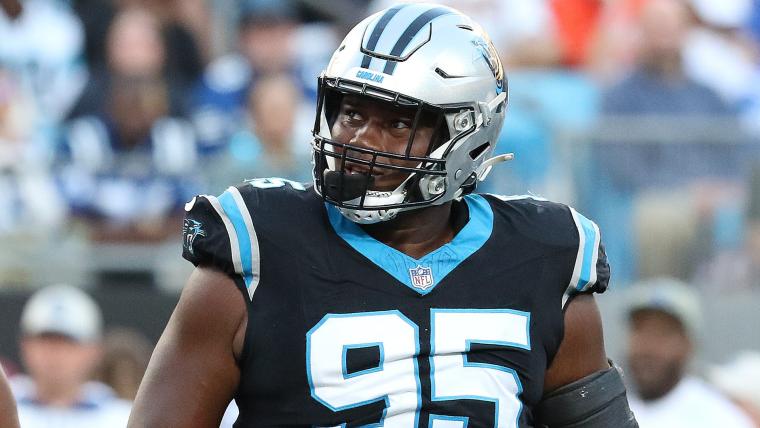
POLICY WIRE — Charlotte, USA — It’s a cruel alchemy, isn’t it? The entire superstructure of a multi-million-dollar athletic enterprise, meticulously built, hyped to high heaven, and then—poof. It all evaporates, reduced to so much dust — and sideline despondency. Not by some systemic breakdown, mind you, or a coaching collapse, but by the capricious fate of one man’s knee cartilage. That’s the rather unromantic tale of the Carolina Panthers, a squad that managed to snatch playoff contention from the jaws of statistical oblivion, largely on the broad shoulders of defensive tackle Derrick Brown.
Last year’s tale began less with a bang — and more with a prolonged, agonizing whimper. Imagine a sieve, but less efficient. That was the Panthers’ defense in 2024, conceding a league-worst 6,877 total yards and an almost inconceivable 534 points. By Week 17, they weren’t just playing with third-stringers; they were reportedly digging through local flag football rosters for anyone who could remember a playbook. Their defensive front was an open turnstile. They bled. But things changed. But how, you might ask?
Brown. A mountain of a man—six-foot-five, 320 pounds of organized chaos—was felled early in that ’24 season opener. A simple knee tweak, but it was enough to unravel the whole shebang. Because in the intricate dance of modern professional sports, a single missing piece can render the entire contraption inert. It’s not just about one position; it’s about the gravitational pull, the sheer presence that alters the geometry of the game for everyone else. Brown’s absence, analysts contend, wasn’t just a hole; it was a gaping maw. The run defense, for example, transformed from a robust average of 123.3 yards yielded per game when he played in 2023, to an embarrassing 179.8 yards without him in 2024. That’s not a slight dip; it’s an open-door policy for opposing offenses.
When he returned healthy, the numbers performed a rather abrupt U-turn. From being a perennial doormat, the Panthers’ defense somehow climbed to 15th in scoring defense last season, allowing 22.4 points per contest. Brown wasn’t just a warm body. He led the team with five sacks, tallied 73 combined tackles, and knocked down seven passes at the line—an absurd stat for an interior lineman. The NFL Network, ever keen on its metrics, saw fit to rank him 90th among the league’s top 100 players, a rather conservative estimation if you’d witnessed the on-field transformation. For his part, Brown remains outwardly unfazed by the seismic impact of his health, offering a typically straightforward prognosis. “It’s going to be different,” Brown confidently asserted to The Charlotte Post last year. “I can guarantee you that. We don’t want to harp on the past. Last year was what last year was, and then it’s time for us to move on from that, so I mean we’ve completely turned the chapter from that, and you can look for a more exciting defense, for sure, coming this fall.” He delivered. It wasn’t bravado; it was a cold, hard fact.
It’s a curious kind of dependency, the reliance on a few critical tendons and ligaments to prop up an entire institutional façade. The sheer, terrifying fragility of it all should give every owner, every GM, sleepless nights. One could even liken it to the diamond market — a few rare gems dictate the value of everything else. Carolina’s General Manager, Dan Morgan, whose reputation undoubtedly rode on the performance turnaround, hasn’t shied away from acknowledging Brown’s unique importance. “You build a team piece by piece,” Morgan remarked during an off-season interview, “but sometimes, you find that one structural beam—that keystone player—who simply cannot be replicated. And when that beam is solid, the whole house stands tall. When it falters… well, you’d better have good insurance.” Because, honestly, what’s a franchise without its foundational assets?
📄 POLICY WIRE WHITEPAPER PUBLISHED: PAKISTAN'S NATIONAL SECURITY POLICY PRIORITIES
👉 READ BY CLICKING HEREWhat This Means
This saga of Derrick Brown isn’t merely about one athlete; it’s a stark, rather brutal reminder of how thinly stretched many modern sports franchises truly are, and by extension, their economic models. The health of a single player—a highly paid, yet inherently fragile human asset—can directly translate into playoff revenue, media rights value, merchandising potential, and local economic impact. A deep playoff run means more jobs in concession stands, more local tax revenue, and a ripple effect on surrounding businesses that feed off fan enthusiasm.
The inherent instability here isn’t lost on observers beyond the stadium walls. The profound dependence on singular points of failure—be it a star athlete, a critical piece of infrastructure, or a single commodity export—mirrors challenges seen in various developing economies. Think about a nation like Pakistan, where the reliable flow through strategic trade corridors or the stability of key agricultural regions can disproportionately dictate economic fortunes. A disruption, whether due to conflict, climate, or political upheaval, creates cascading failures that extend far beyond the immediate impact. For the Panthers, Brown is that economic corridor; his healthy passage onto the field clears the path for the team’s fiscal vitality. It’s a fragile equilibrium, where millions ride on the structural integrity of one man’s joints.
It’s not just about winning or losing; it’s about the financial viability of an entire operation. Investors look for stability, predictable returns. When a team’s fate, and by extension its market value and ancillary business, can be so dramatically swayed by an unfortunate misstep during a training camp drill—it signals a high-risk proposition. This isn’t just a game; it’s a high-stakes, flesh-and-blood derivatives market, with the primary collateral being human endurance. And they’re betting big on Derrick Brown’s legs holding up.