


Heisman Hangover: Football’s Dynastic Succession Crisis and the Weight of Inherited Glory
POLICY WIRE — Washington D.C., USA — The crown always feels heaviest on the second head. We see it in hereditary politics, in corporate successions, and certainly, on the collegiate gridiron where...

POLICY WIRE — Washington D.C., USA — The crown always feels heaviest on the second head. We see it in hereditary politics, in corporate successions, and certainly, on the collegiate gridiron where replacing a Heisman Trophy winner has become less a passing of the torch and more a trial by fire. It isn’t just about athletic talent; it’s about managing the myth, the ghost of glory past, a task more demanding than any blitz package.
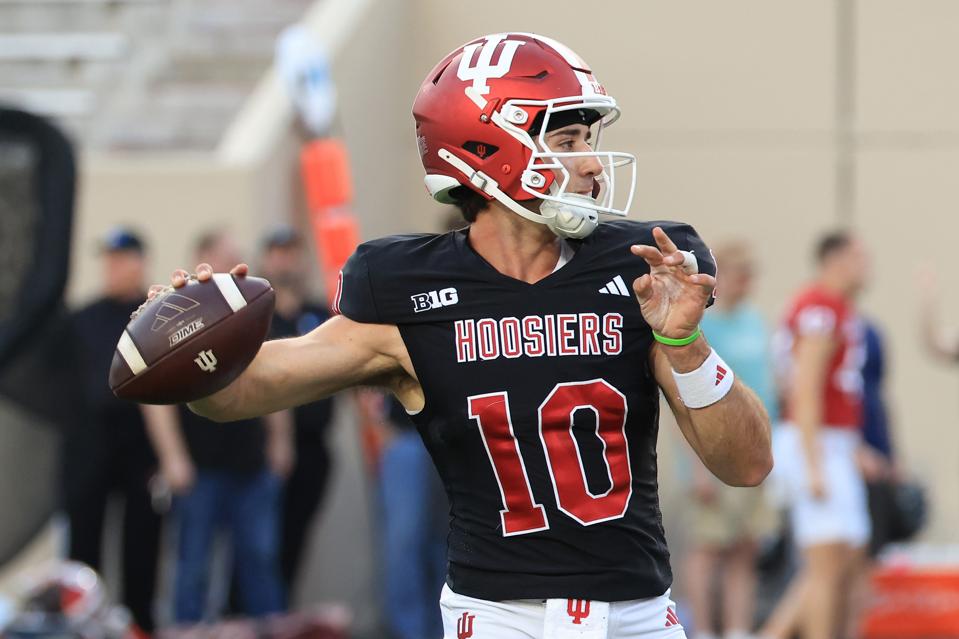
Down in Bloomington, Indiana, they’re readying for another go-around. Josh Hoover, the TCU transfer, has got the unenviable gig of stepping into the massive cleats left by Fernando Mendoza, a man who didn’t just hoist the Heisman but also clinched a national championship. It’s an almost regal ascension, this handing over of a sport’s scepter, laden with impossible expectations. [QUOTE_PLACEHOLDER]
But history, you see, it’s rarely kind to the successor. Just look at LSU, after Joe Burrow engineered their 2019 national title run. The program didn’t just dip; it faced two seasons of mediocrity — and instability at quarterback. Myles Brennan’s season—and career, tragically—ended three weeks into the pandemic-delayed schedule. Then came T.J. Finley — and Max Johnson, a revolving door trying to fill an unfillable void. Brennan did throw 11 TD passes in those few starts; that was something, I suppose. The entire trio combined to rank 57th nationally in pass efficiency. Think about that for a second: a team goes from Heisman glory to middle-of-the-pack scrambling within a year. The transition can be brutal.
We’ve seen a pattern emerge, a recurring drama of unmanageable expectations. When you consider the Heisman itself, an individual award in the ultimate team sport, it’s already an anomaly. But the season after, for the incumbent or the replacement? That’s where the true story lies. The average fan, often transfixed by individual brilliance, tends to overlook the collective structure that underpins such achievements.
Now, some managed. Caleb Williams, after snagging his Heisman at USC, actually improved his pass efficiency ranking the following year. And Lamar Jackson? He was a statistical marvel both years, averaging 405 yards of total offense per game versus 393 during his Heisman season. That’s splitting hairs, frankly, for a player who logged a remarkably similar number of combined passing and rushing attempts in 2017 (662) as 2016 (669).
But the true lessons often come from the other side of the ledger. Jameis Winston, another Heisman winner, saw his numbers take a hit the next season, dropping to 27th in pass efficiency. His touchdown-to-interception ratio plummeted from 40/10 to 25/18. He was good, but not Heisman-good again. It’s almost as if the universe demands a penance for such singular brilliance.
And what about the sheer burden of carrying such a title? In regions like Pakistan, for instance, where national cricket heroes are revered almost as deities—the expectations following a legendary performance are immense. The adulation is immediate, overwhelming. And so, too, is the subsequent scrutiny, every single mistake magnified through the lens of that previous, seemingly effortless, triumph. Think of a Pakistani fast bowler after a record-breaking series; the next match, every wide ball, every missed wicket, feels like a betrayal of national honor. It’s an unsustainable burden, no matter the sport or the cultural context, whether it’s a packed cricket stadium in Lahore or a college stadium in Louisiana.
Oklahoma actually pulled off the improbable, with Kyler Murray following Baker Mayfield for consecutive Heismans. That’s an anomaly—the only time in the prestigious award’s history that the same team had quarterbacks win it in consecutive years. But even then, the system had its flaws; Murray left for the NFL after just one year at the helm, proving the college football carousel spins faster than ever, and sustained greatness (on one roster) becomes an increasingly rare commodity. But what can you expect? In a professional sporting career, every season is a contract negotiation, every game a performance review.
Policy-wise, this hyper-individualization of achievement within a team framework highlights an intriguing paradox. The entire ecosystem around college football, from media narratives to recruiting pitches, is built upon star power. Yet, the statistics show a significant challenge in maintaining, let alone surpassing, Heisman-level performance. This relentless churn, the almost systemic inability to reproduce individual excellence year-over-year, speaks volumes about the ephemeral nature of glory and the profound psychological — and sometimes physical — toll it takes.
The business of college football demands constant reinvention, a ceaseless pursuit of the next prodigy. But how many players, especially those stepping into such hallowed shoes, get truly set up for success, rather than merely set up for comparison? It’s a machine designed to consume and move on, always looking for the fresh narrative, leaving the prior year’s hero, or his immediate replacement, to navigate an almost impossible psychological labyrinth.
What This Means
This cycle of Heisman highs and subsequent struggle or replacement instability carries clear political and economic implications, far beyond just touchdowns. Economically, universities invest millions in recruiting and facilities, chasing the intangible ‘buzz’ that a Heisman contender brings. Think of the sudden surge in merchandise sales, ticket revenue, and even applications that accompany a national-caliber star. But if the next year brings a significant drop-off, those economic benefits can be fleeting. It’s like a micro-burst of GDP that’s incredibly hard to sustain, much like a commodity-dependent economy. For a politician or business leader in South Asia, for example, making grand promises after one successful year often leads to immense public disappointment if the following year doesn’t meet sky-high, almost Heisman-like, expectations. The market for talent, be it athletic or intellectual, is hyper-competitive — and unforgiving. The quest for continuous excellence impacts policy around NIL deals, transfer portals, and even player development pathways, reshaping the very structure of collegiate sports into a quasi-professional league with professional pressures. It’s an unstable equilibrium.
Politically, the constant narrative of heroic rise and inevitable succession struggle reflects broader themes of leadership and legacy. Just as political systems wrestle with effective transfers of power—smoothly or tumultuously—college football grapples with the transition from one era-defining quarterback to the next. The cult of personality surrounding these Heisman winners is immense, drawing comparisons to political leaders who, after an election triumph, face an even greater battle to deliver on the expectations their charisma forged. In Pakistan’s democratic journey, for instance, a leader’s popularity often reaches an apex during their first electoral victory. Sustaining that popular mandate and the associated political capital through the mundane grind of governance is where many falter. It’s not enough to be brilliant once; you have to do it consistently, year after year, under the brightest spotlights, because the public’s memory for past glories is disturbingly short, particularly when you’re no longer winning.