


Gaza’s Unquiet Truce: Child Casualties Mount Amid Lingering Strikes
POLICY WIRE — Washington, D.C. — Even the supposed lulls in the perpetual churn of conflict, those fragile pauses euphemistically termed [QUOTE_PLACEHOLDER] hold a grim distinction. They rarely ever...

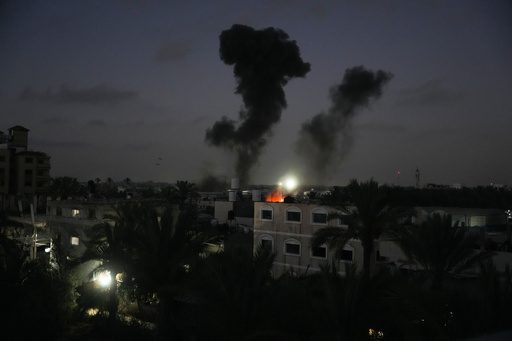
POLICY WIRE — Washington, D.C. — Even the supposed lulls in the perpetual churn of conflict, those fragile pauses euphemistically termed [QUOTE_PLACEHOLDER] hold a grim distinction. They rarely ever truly cease the firing. For residents of the Gaza Strip, this particular unquiet period saw the metallic hum of quadcopters—those ever-present, watchful eyes of the sky—overshadowing another Sunday that brought more death to their already battered enclave. And it wasn’t a sudden, grand offensive. No, this was just a typical day, a stark reminder that peace remains a phantom limb.
It’s a peculiar thing, the way violence can become normalized. A 13-year-old girl, Eileen al-Farra, met her end not in some headline-grabbing bombardment, but from shrapnel. Shrapnel, they say, from Israeli tank shelling in southern Gaza. Health officials at Nasser hospital confirm her death. And she wasn’t alone; the tally from a scattering of Israeli strikes on that day saw at least four Palestinians dead, according to health officials. Imagine the casual cruelty of that number in such a concentrated geography.
One incident took place in northern Gaza’s Beit Lahiya. The Palestinian Red Crescent Society reports that strike killed two individuals — and left another wounded. But it didn’t stop there. Another strike in southern Gaza claimed the life of a man, according to Nasser hospital officials. The Israeli military, predictably, didn’t immediately respond to a request for comment. However, they did later offer a familiar explanation: one of the targets was a [QUOTE_PLACEHOLDER] No further details provided, as is often the case. Such ambiguity, unfortunately, does little to clarify—or to comfort. It merely deepens the mire of conjecture — and accusation.
It’s true, the intensity of fighting in Gaza has lessened somewhat since October’s fragile ceasefire deal between Israel and Hamas. But don’t misunderstand. Palestinians still report fresh casualties on a near-daily basis. Israel maintains its stance, stating it targets Hamas — and other militants who pose a threat. It’s also often in response to perceived ceasefire violations. A never-ending cycle, isn’t it? A sort of brutal, localized entropy. Five Israeli soldiers have been killed since the ceasefire, Israel has said. This particular statistic offers a different lens, but the broader picture remains grim for the besieged population.
The scale of the destruction is just staggering. Since the ceasefire came into effect, Israel has killed more than 1,040 people in Gaza, according to Gaza’s Health Ministry. That’s a lot of lives, you know? And the same ministry—part of the Hamas-led government—says its casualty records are [QUOTE_PLACEHOLDER] But here’s the rub: they don’t differentiate between civilians and militants. They do say, though, that [QUOTE_PLACEHOLDER] Think about that. Almost 50 percent. It puts the concept of targeted operations into sharp relief.
The initial conflagration, the one that really got things going, kicked off on Oct. 7, 2023. That’s when a Hamas-led attack on southern Israel [QUOTE_PLACEHOLDER] The retaliatory offensive that followed has seen staggering losses on the Palestinian side. Gaza’s Health Ministry reports that more than 73,050 Palestinians, including those killed since the ceasefire, have perished. These aren’t just numbers on a page. Each digit represents a life extinguished, a family fractured, a future denied. It’s an almost unimaginable human cost for such a tiny strip of land.
What This Means
These recurring fatalities, even amidst a declared truce, aren’t just isolated tragedies. They’re symptoms of a festering political wound. Economically, Gaza remains choked, an open-air prison dependent on aid that barely scratches the surface of its needs. Every airstrike, every tank shell, only tightens the tourniquet, making reconstruction an impossible dream, keeping its people in a state of perpetual limbo. Politically, the sporadic killings erode any semblance of trust or stability. It hardens positions, reinforces radical narratives, — and makes diplomatic solutions feel like an elaborate fiction. Because really, what kind of ceasefire allows for hundreds of subsequent deaths?
From a global perspective, particularly within the Muslim world—stretching from Rabat to Jakarta, including critical nations like Pakistan—this ceaseless attrition of Palestinian lives resonates deeply. It fuels anti-Western sentiment — and underscores perceived double standards in international law. Governments in countries like Pakistan often find themselves balancing strategic alliances with overwhelming public solidarity for the Palestinian cause. The killing of a 13-year-old girl in Gaza, irrespective of who fired the shot, sends ripples that empower extremist narratives and complicate foreign policy for many Muslim-majority states. The human face of the conflict, particularly that of children — and women, becomes a powerful symbol. It’s a reminder, too, that some conflicts, even when they’re not at full boil, can scald the international order far more profoundly than anyone initially accounts for. It’s not just a regional spat; it’s a constant, agonizing barometer of global injustice, prompting a global ripple effect of dissent and despair. What, if anything, can break this cycle?
It’s easy to get lost in the sheer statistics of conflict, isn’t it? But behind each report, each casualty count, are real people grappling with incomprehensible loss. That’s a fact we often gloss over in the daily churn of news. The ongoing toll means that for many in Gaza, even the faintest whisper of a ceasefire feels like nothing but a cruel joke.