


Beijing’s Iron Grip Extends: A Bridge, a Railway, and the Long Game Unfold
POLICY WIRE — Beijing, China — While the West obsesses over TikTok algorithms and geopolitical spats, Beijing quietly—and we mean quietly—keeps laying bricks. Or, in this case, suspending kilometers...

POLICY WIRE — Beijing, China — While the West obsesses over TikTok algorithms and geopolitical spats, Beijing quietly—and we mean quietly—keeps laying bricks. Or, in this case, suspending kilometers of steel and concrete over turbulent waters, linking up regions and cementing a strategic vision. It’s a relentless, almost clinical pursuit of connectivity, both internally and globally, often lost in the din of diplomatic squabbles.
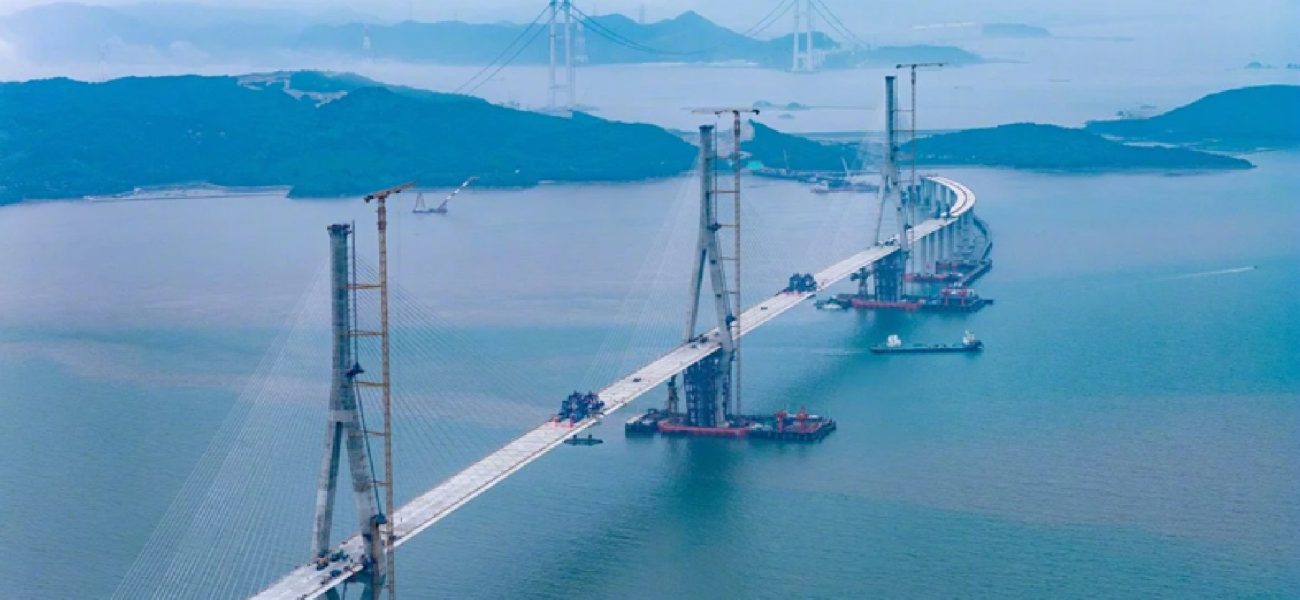
No grand fanfare, no Twitter storms; just the methodical whir of construction, culminating in engineering marvels that’d make empires of old blush. Take the impending completion of its latest crown jewels: a sea-spanning railway bridge and a colossal three-tower cable bridge. These aren’t just new routes; they’re tangible declarations of intent. Don’t think about traffic reduction; think about resource flow, strategic positioning, and the seamless projection of economic —and, by extension, political— influence.
It’s all part of the blueprint, isn’t it? Every gargantuan bridge, every new high-speed rail line, every deepwater port isn’t merely about domestic growth. Because it’s about control. It’s about creating new arteries for the nation’s ever-expanding economic heart, yes, but also for its diplomatic pulse. You see the sheer scale of China’s infrastructure projects —these twin bridges stretching over water— and you start to understand the mindset that drives its broader international endeavors, say, through the Belt and Road Initiative (BRI). It’s a template for exporting that same methodical, strategic dominance.
“We’re not just building bridges; we’re weaving a nation, strengthening our collective prosperity through connectivity,” stated Lin Wei, a spokesperson for China’s Ministry of Transport, with that characteristic understated confidence that often masks incredible ambition. “These structures serve our people, uniting communities and enabling our economic engine to hum louder.” And you can almost hear the unsaid part: an economic engine whose exhaust reaches every corner of the globe.
Look at how that translates, say, to Pakistan. What China is doing within its own borders, creating seemingly impossible connections, they’ve already modeled, perhaps less subtly, abroad. The China-Pakistan Economic Corridor (CPEC) stands as a monument to that vision, linking Xinjiang to Gwadar Port with roads, railways, and energy pipelines. It’s the same engineering philosophy applied to geostrategic ends. Mr. Faisal Hashmi, a former economic advisor to the Pakistani government, has observed, “While the technical specifications of their internal projects astound, what truly matters is the intent. This isn’t about handouts; it’s about a deeply strategic realignment of global trade routes — and political allegiances. Pakistan is just one data point in a very expansive array.” That’s the real story, the one beyond the concrete.
This isn’t an isolated phenomenon, a lone engineering flex. Oh no. It’s consistent. Since 2013, China has reportedly invested over $1 trillion in BRI projects globally, according to the Council on Foreign Relations, shaping the economies and futures of dozens of nations. That’s not pocket change; that’s an agenda in motion. And each internal success, each completed megaproject, adds to the credibility of their proposals abroad. It makes their grand designs, like the economic tides impacting developing nations, seem not just feasible, but inevitable.
📄 POLICY WIRE WHITEPAPER PUBLISHED: PAKISTAN'S NATIONAL SECURITY POLICY PRIORITIES
👉 READ BY CLICKING HEREThe bridge’s statistics are, frankly, mind-boggling—length, height, capacity—but the true metric of its significance isn’t in tons of steel or cubic meters of concrete. It’s in the quiet hum of a strategic engine that continues to expand its reach, project by project, with relentless efficiency. They’re not waiting for anyone’s permission, nor are they slowing down. And why would they? The future, it seems, is being built, one impossibly large structure at a time.
What This Means
This relentless pace of infrastructure development, exemplified by these new bridges, signals Beijing’s unwavering commitment to consolidating its domestic strength as a prerequisite for global influence. Economically, these projects open up new avenues for trade and industrial growth within China, reducing transport costs and improving logistical efficiency. That domestic backbone allows China to absorb economic shocks better, and more importantly, project greater strength in international negotiations and trade policy. But it’s also a demonstration, an advertisement if you will, for their ability to deliver on grand visions elsewhere. For nations considering BRI projects, or weighing allegiances in a multipolar world, seeing such a display of national capability on display at home is a powerful message.
Politically, the successful completion of these megaprojects bolsters the ruling party’s legitimacy domestically, reinforcing the narrative of competent, forward-looking governance. It says, ‘We can build things nobody else can.’ But there’s a sharper edge. The control over critical infrastructure—both at home and increasingly abroad via initiatives like BRI, affecting partners from Southeast Asia to Africa—grants China considerable strategic leverage. Should push come to shove, these physical connections represent supply lines, defensive corridors, and lines of influence. This isn’t just about moving goods; it’s about moving people, capital, — and power on China’s terms. As a result, the balance of power shifts subtly, but irrevocably, every time a new cable is strung, or a new track is laid.