


Budapest’s Rainbow Rebellion: A ‘Defeat’ Unfolds in Hungary’s Illiberal Heart
POLICY WIRE — Budapest, Hungary — The Danube flowed on, impassive as ever, but something felt different in Budapest’s air. It wasn’t the usual grand pronouncements from the Parliament...

POLICY WIRE — Budapest, Hungary — The Danube flowed on, impassive as ever, but something felt different in Budapest’s air. It wasn’t the usual grand pronouncements from the Parliament across the water, nor another volley in the European Union’s endless skirmishes with its Central European outpost. No, this was about a street-level shift, a public gathering that quietly—but resolutely—recalibrated the narrative surrounding Prime Minister Viktor Orban’s seemingly unshakeable grasp on Hungary’s soul. You know, that particular sort of dominance.
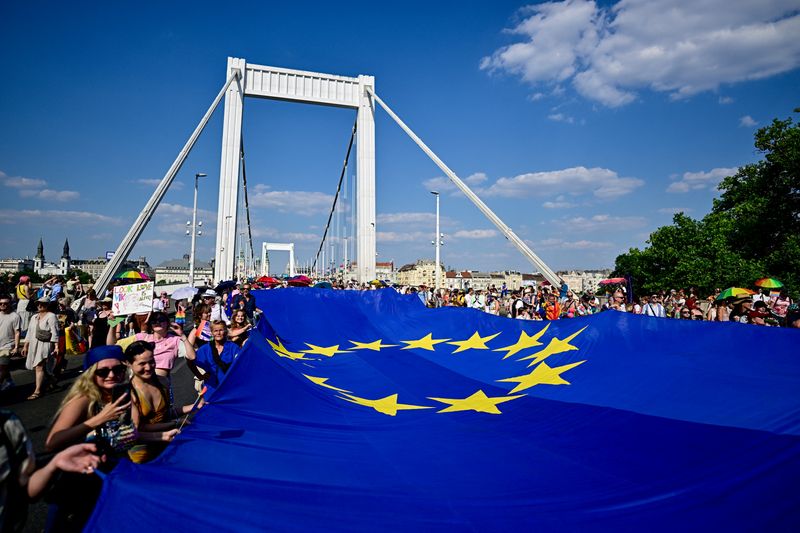
It’s easy to dismiss these events as mere urban liberal spectacles, disconnected from the broader pulse of a nation. But even Orban, for all his electoral muscle — and tight media control, can’t legislate away the streets’ inherent voice. And what a voice it was: thousands — maybe tens of thousands — poured into Budapest, transforming its historical arteries into a temporary, vibrant torrent of protest and visibility. This wasn’t some quaint cultural parade; it was a defiant declaration, the city asserting a pluralism often drowned out by state-backed conformity.
Consider the timing. We’re talking about the first Budapest Pride march of its kind since what many now wryly refer to as [Orban’s defeat] in the capital. But let’s be clear: this wasn’t an electoral defeat that unseated him nationally. Not by a long shot. Orban’s Fidesz party commands a robust parliamentary majority. The ‘defeat’ in question points to something far more localized, a kind of civic insubordination that manifests in places like city hall. Back in 2019, opposition forces — a loose coalition of everyone who wasn’t Orban — managed to snatch Budapest’s mayoral seat. It was a surprising, frankly unsettling moment for the governing party. It proved Budapest wasn’t quite in lockstep with the rest of the nation. Not completely.
Because that’s the rub, isn’t it? An illiberal democracy, as Orban himself coined it, works best when all dissent is either co-opted or rendered invisible. These annual marches, increasingly well-attended, chip away at that manufactured invisibility. They present a human, joyful counter-narrative right in the capital, an inconvenient truth for a government keen on portraying traditional family values as the only authentic Hungarian way. It’s an interesting parallel to watch develop, seeing how deeply entrenched governments grapple with cultural shifts. In some places, it’s about censorship. Here, it’s about control of public space — and narrative.
And when you cast your gaze further east, towards nations like Pakistan, you see echoes. Different contexts, sure, radically different cultural and religious frameworks, but a shared thread of governments attempting to dictate — and enforce — a singular moral code. In Pakistan, the struggle often manifests in laws concerning blasphemy or personal conduct, which severely curtail individual liberties and LGBTQ+ rights, or indeed the rights of minority groups. While Hungary’s moves against LGBTQ+ communities are legislative and rhetorical—think recent laws limiting information about homosexuality and gender change—they’re designed to nudge society towards a state-approved conservatism. The European Parliament, for instance, in a 2023 report, observed Hungary’s worsening record on fundamental rights, noting a 30% decrease in support for LGBTQ+ rights over five years among the broader populace, largely fueled by government campaigns. That’s a stark figure, signaling more than just public opinion; it’s a consequence of policy.
But the Budapest crowds tell another story. They’re a refusal to be nudged. They’re a visible minority—or perhaps, increasingly, a significant urban bloc—saying, [QUOTE_PLACEHOLDER] It’s a spectacle, sure, with music and rainbows, but also a deeply political act. An act of existence, one might say. And that kind of act—just existing, publicly—is potent.
📄 POLICY WIRE WHITEPAPER PUBLISHED: PAKISTAN'S NATIONAL SECURITY POLICY PRIORITIES
👉 READ BY CLICKING HEREThe Fidesz government typically either ignores these marches or dismisses them as a fringe Western phenomenon, alien to true Hungarian identity. But ignorance only works for so long. The sheer number of participants, — and the palpable energy, forces a flicker of recognition, however grudging. It creates a space for dialogue that was otherwise meant to be stifled.
What This Means
This resurgence of public protest, particularly one championed by traditionally marginalized groups, signals a subtle fracturing of Orban’s carefully constructed narrative. It’s not an imminent overthrow, no. Don’t mistake street activism for parliamentary power. But it’s an erosion of consent, a growing dissent among younger generations and urban populations who see Hungary as part of a more open, interconnected Europe, rather than a defiant fortress of traditional values. It implies that while Fidesz might control the levers of state, they don’t — and can’t — fully control the cultural conversation. They’re stuck dealing with a populace that’s proving stubbornly diverse in its views, refusing easy categorization. This makes their long game—the ‘illiberal’ project—harder to sustain without resorting to ever more repressive measures, potentially drawing more scrutiny from Brussels. It shows there’s an alternative pulse beating, despite the prevailing political climate. It’s messy. Europe’s illiberal fault lines are getting wider, you might say.
And for anyone observing from beyond Hungary’s borders, from Islamabad to Istanbul, it’s a reminder. That even in societies where conservative forces seem to be gaining ground, where the state dictates a narrow definition of acceptable life, public expression for a different future never truly dies. It morphs, adapts, sometimes goes quiet, but it’s always there. Waiting for its moment. This march wasn’t just about Pride; it was about the resilience of dissent. Just like the city of Budapest, after everything, it endures. It always does. So we watch, — and we count heads, and we wonder what else might bloom when the pressure finally, truly eases. That’s how it works.