


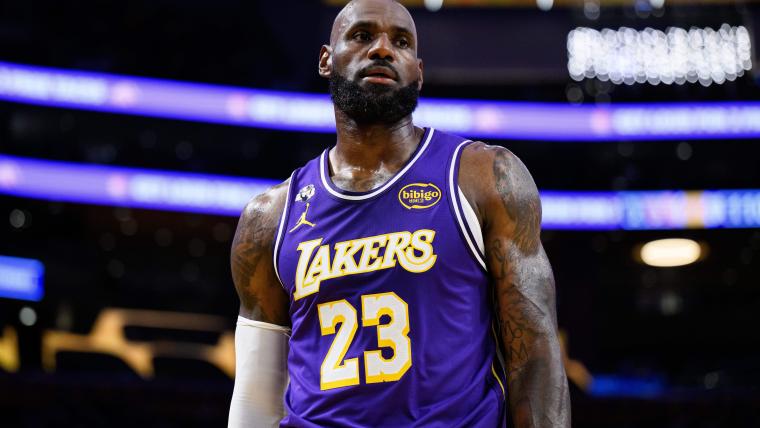
Hoops Hysteria to Hardball Reality: LeBron’s Lakers Exit Signals New Era in Pro Sports
POLICY WIRE — Los Angeles, USA — The twilight of a legend is often more captivating than his zenith. Such is the spectacle unfolding in the gleaming, yet slightly tarnished, kingdom of the Los...

POLICY WIRE — Los Angeles, USA — The twilight of a legend is often more captivating than his zenith. Such is the spectacle unfolding in the gleaming, yet slightly tarnished, kingdom of the Los Angeles Lakers. LeBron James, arguably the sport’s most recognizable icon, isn’t just considering a career shift; he’s hinting at the kind of grand exit that reshapes franchises and sends shivers down balance sheets—even for a team worth billions.
It’s a peculiar game, this dance between athlete, team, — and market. Fans, especially those on the sunny, celeb-obsessed West Coast, they just kinda assume perpetual glory. But even with Luka Doncic now alongside him, the Laker machine has sputtered more often than roared. It seems those in the know—the folks really running things—are reading the tea leaves, and they’re not looking good for James staying put. You see, the NBA just finished up with the Draft, which means general managers are in a frenzy. Teams are making moves for the offseason. Big-time trades like Giannis Antetokounmpo and LaMelo Ball have happened so that free agency will be quite eventful as well. But this, this is different.
James, defying father time, still remains one of the biggest free agents in the market, even at 41. Forty-one! And that’s incredible, don’t it? Because he’s an older player, teams would love the opportunity to give him the last dance of his career. What that looks like, nobody’s certain. Could be a sentimental return to a former stomping ground, or perhaps a fresh, final challenge with an unexpected contender. But it sure sounds like he might not be staying with the Lakers after all, and that’s quite the bombshell for a franchise built on dynastic aspirations.
The chatter, usually just locker room whispers, is gaining volume. Free agency doesn’t start until July, but there are no murmurs of LeBron re-joining the Lakers for one final run. Not even a faint echo. Instead, the consensus, the kind that permeates through agents — and backroom deals, points squarely toward an exodus. As Jake Fischer of Bleacher Report, a seasoned observer of the league’s murky depths, put it bluntly: [QUOTE_PLACEHOLDER] That’s a strong statement. But it explains why this twist is so interesting in the LeBron news because people are thinking he will return to the Lakers to continue his near-decade-long stint with LA.
And so, a major American sports city finds itself contemplating life after King James. For years, his presence alone ensured relevance, jersey sales, — and eye-watering TV ratings. Without him, even with a prodigious talent like Doncic—they’ve only had a season and a half together, by the way—the Lakers would surely still generate buzz, but the aura would diminish. Consider this: in a fiscal landscape where top-tier athletes are often global brands unto themselves, their movements become market tremors. The Los Angeles Lakers are, for context, one of the most valuable sports franchises in the world, with Forbes pegging their valuation at approximately $6.4 billion in October 2023. But it will come down to what he eventually decides on moving forward.
The franchise, desperate not to fall into a post-LeBron malaise, is already plotting its future. They’re trying to make some massive moves in the offseason to improve the roster. Miles Bridges is one of the Lakers’ potential targets in the offseason, and there’s also the subtle maneuvering to comfort Luka Doncic, their newly acquired superstar. That’s smart business. But for all their strategic trades and talent scouting, a genuine titan walking away leaves a void no single player can immediately fill.
📄 POLICY WIRE WHITEPAPER PUBLISHED: PAKISTAN'S NATIONAL SECURITY POLICY PRIORITIES
👉 READ BY CLICKING HERE***
What This Means
The impending departure of LeBron James from the Lakers isn’t just sports news; it’s an economic and cultural event, sending ripples far beyond the court. Financially, it’s a gut punch for the Lakers organization — and the wider L.A. economy that benefits from game-day revenues, tourism, — and merchandise sales tied to a megastar. Think about the countless small businesses—the hot dog vendors, the jersey shops, the parking attendants—whose fortunes are inextricably linked to the spectacle. But even for an economic powerhouse like Los Angeles, such an exodus impacts more than just wallets. It’s about cultural currency.
Internationally, this story takes on a different flavor. In countries like Pakistan, where basketball’s popularity is certainly on the rise, but still playing catch-up to cricket’s fervent devotion, stars like LeBron James serve as ambassadors for the sport. His image—the hard work, the discipline, the sheer talent—transcends borders, appealing to young aspiring athletes from Karachi to Lahore. It’s a soft power play, a cultural exchange facilitated by an individual’s immense gravitational pull. Losing James, or seeing him move to a smaller market, diminishes the global focus on the traditional big-city teams, impacting viewership and interest even in burgeoning markets like South Asia. They’ve built up brand equity over decades, establishing themselves as entertainment juggernauts. This isn’t simply about points and assists; it’s about prestige, brand loyalty, and the complex calculus of maintaining cultural dominance in an increasingly fragmented global media landscape. It’s about how global figures influence local aspirations, even thousands of miles away—whether it’s a young kid in Rawalpindi practicing free throws or a shop owner stocking Lakers gear for the devout few. And you can bet the strategists in every major league are watching, learning what a single player’s decision means for their enterprise, domestically and internationally. Maybe there’s a lesson for emerging leagues too; from transfer turmoil to summer league gamble, the dynamics of athlete movement continue to dominate. But this silent spectacle is far from a small matter; it impacts futures, much like AI’s glare on Asia’s education arena.