


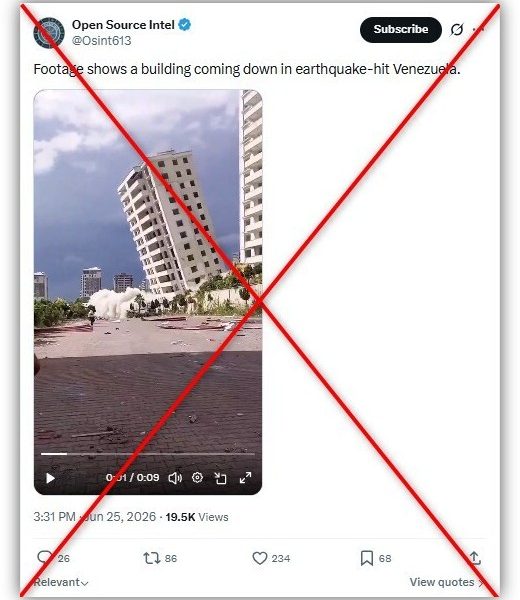
Digital Dust: Turkish Demolition Video Morphing Into Venezuelan Catastrophe Exposes Perilous Online Currents
POLICY WIRE — Istanbul, Turkey — In the digital currents of our era, truth isn’t just distorted; it’s sometimes altogether remade, a Frankenstein’s monster of pixels and panicked...

POLICY WIRE — Istanbul, Turkey — In the digital currents of our era, truth isn’t just distorted; it’s sometimes altogether remade, a Frankenstein’s monster of pixels and panicked shares. This week, a stark reminder slammed across news feeds: a video, gritty and unsettling, depicting a building collapsing in a plume of dust. Many believed it showed the aftermath of a catastrophic earthquake in Venezuela, a nation no stranger to instability. But the reality, as it often does online, was far more mundane—and far more insidious in its implications.
It wasn’t a natural disaster striking Caracas; it was a controlled demolition in Turkey. An event orchestrated, planned, filmed for specific local reasons, hijacked, and recontextualized into a narrative of tragedy thousands of miles away. It’s a dizzying process, isn’t it? One click, one quick repost, and suddenly a scheduled implosion in Anatolia becomes a grim natural disaster gripping South America. These kinds of swaps aren’t accidental slips of the keyboard; they reveal a deeply unsettling susceptibility to deception built right into the fabric of our interconnected world.
And what does this mean for a public desperately trying to make sense of genuine crises? “When misinformed content, especially around seismic events, gains traction, it diverts vital attention and resources,” explained Dr. Anya Sharma, a media forensics expert with the International Crisis Monitoring Group. “It doesn’t just mislead; it actively harms genuine relief efforts by sowing doubt and creating false emergencies where none exist.” Her group’s latest findings indicate a startling trend: misidentified crisis footage accounts for nearly 40% of viral disinformation during major global emergencies—a figure that ought to alarm us all.
The Turkish government, grappling with its own construction codes and urban renewal projects, found itself inadvertently entangled. “Our priority remains public safety and robust infrastructure development,” stated Selim Demir, a spokesperson for Turkey’s Ministry of Urbanization and Environment, in a rare comment on digital flotsam. “But it’s frustrating, you know, when controlled efforts to improve our cities are twisted into foreign calamities. It detracts from real achievements.” He emphasized the need for vigilance—a call echoing loudly across nations.
But the damage was already done. The video circulated rapidly across platforms, fueled by algorithms that prioritize engagement over veracity. It spread like wildfire through various chat groups and obscure social media channels before reputable fact-checkers could even begin to douse the flames. Because people are drawn to spectacle—to dramatic imagery, no matter its provenance—they often forget to hit the pause button and actually think. It’s a rush, a digital adrenaline surge, sharing something that seems to confirm anxieties or fulfill an unconscious desire for narrative drama.
📄 POLICY WIRE WHITEPAPER PUBLISHED: PAKISTAN'S NATIONAL SECURITY POLICY PRIORITIES
👉 READ BY CLICKING HEREThe phenomenon isn’t exclusive to the Americas or the Aegean. The Global South, including nations in South Asia and the broader Muslim world, is frequently—and disproportionately—the target of such digital fabrications. Crises in Pakistan, for instance, from natural floods to political turmoil, have often seen genuine footage repurposed or old content recycled to inflame tensions or undermine legitimate reporting. The quick pace of news in a region with high smartphone penetration and varied media literacy means false narratives can consolidate before counter-narratives gain any traction. This digital onslaught makes nuanced reporting, like understanding the historical complexities of Balochistan, an even greater uphill battle.
It’s an exhausting fight against a tide of falsehoods. Kremlin efforts, for example, have repeatedly scrambled to douse digital firestorms when inconvenient truths — or outright fabrications — challenge their carefully constructed narratives. And this little Turkish incident, however quickly debunked, is just another drop in a very large, murky ocean.
What This Means
This incident is more than just an inconvenient misidentification; it’s a stark illustration of information warfare’s mundane frontline. The blurring of lines between real catastrophe and digital theatrics corrodes public trust, not just in traditional media but in the very fabric of shared reality. For governments and aid organizations, it means an additional, almost Sisyphean, task of constantly correcting the record while attempting to address actual humanitarian needs. Politically, such incidents can be weaponized to discredit administrations, spread panic, or simply exhaust the populace with a relentless barrage of non-information, leaving citizens cynical and disengaged. Economically, false reports of disaster can impact markets, tourism, and foreign investment, causing tangible damage based on phantom events. It creates a global media landscape where every frame needs scrutiny, every share questioned, because what you think you’re seeing often isn’t what’s actually there. And that, dear reader, is a chilling prospect.