


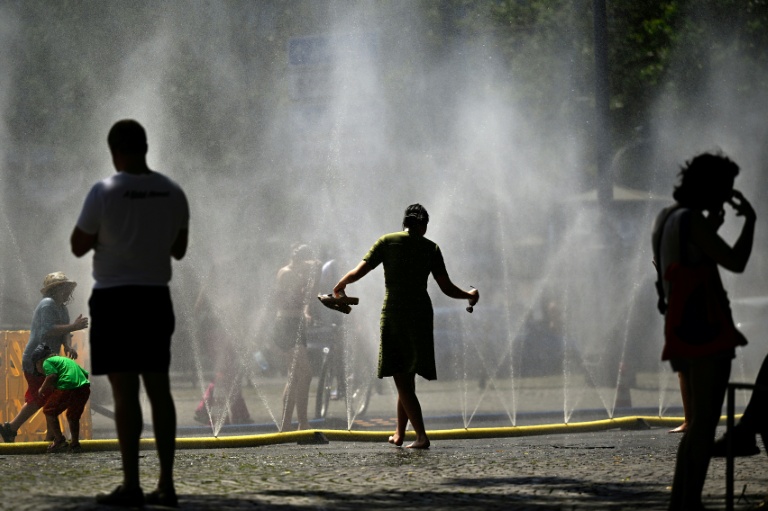
Europe’s Scorching Reality: German Record Shatters Illusion of Climate Immunity
POLICY WIRE — Berlin, Germany — You know a situation’s turned decidedly gnarly when one of Europe’s most ordered, infrastructurally sound nations begins to sweat through its foundational fabric....

POLICY WIRE — Berlin, Germany — You know a situation’s turned decidedly gnarly when one of Europe’s most ordered, infrastructurally sound nations begins to sweat through its foundational fabric. Germany, long viewed as a paragon of industrial efficiency and environmental foresight, just clocked an air temperature that’d make even a desert-dwelling camel pause for thought: 41.3 degrees Celsius.
It wasn’t a freak summer day in the Canary Islands, nor some distant, climate-ravaged land we only read about in dispatches. No. This record-smashing heat settled squarely over Germany, forcing its national weather service to confirm what millions of sweltering citizens already felt: a new national benchmark for sheer, oppressive heat. But it’s not just a statistic on a meteorological chart; it’s a symptom. And it’s a stark, brutal wake-up call that Europe’s not immune to the planet’s increasingly hostile temperament.
And while the chattering classes discuss air conditioning retrofits—a quaint notion in a country where AC was once seen as an exotic, American indulgence—the reality is far more severe. The blistering heatwave that blanketed much of Western Europe, extending its suffocating grip from Paris to parts of the UK, didn’t just inconvenience folks; it strained public services, buckled railways, and, frankly, pushed the physiological limits of an unprepared population. We’re talking widespread disruptions, health warnings that sound increasingly like dire prophecies, and a palpable sense of unease. Nobody likes a heatwave that breaks records, especially when those records are meant to stand for generations, not just seasons.
“We can no longer afford to debate the nuances of climate action,” declared Federal Environment Minister Steffi Lemke, her statement to Policy Wire delivered with a barely concealed urgency usually reserved for impending fiscal crises. “This isn’t a problem for future generations to tackle; it’s here, now. Our infrastructure, our public health systems—they’re all feeling the immense pressure of a changing climate. It’s a bitter pill to swallow, isn’t it?”
But swallowing those pills means policy recalibrations that don’t just tinker around the edges. It’s not just about managing heat anymore; it’s about adapting an entire society. Think about it: German productivity, the engine of Europe, can’t sustain these temperatures. The construction sector grinds to a halt. Agricultural yields get hammered. Energy grids, ironically, strain under increased demand for cooling, even as the push for green energy intensifies. We’re in a feedback loop, aren’t we?
“The economic impact is becoming undeniable,” remarked Dr. Klaus Müller, president of the German Federal Network Agency for electricity, gas, telecommunications, post and railway markets. “We’re seeing spikes in energy consumption that test our reserve capacities, and a noticeable slowdown in outdoor industries. For an economy that prides itself on precision and output, these recurrent, extreme weather events represent a considerable, persistent drag. It isn’t just a bad summer; it’s an operational challenge, year in, year out.”
📄 POLICY WIRE WHITEPAPER PUBLISHED: PAKISTAN'S NATIONAL SECURITY POLICY PRIORITIES
👉 READ BY CLICKING HEREBecause, for all of Europe’s relative wealth, its population centers are designed for milder climes. Compare this to the cities of Pakistan, for instance, where sustained temperatures well over 45 degrees Celsius aren’t uncommon, leading to devastating public health crises and humanitarian emergencies for decades. Their challenges—of heat-stressed populations, infrastructure failures, and water scarcity—offer a grim preview for Europe if action falters. It’s a stark reminder that climate injustice often sees the global South bearing the brunt first, but the North isn’t somehow magically immune. A recent report from the German Federal Environmental Agency suggests heat-related mortalities in elderly populations have surged by over 20% in the last decade, even before this latest extreme.
The lessons from places like Karachi, where urban planning often struggles against perennial heatwaves, or even Lahore’s smog-choked, furnace-like summers, seem to be filtering into European consciousness, albeit slowly, painfully. It’s no longer an abstract problem. It’s your broken railway track, your overheated classroom, your dehydrated elderly neighbor. For Germany’s climate reckoning, it seems the bill for inertia is now being delivered not in euros, but in mercury readings.
What This Means
This unprecedented heatwave isn’t merely a headline-grabber; it’s a political — and economic tripwire. Firstly, it ratchets up pressure on Berlin’s ruling coalition to accelerate its climate commitments. Expect intensified rhetoric around renewable energy deployment and a re-evaluation of building codes, particularly in urban centers designed for historically temperate weather. Economically, prolonged periods of extreme heat will inevitably impact GDP, disrupting logistics, reducing outdoor work capacity, and driving up energy costs. Secondly, it could further exacerbate social inequalities. Those without access to cooling, or who work in physically demanding outdoor jobs, disproportionately suffer. Lastly, this event solidifies Germany’s role not just as a global economic player, but as a critical laboratory for how affluent, industrialized nations respond—or fail to respond—to the immediate, tangible threats of climate change. It’s a situation that has policymakers scrutinizing everything, right down to the durability of their country’s asphalt. As global temperatures continue their relentless climb, Europe won’t just be reacting to distant crises; it’ll be battling them on its own doorstep. One could argue, it already is. Because the idea of a climate refuge, even for places as resilient as Germany, is fading faster than polar ice.
And what about those links to Magdeburg or other specific towns? The broader point here, folks, is that these record-breaking temperatures aren’t isolated incidents. They’re part of a pattern, — and Germany just joined a very hot club.