


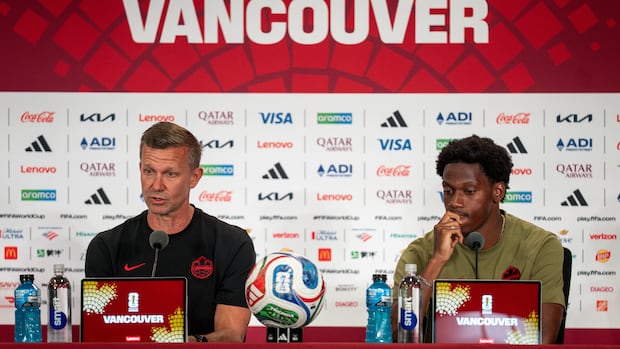
Canada’s Marsch Rejects Defensive Play, Pushes ‘Relentless Style’ in Decisive Switzerland Clash
POLICY WIRE — Toronto, Canada — A simple tie. That’s all Canada’s national football team ostensibly needs to advance from Group B, yet its head coach, Jesse Mar...

POLICY WIRE — Toronto, Canada — A simple tie. That’s all Canada’s national football team ostensibly needs to advance from Group B, yet its head coach, Jesse Marsch, seems disinclined to pursue such pragmatic minimalism. Instead, he plans to stick to the aggressive, high-intensity playbook that has become his hallmark.
As the Group B finale against Switzerland looms on Wednesday, the Canadian side finds itself in a tantalizing position: a single point will secure progression to the knockout stages of what’s presumed to be a major international tournament. The temptation for many coaches in such a scenario would be to prioritize defensive solidity, to pack the midfield, and to soak up pressure, effectively playing for the draw. But according to wire reports, that’s not Marsch’s strategy.
Marsch has reportedly indicated he’s not going to ask his team to stray from its relentless, baked-in style — even if a tie, if just this once, would be victory enough when it plays Switzerland on Wednesday. This declaration sets up a fascinating tactical contest: Canada’s philosophical commitment to attack-minded football against the renowned efficiency and organized defense of the Swiss.
The philosophy of Jesse Marsch is well-documented within footballing circles. Known for his tenure with clubs like RB Leipzig and Leeds United, Marsch favors a high-pressing, transition-heavy game, demanding relentless energy and intensity from his players. It’s a style built on dominating possession when possible and, more crucially, winning the ball back quickly and high up the pitch. Asking his squad to abandon this ‘baked-in style’ for a single game, even a decisive one, would arguably be to betray the very principles he has instilled since taking the reins of the Canadian program. Such a tactical shift, while potentially safer in theory, could also introduce unfamiliarity and hesitancy into a team whose confidence is rooted in its established identity.
For Canada, qualifying for the knockout stage would represent a significant achievement. It validates the ongoing development of Canadian soccer, which has seen increased investment and a surge in talent over the past decade. The psychological boost of advancing, particularly by staying true to their offensive identity, could prove invaluable for future campaigns and the growth of the sport nationally.
Switzerland, meanwhile, represents a stern test. Known for their tactical discipline, defensive organization, and ability to frustrate more offensively-minded teams, they will likely pose a considerable challenge to Canada’s intended approach. The Swiss are accustomed to navigating tight group-stage scenarios and have a history of making life difficult for opponents in major tournaments. Their tactical flexibility could allow them to absorb Canadian pressure and hit back on the counter, making Marsch’s chosen strategy a high-risk, high-reward gamble.
The stakes extend beyond just this single match. How a team performs in such pressure-cooker situations often defines its tournament narrative. Should Canada succeed while adhering to Marsch’s philosophy, it reinforces the belief in their long-term project. Conversely, a failure, especially if attributed to an inability to adapt, could prompt questions about tactical inflexibility at critical junctures. Marsch’s choice is not just about Wednesday’s scoreline, but about the long-term strategic direction of the national team.
What This Means
The decision by Coach Marsch to maintain Canada’s aggressive playing style, even when a draw would suffice for progression, highlights a common tension in elite-level football: the balance between philosophical purity and tactical pragmatism. Coaches often grapple with whether to deviate from their core principles for a specific result or trust the process they’ve cultivated.
Historically, teams known for a distinct playing identity, such as Arrigo Sacchi’s AC Milan or Pep Guardiola’s Barcelona, often adhere to their principles regardless of immediate circumstances, believing sustained success comes from mastering a singular approach. On the other hand, tournaments frequently reward tactical adaptability, where teams can switch formations or adjust their pressing schemes to counter specific opponents or match situations.
For Canada, this approach by Marsch suggests a long-term vision. He appears to be prioritizing the consolidation of a national team identity — a ‘baked-in style’ — over a potentially one-off tactical compromise. If successful against Switzerland, it wouldn’t only secure qualification but also emphatically affirm the efficacy of his methods and instill deep-seated confidence in the squad. Should it falter, however, it will inevitably spark debate over whether a more conservative, pragmatic approach might have been warranted given the high stakes of a decisive group stage match.