

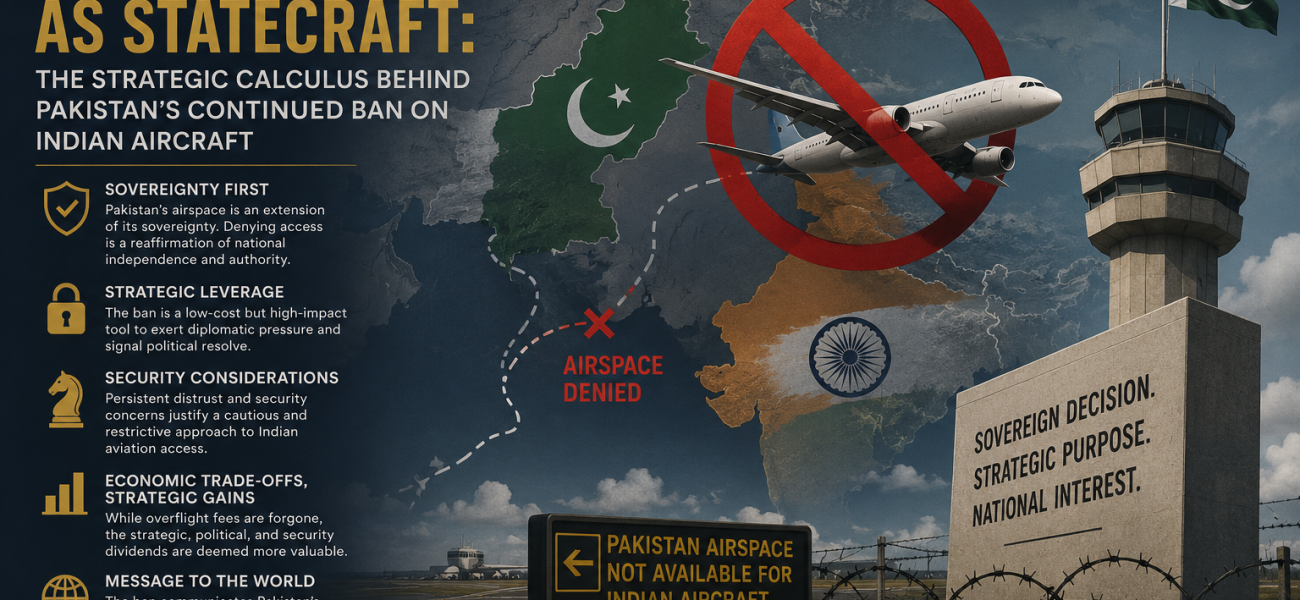
Airspace as Statecraft: The Strategic Calculus Behind Pakistan’s Continued Ban on Indian Aircraft
Pakistan’s decision to prolong airspace restrictions on Indian aircraft till July 24 may appear to be a regular aviation measure, but the consequences go well beyond flight schedules and...

Pakistan’s decision to prolong airspace restrictions on Indian aircraft till July 24 may appear to be a regular aviation measure, but the consequences go well beyond flight schedules and commercial lines. In today’s geopolitics, airspace is more than just a transportation route. It is a strategic asset, a weapon of statecraft, and an increasingly effective way for nations to inflict costs on rivals without using military action.
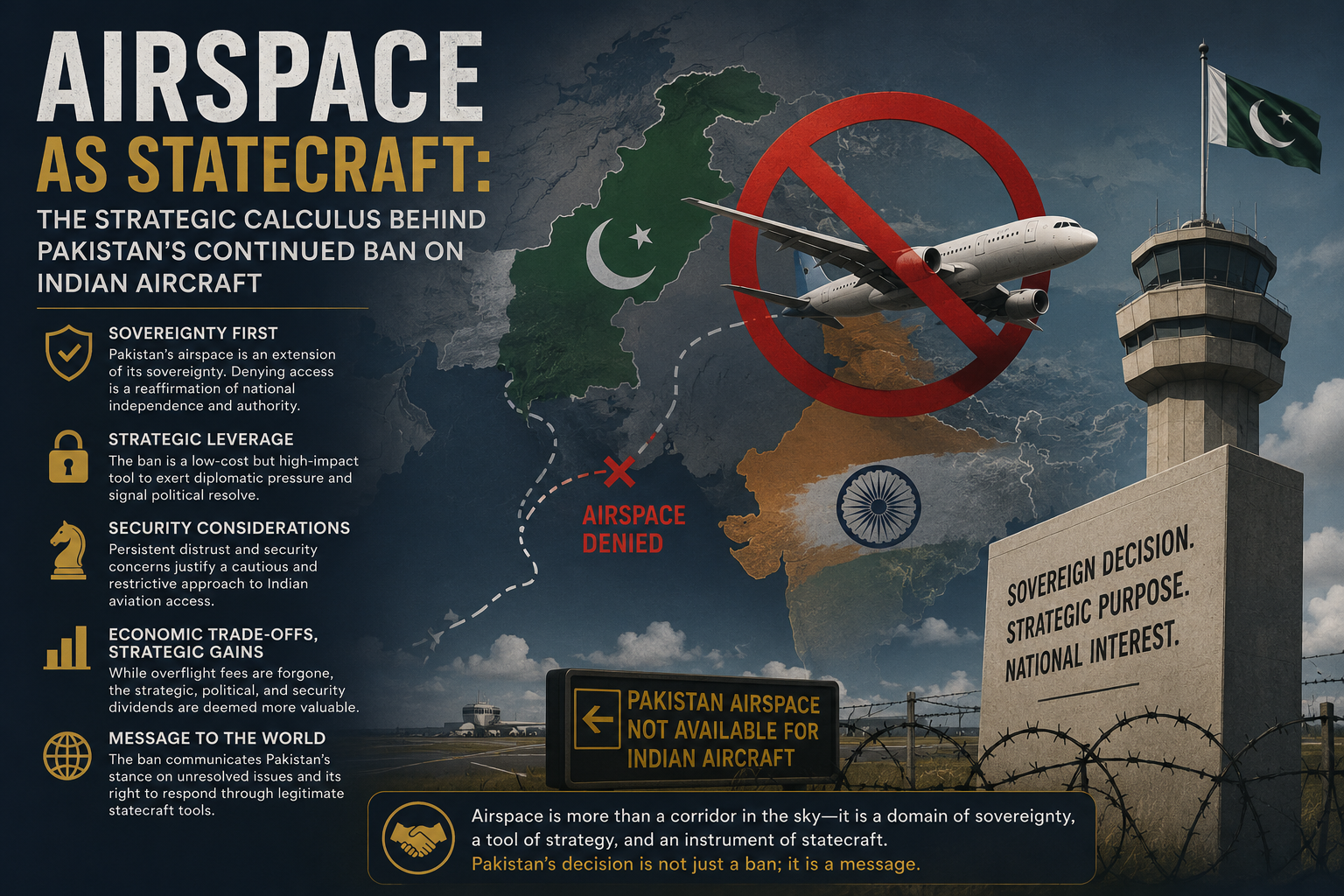
The ongoing restriction of Pakistani airspace to Indian aviation is one of the most apparent reminders that ties between South Asia’s two nuclear-armed neighbours are far from normal. More than a year after the limits were implemented in response to rising bilateral tensions, the policy continues to have an impact on both sides’ economic calculations, diplomatic signaling, and strategic perspectives.
There are a few important strategic benefits for Pakistan with regard to this ban. The most obvious one is that Pakistan will be able to show India that it still has non-military means to impose costs on India. In contrast to military measures, airspace restrictions are fully in line with the principles of sovereign state conduct and are widely recognized under international rules governing air transport.
As far as the economic effect of the ban on India is concerned, this effect turns out to be quite serious as well. For instance, flights to Europe, North America, and other regions of the world become much longer and require increased amounts of fuel, more money for paying crews, and increased spending on maintenance services. In today’s challenging environment for the airline industry, such an impact is quite tangible.
Apart from economic considerations, these restrictions also have a political significance. When it comes to strategic signals, these are mostly about sending a signal rather than causing real harm. Through imposing these restrictions for an extended period of time, Pakistan wants to send out a message that the tension still exists, and any hope of normalizing relations should not be assumed to be the case. This move further emphasizes that for Pakistan security remains key in the bilateral ties.
But as in most cases, no strategic benefit is costless.
In addition to foregoing potential profits, Pakistan also misses out on revenues obtained through overflight fees, which could have been collected had international airlines used Pakistani airspace. While revenues from overflight fees will not make much of a difference from an economic perspective, they do mean losses for Pakistan nonetheless. More seriously, extended restrictions can prevent the region from establishing connections.
Another important aspect is the diplomatic one. The restrictions tend to become effective when they are internationally recognized as reactions to extraordinary situations. However, as they get prolonged, it becomes more difficult to justify their strategic importance. At first, measures seen as temporary reactions to emergency situations may eventually turn into symbols of ongoing hostilities, losing their coercive power while creating new norms of accepting the associated expenses.
In the case of India, the negative aspects will manifest themselves much faster. First, increased flight time is equivalent to increased expenditures for aircraft companies. Routes which earlier passed through the airspace of Pakistan would need to go through new ones that would take more time and fuel.
The restrictions become especially significant in the context of India’s aspirations towards becoming a major international hub for air transportation. It is important to note that modern aviation depends on efficiency and optimal routes, thus making it difficult for India to compete with well-established international centers.
📄 POLICY WIRE WHITEPAPER PUBLISHED: PAKISTAN'S NATIONAL SECURITY POLICY PRIORITIES
👉 READ BY CLICKING HERENonetheless, it is not that India lacks any adaptation strategy at all. With time, airlines and government officials change their ways. New routes are found; schedules are changed; and costs become part of the long-term plan. As such, the effects of coercion begin to fade away. That which was once a problem can slowly turn into a mere constraint of operation.
As it can be seen from the perspective of coercive diplomacy, airspace denial from Pakistan against India can be regarded as an act of strategic denial. In an age when nations are now turning to geo-economics rather than the use of hard power, the skies have become a new tool for competition.
Nevertheless, what matters in the context of any form of coercion is not only whether costs are imposed but whether these induce behavioral change. For some time now, Indian airlines have been managing their operations and costs by changing schedules, looking for alternative routes, and making allowances for the increase in operating costs in their plans. The pertinent point is, then, whether the costs imposed by the ban still exert effective pressure or whether they have been normalized in the region’s airspace environment.
The geographic location of Pakistan continues to contribute to its strategic position in regional air corridors despite the country’s relative economic weakness. Being located at the crossroads of South Asia, Central Asia, the Middle East, and western China, it controls routes that remain significant in regional air traffic. Geography thus remains a structuring element in defining Pakistan’s presence in the region’s airspace.
It is equally important to understand this context in relation to other trends that exist in the region. Restrictions on airspace and aviation have sporadically come up between India and Pakistan whenever there have been tensions between them, demonstrating a broader tendency of engaging in reciprocal actions in times of crisis.
What can be learned from the situation at large is that neither country wins by imposing these restrictions for long-term gains. Both Pakistan and India incur costs, while one of the two suffers economically and diplomatically, whereas the other finds ways of managing their problems. This means that while nothing dramatic happens, there is strategic friction rather than transformation.
The very situation is indicative of what is becoming a broader trend in international politics. Today, states are turning to geo-economic statecraft by using various means such as sanctions, trade barriers, technological constraints, finance, and transportation to achieve political aims without resorting to militarization of situations. Denial of airspace falls neatly into the list of options available to modern nations in projecting power and pursuing national interests.
It is not whether or not Pakistan will be able to maintain its air space closure that is at stake here but whether or not air space denial is going to become a tool of geostrategic power or is going to be seen as something representative of a new era of relations in the region. Competition between the two nations has become a routine feature in South Asia even without active conflict, and therefore, the sky above South Asia can no longer be just a passage for planes.
Author