


MLB’s Trade Deadlines Expose Raw Global Market Dynamics, Even for Batting Cans
POLICY WIRE — New York, United States — In the cutthroat world of elite athletics, a team’s strategic acquisitions often mirror the brutal realities of the global economic landscape. It’s not just...

POLICY WIRE — New York, United States — In the cutthroat world of elite athletics, a team’s strategic acquisitions often mirror the brutal realities of the global economic landscape. It’s not just about winning a championship; it’s about control, scarcity, and the unyielding pursuit of finite, high-value human capital. Forget the quaint nostalgia of baseball for a moment; the ongoing saga surrounding the New York Yankees’ relentless search for a right-handed hitting catcher serves as a stark, if somewhat bizarre, case study in market dynamics and the illusion of choice.
It’s mid-season, and the Yankees—they’ve got the best record in the American League, by the way—are casting about. They need someone, anyone, to solidify their lineup. Their current options behind the plate, Austin Wells — and J.C. Escarra, aren’t exactly setting the world alight on offense. And Wells’ injury replacement, Ali Sanchez, well, he’s a stopgap, a temporary fix, like a plaster on a bullet wound. But their desperation is palpable, a scent that savvy market players—i.e., rival teams—can smell from a mile away. It raises questions: what exactly is the true cost of ‘winning,’ — and who ultimately pays it? (Awaiting official quote)
Initially, all eyes were on Ryan Jeffers of the Minnesota Twins. He appears to be the best potential available backstop if the AL Central club decides to sell. Think of it as a nation eyeing a neighbor’s rich oil fields, ready to pounce if internal instability offers an opening. But if Jeffers stays put, or gets snapped up by some other contender, then the Yankees, ever the imperialists of the baseball world, are forced to consider options that feel almost…heretical.
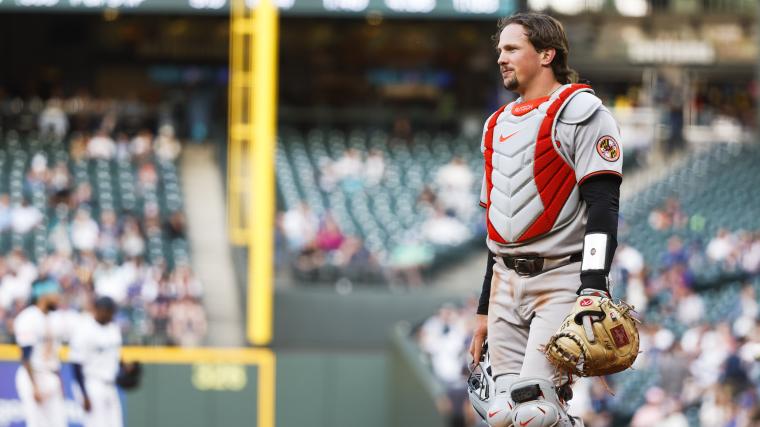
Enter the Baltimore Orioles. Yes, their fiercest division rivals. The mere suggestion sends shivers down spines, a notion akin to rival nation-states brokering a peace deal with an unspoken understanding that neither truly trusts the other. Jim Bowden of The Athletic articulated this peculiar political tightrope perfectly, writing Thursday: ‘They also have been searching for a right-handed hitting catcher, with the Twins’ Ryan Jeffers being a name that’s been bandied about. They’d love to be able to find a way to trade for Adley Rutschman of the Orioles, but a blockbuster like that’s unlikely.’ Unlikely, indeed. But also, revealing.
Adley Rutschman isn’t just any catcher; he’s a generational talent, a switch-hitter, a two-time All-Star, the kind of player whose raw statistical output makes even a hardened executive salivate. For instance, after hitting nine home runs with a .673 OPS in 90 games in 2025 (a bit of a down year, admittedly), Rutschman currently boasts eight home runs and an .802 OPS this season. Those numbers aren’t just digits; they’re the language of an invaluable asset, locked up until after the 2027 season, making him far more than a fleeting rental. And it’s this security, this long-term investment, that makes him so utterly desirable, so utterly unattainable.
📄 POLICY WIRE WHITEPAPER PUBLISHED: PAKISTAN'S NATIONAL SECURITY POLICY PRIORITIES
👉 READ BY CLICKING HEREBut the market always has other, lesser, options. ‘Other possibilities include Keibert Ruiz of the Nationals — and Agustín Ramírez of the Marlins,’ Bowden noted. These are not the crown jewels, mind you, but serviceable assets for a franchise that, let’s face it, needs to plug a hole. It’s the same cynical pragmatism you see in diplomacy: if you can’t get the optimal, you settle for the adequate, especially when the clock’s ticking.
What This Means
This whole Yankee-catcher imbroglio—this constant scramble for the right ‘piece’—speaks to something deeper than just sport. It’s a vivid demonstration of how value is assigned — and pursued in a world obsessed with quantifiable outcomes. The fierce protection of a talent like Rutschman by the Orioles isn’t just about team loyalty; it’s about holding a strategic resource that defines their identity and future competitiveness. You see this play out in resource-rich nations fiercely guarding their oil, minerals, or even their intellectual capital from larger, more aggressive powers.
Think about the dynamics within South Asia, for instance. Pakistan, despite its considerable cricketing talent, often sees its stars drawn to lucrative foreign leagues—a ‘brain drain’ not entirely dissimilar to a struggling MLB team losing its best prospect because they can’t afford to compete. The challenge for cricket boards, like the Pakistan Cricket Board (PCB), isn’t just about finding and developing talent, it’s about creating an infrastructure and financial framework robust enough to retain them. Just as the Orioles recognize Rutschman as a non-negotiable asset, a strategic imperative for their long-term viability, so too must nations safeguard their intellectual and athletic prowess against wealthier entities eager to scoop them up. It’s a battle over talent — and resources, played out on fields both grassy and geopolitical. You simply don’t trade away your future unless you’re truly desperate, or have an even grander plan in mind—something, frankly, not always apparent in these high-stakes negotiations.