


EU Walks Diplomatic Tightrope: Backdoor Russia Talks Emerge Amid Ukraine’s EU Aspirations
POLICY WIRE — BRUSSELS, Belgium — While Ukrainian President Volodymyr Zelenskyy charts a course for EU membership and Western leaders pledge unwavering support, Brussels has quietly, almost...

POLICY WIRE — BRUSSELS, Belgium — While Ukrainian President Volodymyr Zelenskyy charts a course for EU membership and Western leaders pledge unwavering support, Brussels has quietly, almost surreptitiously, engaged Moscow. It isn’t a headline you’d expect — not with missile fragments still falling and a full-blown war raging— but that’s precisely the point. The European Union, it turns out, plays a longer, more cynical game than its public pronouncements suggest, pushing feelers out to the Kremlin in a move of stark realpolitik.
It’s a dissonance one hardly anticipates. Just days ago, a major Moscow oil refinery got hit for the second time in a week. Commercial flights across the capital suffered disruptions, courtesy of Ukraine’s drone attacks. And, Russia’s all-out invasion of its neighbor more than four years ago, a fact underscored by Russian officials, looms large. But, here’s Europe, publicly rallying around Kyiv while discreetly exploring detente. It’s an arrangement that speaks volumes about the continent’s profound strategic anxiety. (Awaiting official quote)
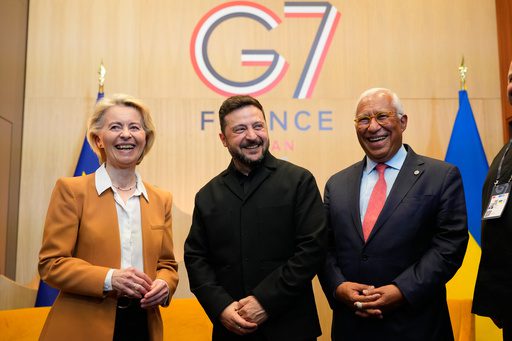
EU officials, opting for anonymity given the touchiness of the topic—and who wouldn’t?— confirmed the outreach. Brief contacts happened at a diplomatic level, they said, intended merely to open channels. And nothing was discussed on substance. Imagine that: diplomats engaging with an adversary on the grandest stage of geopolitics, yet claiming they’re just… chatting. A second official, likewise unauthorized to speak on the matter, corroborated the Russia outreach is taking place but offered no further details. Such delicate diplomacy unfolds, naturally, in the shadows, far from the cameras that captured the G7 leaders reaffirming their backing for Ukraine at Evian-Les-Bains. Because, when you’re dealing with an existential crisis right on your doorstep, public solidarity and private pragmatism can often become strange bedfellows.
This subtle, even furtive, initiative appears motivated by a desire to ensure the EU isn’t an afterthought in any future negotiations about Ukraine’s destiny. Russian President Vladimir Putin, bless his geopolitical heart, has actively tried to sideline Europe, preferring to cut deals directly with Washington. But the Europeans aren’t quite ready to concede that high ground, it seems. As one official rather primly put it: In any future scenario, the EU has specific interests that will need to be defended, therefore it’s important to have established diplomatic channels with Russia. The EU is not a mediator. It supports Ukraine in its efforts to achieve a just — and lasting peace. One wonders if Kyiv fully appreciates the distinction, or perhaps if Brussels believes Moscow genuinely seeks Europe’s interests. Old habits—like talking to a traditional adversary—die hard, don’t they?
Putin himself, for his part, claims an open door. We have never refused contacts with representatives of the European Union in any format, he declared earlier this month. And he wasn’t done. We’re not rejecting contacts. If they want to talk, they know how to reach us. They can pick up the phone and call. If they want to come, they’re welcome to do so. It’s not Russia that’s refusing engagement. A seemingly benign offer, yet it’s delivered with all the subtle menace of a grandmaster inviting a pawn to sacrifice itself.
📄 POLICY WIRE WHITEPAPER PUBLISHED: PAKISTAN'S NATIONAL SECURITY POLICY PRIORITIES
👉 READ BY CLICKING HEREEuropean Council President Antonio Costa has, reportedly, been coordinating closely with European leaders on possible engagement with Russia and the issues to be discussed when the right moment comes. The timing couldn’t be more loaded. EU leaders were en route to Brussels for a summer summit where Ukraine’s plight sat high on the agenda. Zelenskyy himself was expected to address the 27 leaders, all supposedly aiming for tighter bonds with Kyiv. On Monday, Ukraine formally started its path to EU membership—a process demanding years of political reform, even as it battles the Russian invasion.
The juxtaposition isn’t lost on observers beyond Europe’s borders. The convoluted signals from Brussels are undoubtedly watched closely from capitals in Islamabad to Jakarta. The Muslim world, too often navigating complex geopolitical currents—from energy dependency to security alliances—understands that a wavering, internally conflicted Europe presents a different calculus on the global stage. If the collective Western front cracks, even slightly, it could embolden other revisionist powers, setting off unpredictable domino effects in regions already struggling with stability. Pakistan, for instance, which often balances its relationships with competing global powers, can only wonder what the EU’s apparent equivocation might signal for broader international norms and alliances. Its delicate regional diplomatic strategies could certainly feel the tremors of European ambivalence toward Moscow. They’re already grappling with the implications of great power competition, aren’t they? And this doesn’t simplify matters for anyone.
What This Means
This quiet diplomatic maneuver is a flashing neon sign illuminating the European Union’s deep-seated anxieties. It’s an acknowledgement that despite fervent declarations of support for Kyiv—and those continue, yes—some in Brussels can’t shake the fundamental reality: Moscow will remain a significant force on the continent. The decision to establish contact, even without substance, represents a pragmatic bid to preserve European agency in future peace talks. It’s an attempt to avoid being relegated to the role of a mere spectator while Washington and Moscow decide Ukraine’s fate. And that, really, is an admission of diplomatic weakness, or at least a stark limit to diplomatic muscle, however it’s framed. But this dual strategy also carries considerable risk: it could dilute the perceived solidarity with Ukraine, offering Putin a propaganda coup, or worse, hinting at fissures he’s long sought to exploit. Economically, it suggests a tacit understanding that severing all ties is unsustainable, especially for nations heavily reliant on Russian resources or trade routes—even if those ties are now indirect. It’s less a firm policy shift — and more a hedging of bets. And we’ll just have to see if that gamble pays off.