
Madrid’s Floral Paradox: Pope’s Grand Spectacle Navigates Spain’s Secular Fault Lines, Amid Whispers of Scandal
POLICY WIRE — Madrid, Spain — A sea of vibrant petals, meticulously arranged to spell out faith, then trampled underfoot by a pontiff, followed by millions. That’s the scene in Madrid...

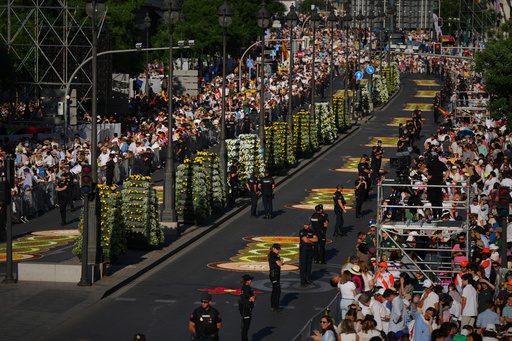
POLICY WIRE — Madrid, Spain — A sea of vibrant petals, meticulously arranged to spell out faith, then trampled underfoot by a pontiff, followed by millions. That’s the scene in Madrid this past Sunday, where Pope Leo XIV rolled through streets festooned with ancient, fleeting beauty. It wasn’t just a parade, mind you; it was a potent, if complicated, declaration, a public reassertion of Catholic tradition smack dab in the heart of a country that’s been methodically shedding its ecclesiastical skin for decades.
It’s an almost cinematic clash, this convergence of meticulous devotional art—the ephemeral, vibrant flower carpets—and the hard-nosed realities of modern Spanish life, where secularism increasingly reigns. But for a few hours, the capital belonged to the old ways. Organizers, you see, claimed a whopping 1.2 million people swarmed into Plaza de Cibeles and surrounding thoroughfares for Leo’s Mass. (That figure, provided by event staff, might give you pause, but nobody could deny the sheer scale of the turnout.) People came in droves, packed in tight, cheering like it was a football match.
Leo, the American Pope, didn’t miss a beat. He called Spain a “school of faith,” an institution meant for today’s students, not just some dusty museum relic. He wants young folks, particularly, to reconnect, to rediscover the spiritual heft that once powered this country. It’s an uphill climb, for sure, especially when you consider how fiercely the pendulum swung away from institutional religion after Franco’s iron-fisted rule, an era when the Church was practically the state’s co-pilot.
And yet, here they were, a huge turnout, giving pause to anyone who’d written off Spanish religiosity entirely. “It’s spectacular,” a consultant named Julián Tapiador told the press, his pride evident. “I’m so proud that the pope is in Spain after 15 years.” Octavio Puche, a retiree, thanked Leo for the trek, noting that “Apparently society is not as secularized as it seems, because there are a million people here.” For an American pontiff, a global traveler, this pilgrimage to Europe’s old Catholic heartlands is a delicate dance between past glories and future uncertainties.
Because while the hymns swelled — and the bells rang, the grimy truth of modern Catholicism hung like an unwanted shadow. The sex abuse scandal, late to erupt in Spain compared to other nations, but no less virulent, casts a long pall. Victims’ groups were, to put it mildly, less than thrilled. They complained they’d been left in the dark about any potential meeting with the Pope, a bitter pill to swallow for those who’ve endured silent decades of torment.
Miguel Hurtado, a prominent survivor who alleges he was abused by a monk years ago, was outside the Vatican embassy on Sunday, protesting. He even spoke to a cardboard cut-out of Leo, a rather pointed theatrical gesture. “I understand you can’t meet with all of us victims, because we’re more than 400,000,” Hurtado said. It’s a sobering statistic—an acknowledgment of just how vast this wound really is—and it highlights a disconnect between the joyous public spectacle and the painful internal reckoning that the Church continues to resist in many quarters.
📄 POLICY WIRE WHITEPAPER PUBLISHED: PAKISTAN'S NATIONAL SECURITY POLICY PRIORITIES
👉 READ BY CLICKING HEREInterestingly enough, the protestors at the embassy weren’t all for Hurtado. Across the street, some old guard—nuns and others—waved Spanish flags and chanted in favor of former dictator General Francisco Franco. “Spain is Christian — and not Muslim!” they roared. A jarring reminder that Spain’s historical relationship with faith isn’t just about piety; it’s steeped in politics, national identity, and centuries of complex interactions with other traditions—a historical context that even today sees debates around the presence of Islam and Muslim communities, not just in Spain but across Europe. It’s a tension that plays out in various ways globally, where public expressions of faith sometimes brush against prevailing cultural narratives, be it in Spain or, say, in parts of South Asia where the visible practice of Sufi traditions can similarly blend deep devotion with vibrant, public spectacle.
The floral carpets, gorgeous as they’re, aren’t unique to Spain. Many Catholic countries share this custom, including those in Latin America. Poland’s already got its Corpus Domini flower carpet tradition recognized by UNESCO; Spain’s Galicia region wants similar recognition. They’re called “expressions of the spiritual sentiments of this country” by the Pope himself—a statement, he insisted, “not an exhibition, a remnant of folklore or a simple display of beauty.” He’s selling it as a genuine, living school of faith, and on Sunday, Madrid certainly looked like a packed classroom.
What This Means
This massive turnout in Madrid offers a complex political — and social reading. For the Vatican, it’s a propaganda win, plain and simple: proof that Catholicism still has drawing power, even in ostensibly secularized societies. It provides ammunition for a global church struggling with declining attendance in many Western nations, presenting a narrative of enduring popular piety. For Spain, however, it’s not quite so straightforward. While many clearly enjoyed the spectacle, the chants for Franco and the pointed silence surrounding the abuse scandal suggest deep, unresolved historical and institutional wounds. It highlights the continued struggle within Spanish society to reconcile its fiercely Catholic past with its more liberal present, and it implies that popular religiosity, while visibly vibrant, remains fragmented, susceptible to old political divisions. It also serves as a potent reminder that while many European nations wrestle with their post-religious identity, public displays of faith and the associated societal debates remain profoundly influential, shaping everything from cultural policy to intercommunity relations across the continent, even as governments continue to navigate global political divides and economic challenges.