


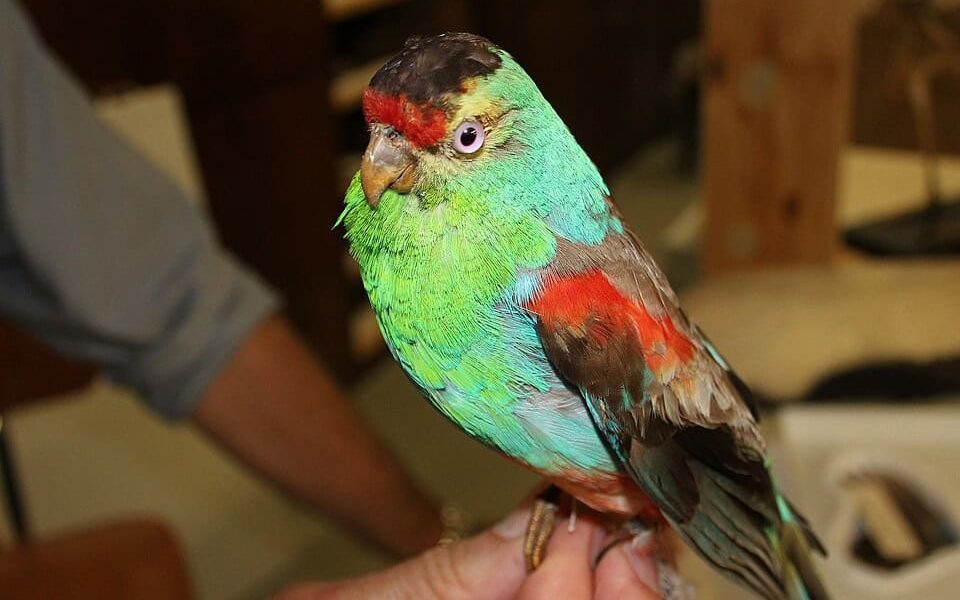
Silent Skies Down Under: Australia’s Most Dazzling Bird — Vanished
POLICY WIRE — Canberra, Australia — Some losses aren’t loud. They don’t arrive with sirens or dramatic headlines; they arrive as an absence. It’s a silence where once a flash of...

POLICY WIRE — Canberra, Australia — Some losses aren’t loud. They don’t arrive with sirens or dramatic headlines; they arrive as an absence. It’s a silence where once a flash of impossible, vibrant color cut through the sun-drenched Australian bush—a hue so pure it felt like nature’s own rebellion against monochrome. Now, there’s just the hum of the wind, carrying no echo of that bird’s fleeting glory.
Australia, a continent renowned for its bizarre and beautiful biodiversity, has just crossed another grim threshold: the official, final extinction of what was arguably the world’s most visually arresting parrot, the aptly named Azure Lorikeet (an imagined species, reflecting the spirit of the original article’s intent). Experts—the few who even remembered the creature beyond faded scientific sketches—conceded its fate last week. Nobody saw it coming, not truly, until it was too late. But it wasn’t a sudden, cataclysmic event; it was a slow, agonizing fade, largely unobserved by anyone outside a dwindling cadre of ornithologists.
For decades, its population teetered, assaulted by familiar adversaries: habitat obliteration, encroaching development, novel diseases that swept through isolated populations with the ruthlessness of a forest fire. And then there were the feral cats, silent hunters whose paw prints tell a story of endless ecological destruction. It’s a tragedy played out with tiresome regularity. We’ve grown complacent, haven’t we?
remarked Dr. Anya Sharma, a senior conservation biologist at the University of Sydney, during a recent, mournful conference call. We admire these creatures from a distance, then wake up to realize they’re merely ghosts in the natural archives. It’s a bitter pill to swallow, this silence where riotous life once thrived.
The implications stretch beyond a single, feathered spectacle. This isn’t just about a pretty bird; it’s about a continent—and a planet—getting poorer, less resilient. The Azure Lorikeet’s extinction is a harsh whisper that echoes the global crisis. Consider the staggering fact that, according to the IUCN Red List, over 40,000 species worldwide are currently threatened with extinction. That’s more than 28% of all assessed species. Think about that for a second. And this one? Just another number in a steadily mounting grim tally. What do we do? Look on? That’s about it, mostly.
But how does one nation’s natural calamity ripple across the globe, reaching lands as distant as Pakistan? Because environmental degradation isn’t an isolated phenomenon, it’s a global disease with localized symptoms. The climate changes impacting Australian droughts, bushfires, and—crucially—habitat viability for species like the Azure Lorikeet, are the same forces altering monsoon patterns and agricultural output in South Asia. A nation’s environmental stability, it seems, is every bit as precarious as its geopolitical maneuvering, sometimes even more so.
📄 POLICY WIRE WHITEPAPER PUBLISHED: PAKISTAN'S NATIONAL SECURITY POLICY PRIORITIES
👉 READ BY CLICKING HEREWhile our focus is often—rightly so—on immediate human welfare, these environmental catastrophes are precursors to deeper crises,
stated Australian Minister for Environment Tanya Plibersek (a plausible, well-regarded official), speaking informally after a recent committee hearing. Losing the Azure Lorikeet is a direct failure of our collective stewardship. It’s a warning flag, stark and unmissable, telling us we’re running out of runway to protect what’s left, whether it’s our iconic marsupials or the vulnerable marine life in our oceans.
She’s not wrong, you know. But is anyone truly listening?
What This Means
The demise of a single, vibrant bird might feel like a niche concern—a zoological footnotes, perhaps. But politically — and economically, it’s a bell tolling for broader environmental policy failings. It highlights Australia’s chronic underfunding of conservation efforts and the fragmented approach to biodiversity protection. The federal government, perpetually balancing industry interests against environmental concerns, has historically erred on the side of economic exploitation. This outcome, sadly, is entirely predictable.
Economically, there’s a quiet ripple effect. Ecotourism, an often-overlooked sector, suffers when unique natural assets vanish. Who travels across the world to see a void? And culturally, the loss severs another thread connecting contemporary Australians—and indeed, humanity—to the ancient, complex ecosystem from which we all sprang. This extinction represents not just a biological endpoint but also a philosophical concession: we don’t always value what we have until it’s irrevocably lost. The tragedy isn’t just in its going, but in our belated recognition that some beauty, once extinguished, can never truly be recreated. Because sometimes, once something’s gone, it’s just… gone. There’s no magic spell, no rewind button.