


Pakistan Keeps Its Promise to AJK While Political Opportunists Play Games
There is a version of Azad Jammu and Kashmir‘s (AJK) story that goes untold amid the noise of strikes, long marches and shutdown calls. It is the story of a federal government that, at...

There is a version of Azad Jammu and Kashmir‘s (AJK) story that goes untold amid the noise of strikes, long marches and shutdown calls. It is the story of a federal government that, at considerable fiscal cost and genuine political will, has repeatedly delivered for the people of AJK, only to watch those deliveries get buried under fresh cycles of agitation orchestrated not by the public but by those who profit from the performance of suffering.
The unrest building ahead of the June 9 strike call by the Jammu Kashmir Joint Awami Action Committee (JAAC) is the latest and most cynical episode in that pattern, timed with unmistakable precision to coincide with the opening of nomination papers for the July 27 general elections.
Begin with the record. When the JAAC mobilised its first major wave of protests in May 2024 over electricity tariffs and wheat flour prices, Pakistan’s federal government did not equivocate. Prime Minister Shehbaz Sharif convened a special cabinet-level meeting and within days approved an immediate Rs23 billion grant to subsidise both commodities.
Electricity rates for residential consumers in AJK were slashed to as low as Rs3 per unit, and wheat was made available at Rs2,000 per 40 kilograms against Rs3,900 in the rest of Pakistan. The JAAC itself called the outcome a historic win and called off its protests.
When protests returned in September and October 2025 with a fresh 38-point charter, the government again engaged quickly. An agreement was reached by October 4, 2025, with most of the JAAC’s core demands accepted.
That agreement was followed by substantive institutional action. The AJK government’s budget for fiscal year 2025-26 reached a historic Rs310 billion, an increase of over Rs86 billion from the previous year, secured through both improved fiscal management and continued federal support.
The federal PSDP for 2025-26 maintained dedicated allocations for AJK and Gilgit-Baltistan, with the 2026-27 planning cycle earmarking Rs54.1 billion specifically for AJK, GB and newly merged KP districts. In April 2026, the AJK Cabinet Development Committee approved 44 projects worth over Rs34.85 billion spanning roads, health, education, energy and IT, including 30 kilometres of link roads across each of AJK’s 33 constituencies and IT excellence centres for youth employment.
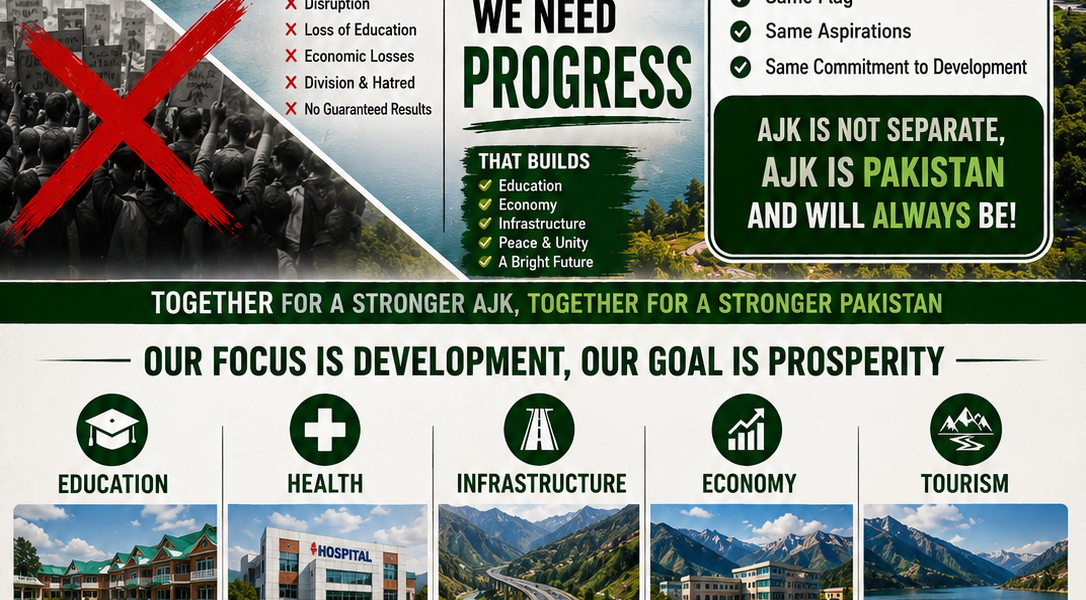
Against this backdrop, the JAAC’s June 9 strike call is not a cry of an abandoned people. It is a political manoeuvre by an organisation that has discovered street agitation is more rewarding than governance. The timing is the tell. Nomination papers for the July 27 AJK Legislative Assembly elections open on June 9. The JAAC chose that date for its region-wide wheel-jam strike and long march. This is not coincidence.
A movement genuinely focused on policy delivery would demand faster implementation through the institutions that are now, constitutionally and legally, available to it. An election provides precisely that mechanism. Instead, the JAAC’s chosen instrument is disruption of the process through which the people of AJK would acquire elected representatives empowered to legislate every reform on the 38-point charter.
The JAAC’s central remaining demand, abolition of the 12 Legislative Assembly seats reserved for Kashmiri refugees settled in mainland Pakistan, reveals the political rather than economic nature of its current agitation. Federal Defence Minister Khawaja Asif stated directly that raising this demand on the eve of elections amounts to disrupting the electoral process, and that electoral matters must be settled through democratic mandate, not street pressure.
The All Parties Conference convened at the AJK Prime Minister’s Secretariat this week unanimously rejected the abolition demand, noting that constitutional reforms are the exclusive prerogative of elected representatives. These seats represent communities whose forebears sacrificed everything at partition; stripping them of representation via agitation rather than legislation is not a democratic demand. It is a factional power play dressed as constitutionalism.
📄 POLICY WIRE WHITEPAPER PUBLISHED: PAKISTAN'S NATIONAL SECURITY POLICY PRIORITIES
👉 READ BY CLICKING HEREThe JAAC’s conduct across this cycle confirms the pattern. It has boycotted all-parties conferences convened to address implementation concerns. It has rejected dialogue channels. It calls for shutdowns that disrupt the same ordinary citizens it claims to represent, suspending university examinations, crippling online businesses, and freezing economic activity in a territory whose young people need every economic opportunity they can access.
The AJK Election Commission’s chief election commissioner acknowledged that prolonged protests or sit-ins could affect the election schedule, adding that elections would be held when the situation was conducive. Deliberately creating conditions that are not conducive to elections is not public advocacy. It is electoral sabotage.
There is also a strategic dimension that cannot be separated from the political one. AJK is not an ordinary administrative territory. It is the frontline of Pakistan’s principled position on the unresolved Kashmir dispute. Any image of chaos, any roadblock or prolonged instability, becomes immediate material for anti-Pakistan narratives designed to portray AJK as ungovernable and to undermine Pakistan’s standing on the Kashmir cause internationally.
Those who light fires in AJK’s streets while India watches from across the Line of Control are not serving Kashmir. They are handing New Delhi precisely the made-up footage it needs.
The 3.8 million registered voters of AJK, half a million more than in 2021, tell the real story of where the people stand. A population that wants anarchy does not register in record numbers to vote. AJK’s people want schools, roads, affordable electricity, and accountable local governance. Pakistan has been providing and expanding all of these.
What they do not need, and what the JAAC’s June 9 strike will not deliver, is another cycle of agitation that closes businesses, grounds their children’s education, and gifts instability to those who wish AJK and Pakistan nothing but harm.
Political opportunism is most dangerous when it wears the language of the people’s cause. The people of AJK deserve representatives who fight for them in the assembly, not agitators who fight on their behalf in the streets while the assembly sits empty.
Pakistan has kept its commitments. It is time to let Kashmir vote.
Author