


The Grim Calculus: Gaza Wakes to Another Echo of Violence and Persistent Diplomatic Stasis
POLICY WIRE — Gaza Strip — The pre-dawn calm in the Gaza Strip shattered yet again this week, not with the usual rhythm of daily life—or what passes for it these days—but with the sickening thud of...

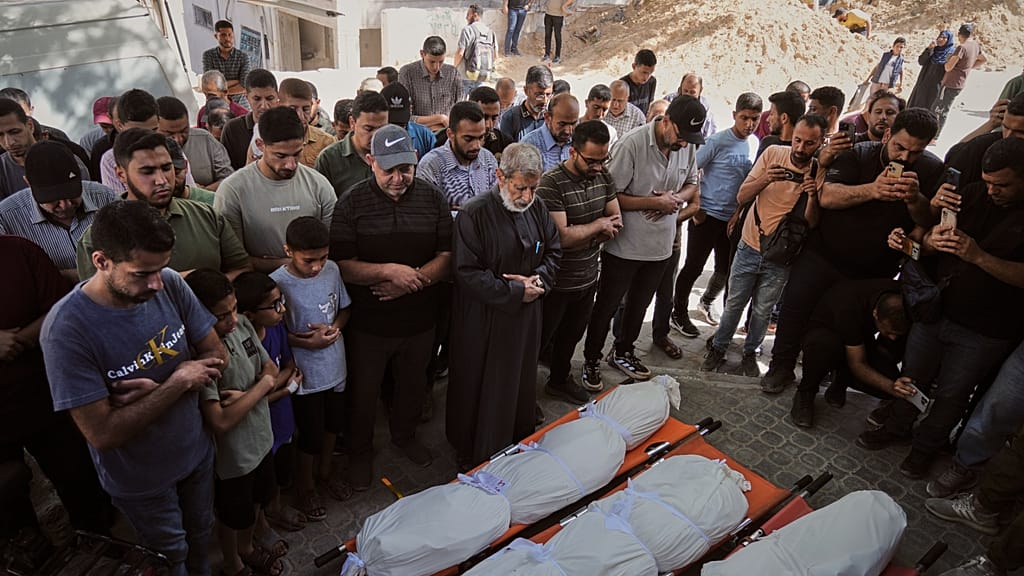
POLICY WIRE — Gaza Strip — The pre-dawn calm in the Gaza Strip shattered yet again this week, not with the usual rhythm of daily life—or what passes for it these days—but with the sickening thud of ordnance. At least nine people, mostly women — and children, didn’t make it to morning coffee. Their deaths weren’t breaking news, not really. They were, instead, another decimal point added to a ledger that’s grown so grim, so vast, it’s lost its human dimension in the diplomatic parsing. Because, you see, the sheer accumulation of such moments tends to anaesthetize even the most attentive observer.
It’s become a pattern, hasn’t it? Night falls. Explosions follow. Mourning rises with the sun. Then the cycle, grim — and relentless, repeats itself. The Israel Defense Forces (IDF) confirmed their operations, stating targets were facilities used by Hamas. And Palestinian officials quickly condemned the actions as, what else, a massacre. Each side sticks to its script. Always. It’s a well-worn performance.
Colonel Eitan Lavie, an IDF spokesperson, articulated the Israeli position with characteristic resolve. "Our operations are surgically precise, targeting terrorist infrastructure designed to inflict harm on our citizens," he told Policy Wire, his voice a practiced calm over satellite. "Any civilian loss is deeply regrettable, a direct consequence of Hamas’s cynical strategy of embedding their war machine within residential areas. We don’t target innocents." It’s the kind of statement you’ve heard before, hundreds of times. They really haven’t changed the playbook.
But the immediate reality on the ground—shattered concrete, wailing families, the frantic sifting through rubble—tells a different, far grittier story. Children didn’t simply become "collateral damage." They were extinguished. A local rescue worker, still caked in dust and the scent of pulverized masonry, described finding an infant’s shoe, neatly placed, not five meters from a crater. Small, telling details like that; they’re often overlooked in the rush to define blame.
And speaking of blame, Mustafa Abu-Laila, a spokesperson for the Palestinian Prime Minister’s Office in Ramallah, didn’t pull any punches. "The world’s persistent silence in the face of these atrocities isn’t neutrality; it’s complicity," Abu-Laila asserted, his tone sharp with undisguised fury. "These aren’t military strikes; they’re acts of collective punishment. How many more families must be erased before the international community—specifically, those Western powers championing human rights—decides to act, really act?"
Consider the raw data for a moment, a sliver of context often buried under the headline of the day. The Palestinian Central Bureau of Statistics reported earlier this month that roughly 85% of Gaza’s 2.3 million residents have been internally displaced since last October. Think about that: a vast, unrooted population, shunted from one precarious haven to another, each morning a fresh roll of the dice. Their lives, reduced to numbers — and policy briefings. It’s a stark accounting, isn’t it?
📄 POLICY WIRE WHITEPAPER PUBLISHED: PAKISTAN'S NATIONAL SECURITY POLICY PRIORITIES
👉 READ BY CLICKING HEREThe tragedy’s ripple effects don’t stop at the Mediterranean’s edge, either. Across the broader Muslim world, from the refugee camps of Jordan to the bustling marketplaces of Karachi, Pakistan, these deaths aren’t abstract statistics. They’re profoundly felt. They stoke public anger, harden political positions, and fuel a deep-seated frustration with what many perceive as a hypocritical international order. It certainly isn’t making regional stability any easier to achieve. Or diplomacy, for that matter.
The sheer constancy of it all has a corrosive effect, not just on Gaza itself, but on the prospects for any meaningful future. International institutions issue stern warnings; diplomatic envoys shuttle back — and forth. Yet, nothing fundamentally changes. The funerals happen. Life (some semblance of it) grinds on. It’s almost as if everyone’s playing their part in a deeply entrenched drama, waiting for the curtain call that never seems to arrive. For more on the complex legal and ethical questions arising from conflict in the region, check out our piece on Jerusalem’s Bench Orders Transparency Amid Prisoner Plight.
What This Means
Politically, these ongoing, localized acts of violence—even with ‘limited’ casualties—serve primarily to calcify existing positions. The Israeli government doubles down on its security narrative, finding renewed public backing domestically to ‘eradicate threats.’ Palestinian factions, meanwhile, see further justification for resistance, however futile it may appear to outside observers. This lack of strategic shift means a sustained deadlock. And don’t imagine anyone’s getting a win here. No one.
Economically, what remains of Gaza’s infrastructure, its human capital, its productive capacity, faces total decimation. Reconstruction efforts, if and when they materialize, are invariably hampered by political instability and donor fatigue. It’s an almost perfect trap, one that ensures perpetual dependency — and deep-seated poverty. These daily strikes don’t just destroy buildings; they obliterate future prospects, creating a permanent underclass that then becomes, perhaps predictably, more vulnerable to radicalization. It’s a cycle, you see. It really is. That cycle creates an unsettling and grim long-term human futures market for the inhabitants of Gaza, priced only in loss and suffering.