


Spain’s Crown Princess Takes the Plunge: Monarchy’s Calculated Leap of Faith
POLICY WIRE — Zaragoza, Spain — It isn’t every day you see Europe’s old guard, its blue-blooded inheritors, flinging themselves from aircraft. But then again, Spain’s monarchy, a...

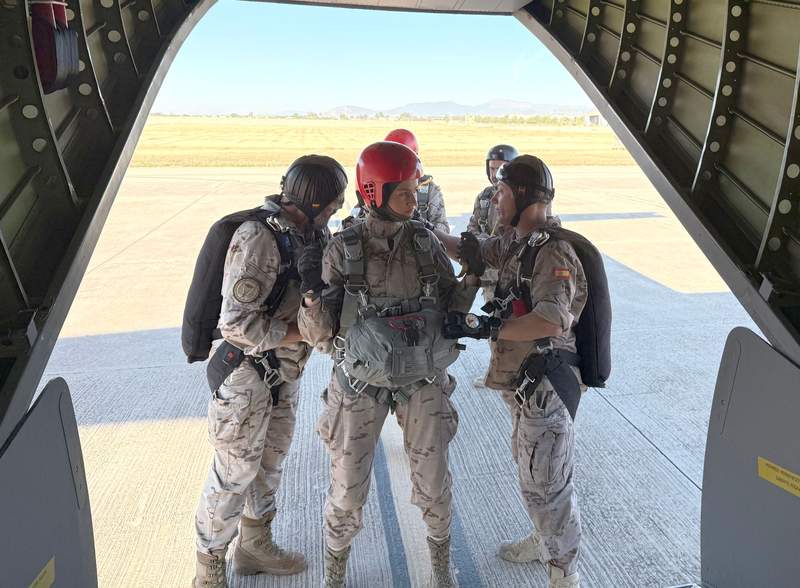
POLICY WIRE — Zaragoza, Spain — It isn’t every day you see Europe’s old guard, its blue-blooded inheritors, flinging themselves from aircraft. But then again, Spain’s monarchy, a fragile construct navigating 21st-century skepticism, isn’t just any royal household. This week, Princess Leonor, the heir presumptive, completed her parachute training, pinning a paratrooper badge to her uniform. It’s a calculated move, this descent from the clouds—a vivid, jarring contrast to the plush velvet and inherited gold usually associated with royalty.
She’s just eighteen, the future Commander-in-Chief, embarking on a three-year military induction program. Most kids her age are stressing about university applications or finding the best coffee. Not Leonor. She’s learning to lead battalions, (presumably) dodge bullets, — and now, apparently, exit airplanes at altitude. You can’t help but wonder if King Felipe VI, her dad, isn’t pushing for something a little more grounded—like, say, stability for an institution that still, for many Spaniards, feels less like a unifying force and more like a historical anachronism.
The image, captured for national consumption, is stark: a young woman, future queen, amidst her comrades, indistinguishable from the other recruits until you catch the flash of the royal cipher. This isn’t just about military discipline; it’s about rebranding. It’s an exercise in public relations, a gritty, earnest performance for an audience that’s grown increasingly unconvinced by inherited privilege. The royal house understands its survival isn’t a given; it’s fought for, jump by jump, speech by speech, carefully curated photo op by carefully curated photo op.
“Her Royal Highness exemplifies the commitment and modernization of our armed forces, bridging tradition with the demands of the contemporary world,” stated Margarita Robles, Spain’s Minister of Defence, during a recent press conference. “It’s an inspiring sight for young Spaniards, truly. She’s not above service, she’s immersed in it.” It’s the party line, certainly, but it paints a picture of a monarchy striving for relatable heroism. And Robles, a Socialist known for her pragmatism, isn’t one to mince words when it comes to national defense.
But the pragmatism cuts both ways, doesn’t it? Because while some applaud this dedication, others squint, seeing through the carefully choreographed transparency. “While her personal dedication is noted, one has to question the optics of a future monarch, whose position is guaranteed by birth, undertaking training that most ordinary Spaniards volunteer for out of economic necessity or genuine patriotism,” remarked Gabriel Rufián, a prominent Republican Member of Parliament, speaking to Catalan media. “Is this genuine service, or simply another public relations maneuver to justify inherited privilege in a nation grappling with very real economic struggles?” He’s got a point. A recent poll by El Español indicated that only 49% of Spaniards approved of the monarchy in 2023, a slight bump from previous years but hardly a resounding mandate.
What This Means
This military immersion, complete with parachute jumps, serves multiple purposes beyond basic training. Politically, it attempts to forge a bond with Spain’s armed forces, a critical institution often viewed as a guarantor of constitutional order—a role with historical precedent. It telegraphs responsibility, a willingness to share burdens, a direct rebuke to those who decry the royals as out-of-touch elites. Economically, well, it doesn’t directly shift GDP, does it? But it’s part of a broader strategy to solidify the monarchy’s social contract, thereby ensuring its public funding and continued acceptance.
📄 POLICY WIRE WHITEPAPER PUBLISHED: PAKISTAN'S NATIONAL SECURITY POLICY PRIORITIES
👉 READ BY CLICKING HEREFor nations like Spain, where the wounds of dictatorship (Franco’s legacy is still very much a living memory) haven’t fully scarred over, the monarchy often finds itself a political football. The progressive left, the regional separatists—they’d rather see a republic. And they’re not shy about saying so. So Leonor’s military exploits aren’t just for show. They’re part of a longer game, a bid to secure public opinion, particularly among the youth who might view traditional monarchies as relics, mere tourist attractions—like visiting Windsor Castle, but without the gift shop. Her presence in uniform tries to re-anchor the crown to national identity — and shared sacrifice. It’s a tricky balancing act.
And let’s think globally for a moment. This emphasis on a female heir in a rigorous military role offers an interesting contrast to leadership structures in various parts of the world. While women increasingly serve in armed forces globally—and in places like Jordan, Princess Salma bint Abdullah even flies fighter jets, holding real command responsibilities—the symbolism can vary wildly. In certain conservative regions of the Muslim world or South Asia, where female leadership, particularly in visible, public, or military roles, can still face traditional barriers or societal scrutiny, such images might resonate differently, sometimes prompting cultural conversations around evolving gender roles versus traditional expectations. The implications for female succession and power are not universally interpreted, you know? But for a European constitutional monarchy trying to stay relevant, this isn’t about setting global precedents; it’s about holding onto a kingdom.
Because ultimately, a monarchy without popular support is just an expensive museum exhibit. The Zarzuela Palace understands this. They’re making darn sure their next exhibit is ready to jump. She’s earning her stripes, literally, and the family name hinges on whether these calculated risks, these spectacular acts of public duty, resonate enough to keep the crown shining. It’s quite the gamble, isn’t it?