


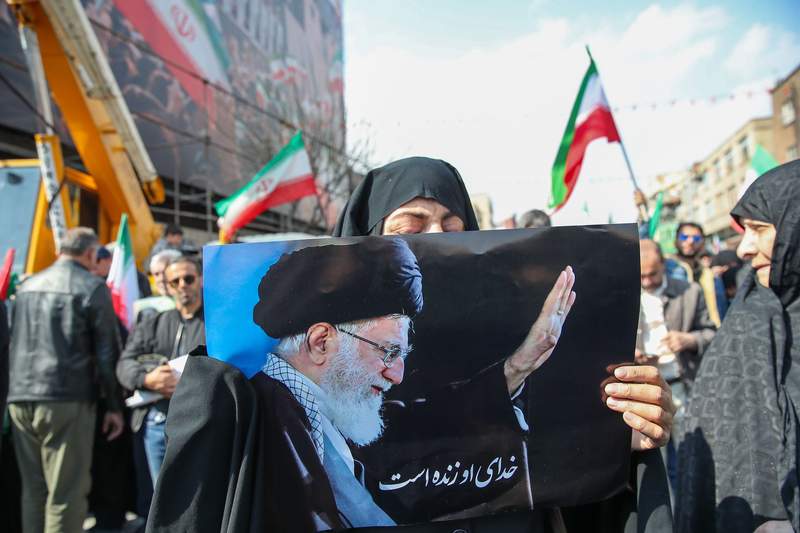
Tehran’s Jittery Silence: An Empire’s Future Hangs After Supreme Leader’s Untimely End
POLICY WIRE — Tehran, Iran — The morning fog, unusually thick, seemed to swallow the city whole, muffling the usual din of traffic and chatter. It wasn’t the announcement itself—Iran’s Supreme...

POLICY WIRE — Tehran, Iran — The morning fog, unusually thick, seemed to swallow the city whole, muffling the usual din of traffic and chatter. It wasn’t the announcement itself—Iran’s Supreme Leader Ali Khamenei, dead—that stunned everyone; it was the whispered phrase preceding it: “slain.” An empire built on ideological unwavering, meticulously groomed for generations, suddenly faced not just a transition but an act of brutal finality. That single word, still not fully parsed by a populace often told what to think, is already ripping the fabric of certainty across the Middle East. It’s a seismic shock, felt from Beirut to Karachi, making even the most seasoned observers re-evaluate their entire geopolitical blueprints.
Security forces, visible but unnervingly calm, established a perimeter around key government buildings hours before state media confirmed the unimaginable. There’s a strange, almost choreographed sorrow settling in – an official grief. But beneath it? You can feel the tremor of frantic backroom negotiations. It’s always been about succession, a quiet chess match played out over decades. But no one, not even the architects of the Islamic Republic, planned for a violent, sudden end for a leader who’d ruled for thirty-five years, shaping everything. They certainly hadn’t planned for it this way.
President Ebrahim Raisi, his face grim, addressed the nation early Tuesday. “We will face this challenge with iron resolve, united under the banner of our revolution. The enemies of Iran will find no solace in this tragedy,” he declared, his voice tight with controlled emotion, or perhaps, something more akin to desperate caution. It wasn’t merely a eulogy; it was a rallying cry, a warning wrapped in black mourning cloth. Because stability is everything, isn’t it? And right now, it’s hanging by a thread.
The streets, normally bustling, are holding their breath. Funeral rites are being planned, vast public spectacles meant to project strength — and unity. But the sheer practicalities of governing – of ensuring a smooth power handover without exposing deep internal rifts – are proving a logistical and ideological nightmare. The Guard corps are on high alert; their role will be more critical than ever, not just externally, but within the clerical hierarchy vying for ultimate authority.
“His sudden exit tears a hole in the establishment – a system designed for his longevity,” commented Dr. Faraz Malik, a senior fellow at the Center for Regional Geopolitics, based in Islamabad, just a short flight from Tehran’s emerging crisis. “The contenders are many, but consensus? That’s another story. And the consequences for the region? Immediate and severe.” Indeed. Iran’s relationship with neighbors, including Pakistan, a state with its own delicate balancing act between Tehran and Riyadh, will face its sternest test yet. The fallout from Tehran’s uncertain future reverberates through fragile regional alliances, proxy conflicts in Yemen and Syria, and the broader sectarian dynamics that already scar the Muslim world.
But the biggest worry, for ordinary Iranians, isn’t just about who sits on the supreme leader’s throne. It’s about what happens to an already fragile economy. The latest UN figures from 2023 place Iran’s youth unemployment rate at roughly 22%, a simmering discontent now likely to be further agitated. People don’t just want a leader; they want a future. They want opportunities that are disappearing faster than the news of their late leader can disseminate. Economic headwinds were already battering the populace, and now, the political compass is spinning wildly. Will the new leadership, whoever they’re, even prioritize their plight? Unlikely, not initially anyway.
📄 POLICY WIRE WHITEPAPER PUBLISHED: PAKISTAN'S NATIONAL SECURITY POLICY PRIORITIES
👉 READ BY CLICKING HEREWhat This Means
The killing of Ali Khamenei isn’t just an isolated incident; it detonates a pre-existing fault line within Iran’s ruling class and significantly reshapes the Middle East. Politically, the immediate future sees an intense, almost clandestine, struggle among a handful of key figures and factions: ultra-conservatives loyal to the Guard, pragmatists within the clerical establishment, and even those elements who previously viewed Khamenei’s chosen successor as inevitable. There’s no clear heir-apparent, which means infighting is bound to intensify, risking a chaotic transition at a moment when Iran’s regional proxies are more active than ever. It’s a gift to external adversaries, giving them a moment of rare weakness to exploit. And for the United States and Europe? They’re watching nervously, calculating every potential ripple effect on nuclear talks, energy prices, and maritime security.
Economically, this sudden void guarantees deeper uncertainty. Investor confidence, already brittle under sanctions, will plunge further. Expect the rial to wobble, — and capital flight to accelerate. The long-term implications depend heavily on the nature of the succession. A unified, strong successor might provide some stability, but a fractured, internally squabbling leadership could trigger prolonged instability, leading to wider public unrest and potential challenges to the very system. Then there’s the Red Sea shipping routes, already tense; any perceived vacuum in Tehran’s leadership could embolden or confuse actors in Yemen and Lebanon, leading to an escalation of skirmishes and disrupting global trade routes further. It’s not just Iran that’s bracing itself; the whole world just took a deep, uneasy breath.