


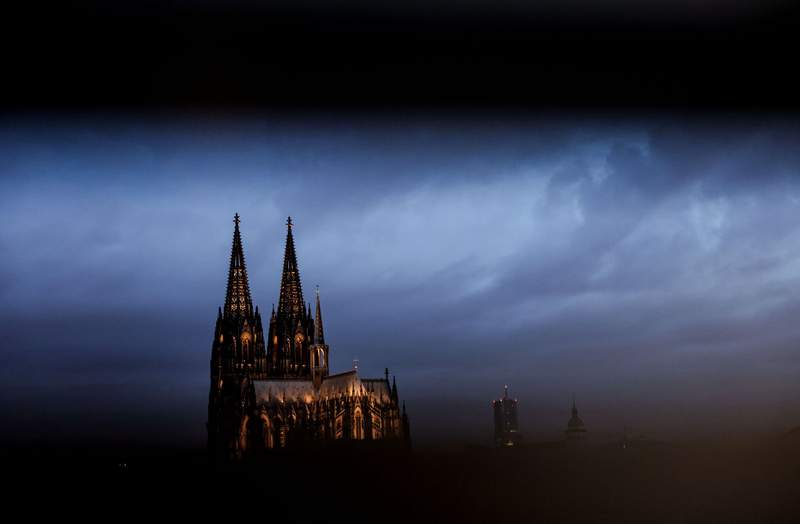
Europe’s Sacred Spaces: Cologne Cathedral’s New Toll Rings Through Old Divides
POLICY WIRE — Cologne, Germany — For centuries, its spires have pierced the Rhineland sky, a gothic behemoth born of medieval ambition and industrial-age steel, miraculously standing...

POLICY WIRE — Cologne, Germany — For centuries, its spires have pierced the Rhineland sky, a gothic behemoth born of medieval ambition and industrial-age steel, miraculously standing defiant even through Allied bombings. But this year, Cologne Cathedral — a silent witness to millennia of German history — began exacting a different kind of toll. No longer a universal right of passage for every visitor, its very threshold now comes with a price tag. It’s a small fee, sure, but a weighty shift for one of Europe’s most storied monuments.
It used to be simple: wander in, gaze up, feel dwarfed by the sheer audacity of human craftsmanship — and faith. Now, casual tourists must hand over three Euros — about $3.25 — just to cross the main nave. The idea, officials claim, isn’t about profit. It’s about upkeep. Think about it: a structure started in 1248, perpetually under construction, demanding constant, expensive love and attention. Because, let’s be real, ancient stone doesn’t just maintain itself. And German church tax revenues? They’re not what they used to be.
“We’ve resisted this for a long time, naturally,” admitted Dompropst Guido Assmann, the cathedral’s provost, in a recent statement that felt more like resignation than justification. “But the simple truth is, maintenance costs continue to climb. The pigeons alone cost a fortune.” He didn’t quite smile, didn’t seem to think it was funny. They’re facing mounting conservation needs and a steady decline in church attendance — meaning fewer local contributions to the coffers. It’s an inconvenient truth for a nation that prizes its historical patrimony.
But the move isn’t just about cash flow for a medieval masterpiece. It scratches at something deeper, something about how contemporary Germany — and, by extension, Europe — views its own identity, its accessibility, and the shared nature of its public spaces. And who gets to define what’s “public”? Does a nominal fee, intended to preserve, inadvertently become a gatekeeper?
Consider the contrast: in many parts of the world, particularly across South Asia and the broader Muslim world, access to major religious sites — mosques, shrines, dargahs — is often, if not always, free and unrestricted, viewed as a fundamental right of faith and culture, supported by state or community endowments. The idea of charging for entrance to a central place of worship and historical significance, especially in countries with large migrant populations — including a significant Turkish-German community right there in Cologne — introduces an interesting tension. It prompts one to ponder who precisely is the target demographic for this entry fee, and if it inadvertently shifts the cathedral’s perceived role from a community and spiritual hub to merely another tourist attraction.
“We’re effectively commercializing a place of worship and national memory,” retorted Wolfgang Thierse, a former Bundestag president and keen cultural observer. “This isn’t just about collecting a few euros; it’s about signaling who belongs, — and on what terms. It sends the wrong message, especially when discussions around Germany’s anxious coexistence with its diverse populations are already so fraught.” He has a point; public spaces have symbolism.
And the economics? Data from the German National Tourist Board indicates that while overall international arrivals have generally rebounded, the financial burden for maintaining iconic structures like Cologne Cathedral — which typically sees around 6 million visitors annually, but only a fraction attend services — remains squarely on the cathedral chapter’s shoulders. Those maintenance efforts cost something north of 10 million Euros each year. It’s a lot, no argument there.
📄 POLICY WIRE WHITEPAPER PUBLISHED: PAKISTAN'S NATIONAL SECURITY POLICY PRIORITIES
👉 READ BY CLICKING HEREThis decision, while fiscally understandable, opens up a Pandora’s Box of questions for German society. Does access to shared historical legacy become a commodity? How does this impact the perception of cultural heritage among new generations or those from different backgrounds, who might already feel somewhat disconnected from dominant narratives? It’s not just a toll gate; it’s a talking point. For better or worse, the mighty Dom now wears a price tag.
What This Means
This fee at Cologne Cathedral is more than just a bureaucratic response to budgetary pressures; it reflects a quiet, yet significant, renegotiation of Europe’s relationship with its historical and spiritual anchors. Politically, it spotlights the dwindling financial clout of traditional religious institutions and the German state’s reluctance, or inability, to fully underwrite cultural patrimony that extends beyond its active congregants. It’s a pragmatic shift that could ignite debates about the secularization of public space, the state’s responsibility for national heritage, and the unspoken class divide it may create.
Economically, it’s a small but telling experiment. If successful, expect other cash-strapped European cathedrals and historical sites — institutions that are centuries old and immensely expensive to preserve — to follow suit. This could gradually transform how international tourism functions across the continent, moving towards an even more monetized experience of cultural exploration. But it also risks pricing out segments of the local populace and even backpackers who make up a considerable chunk of sightseers. On a broader scale, it speaks to a tension within European identity: is its history an open book for all, or a collection of precious artifacts requiring paid admission for the privileged?
Culturally, the ramifications are subtle but potent. It asks Germans, particularly those from immigrant backgrounds — for instance, the Turkish, Moroccan, or Syrian families who’ve built lives there — whether these towering symbols of national identity truly belong to everyone, irrespective of faith or lineage, or if they’re increasingly becoming consumer experiences. In an era where integration and inclusivity are supposedly top priorities, a barrier, however small, can become symbolic. This isn’t just about seeing pretty stained glass; it’s about the emotional and cultural right to walk through history without emptying your pockets. And for those struggling with the rising cost of living, three Euros can indeed feel like a steep climb — like a choice between seeing a relic of the past, or simply navigating modernity’s challenges.