


New York’s New Currency: Karl-Anthony Towns Recharts Worth Beyond Wall Street in Knicks’ Historic Run
POLICY WIRE — New York City, USA — They say money talks in New York. Loudly, obnoxiously sometimes. But if you’ve spent any time observing the city’s notoriously fickle populace—particularly when...

POLICY WIRE — New York City, USA — They say money talks in New York. Loudly, obnoxiously sometimes. But if you’ve spent any time observing the city’s notoriously fickle populace—particularly when their beloved athletic franchises are involved—you’d know that something else, far less tangible, often holds greater sway. For a staggering 27 years, the grand old name of the New York Knicks carried a certain melancholy, a generational sigh accompanying every postseason collapse. That particular strain of New York gloom, it’s been swept clean, just like the Eastern Conference opposition, this spring.
Because, make no mistake, this isn’t just about basketball. It’s about cultural currency, about reclaiming a certain swagger that New York, perhaps more than any other metropolis, desperately covets. And frankly, they’ve waited for ages. Karl-Anthony Towns, the improbable centerpiece of this sudden resurgence, a man once considered an outsider—or at best, a risky gamble—now finds himself at the nexus of a phenomenon. He isn’t just playing; he’s internalizing the city’s unique, often brutal, transactional calculus.
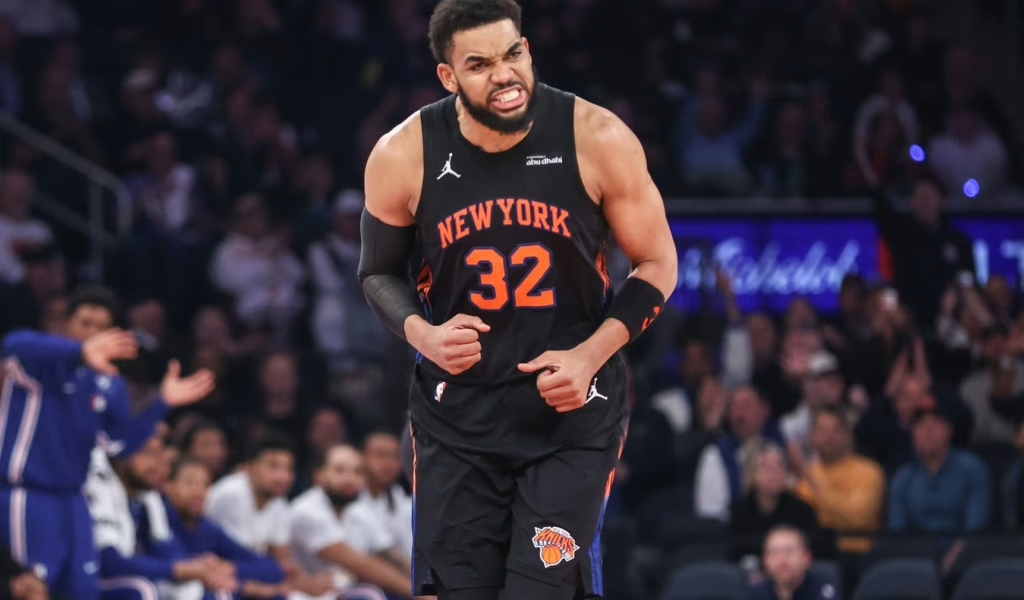
Speaking recently, the veteran big man didn’t just rattle off platitudes about the Finals. Nope. He dove straight into the heart of the matter, framing his immense professional undertaking not in dollars and cents, but in the harder-won commodity of adoration. He’s right, you know. He articulated a sentiment that any seasoned observer of this concrete jungle could affirm. “The greatest currency you can earn in New York City is not money, but it’s respect,” Towns pronounced on Sunday, adding that “To have the respect of the fans in the city, we are rich beyond belief here in the city.” This isn’t just athlete-speak; it’s a political declaration.
The Knicks didn’t just advance to the NBA Finals for the first time in 27 years; they executed a clean sweep through the Eastern Conference semifinals and finals. A statement. It’s a run that’s been, frankly, elite. Towns, often seen as a perimeter-oriented center in his earlier career, has subtly, powerfully altered his game under New York head coach Mike Brown. He’s evolved into what you’d call an elite passing big—a hub, a decoy, setting up easy baskets, embracing the unselfishness required in a collective. It’s an interesting evolution, seeing a prodigious talent bend his individual brilliance to a broader, civic expectation. He’s playing, in effect, for that non-monetary currency.
This pursuit of respect—of ‘izzat’, as it’s often termed in Urdu and other languages across Pakistan and the broader Muslim world—isn’t merely an abstract notion. In many traditional societies, especially across South Asia, honor and communal standing can far outweigh direct financial gain. An individual, a family, or even a local community’s ‘izzat’ dictates social mobility, influence, and even long-term stability. The adulation of an entire city, then, for someone like Towns, transcends a hefty contract. It’s a social capital, a form of communal approval, akin to a local hero or respected elder in Lahore or Karachi, whose worth is measured not by their bank account, but by the esteem in which their community holds them. The demands might be different, but the fundamental human craving for respect, for being held in high regard by your tribe, isn’t.
And Towns isn’t just talking. He appears completely motivated by their fans, explicitly stating that their undying loyalty remains the ultimate reward. You can’t put a price on that kind of emotional investment. His sentiments echo similar situations globally, where the ‘soft power’ of sporting heroes often builds bridges far more effectively than traditional diplomacy or economic aid. Consider the role of cricket icons in Pakistan, who command a devotion that crosses socio-economic divides, their achievements elevating national morale and collective identity, much like sports figures in other regions become de facto cultural ambassadors.
📄 POLICY WIRE WHITEPAPER PUBLISHED: PAKISTAN'S NATIONAL SECURITY POLICY PRIORITIES
👉 READ BY CLICKING HEREThe stage is now set. Game 1 of the NBA Finals is slated for Wednesday at Frost Bank Center in San Antonio. New York will get its chance to scream. They’ll host Games 3, 4, — and 6, and their fans? Well, they’re expected to be loud in cheering their team on. Loudness, in this town, is just another expression of passion, of a deeply personal relationship with the team. And with a fan base that’s waited patiently—or rather, impatiently and with much gnashing of teeth—for nearly three decades, that volume will translate directly into a swelling reservoir of Towns’ cherished respect.
What This Means
The Knicks’ Cinderella run to the Finals, underscored by Karl-Anthony Towns’ nuanced understanding of New York’s emotional economy, holds broader implications beyond the hardwood. Firstly, it represents a significant economic jolt. A team reaching the Finals injects millions into the local economy through ticket sales, merchandise, tourism, and increased patronage of local businesses around Madison Square Garden. This isn’t just anecdotal; a typical NBA Finals run can generate upwards of $100 million in local economic activity, depending on market size and series length, according to economic impact studies of similar sporting events. That’s real money, bolstering the city’s coffers — and providing jobs.
But the ‘respect’ Towns champions also speaks to civic pride—an intangible asset, yes, but one with tangible benefits. A winning team boosts morale, fosters communal identity, and can even influence perceptions of a city on a national and international stage. It’s a form of soft power. Success on such a grand public platform can enhance New York’s appeal, potentially drawing new investments, tourists, or even residents. Conversely, perennial failure erodes this civic confidence, impacting everything from casual conversation to deeper municipal narratives.
From a political standpoint, a successful sports franchise provides a welcome distraction from pressing urban issues, a temporary common ground in an often-polarized metropolis. Local politicians often bask in the reflected glow of success, subtly aligning themselves with the winning narrative. And because New York operates as a global brand, its major cultural touchstones—including its sports teams—contribute to its global standing. This current Knicks squad isn’t just playing for a championship ring; they’re reaffirming the city’s unyielding belief in its own unparalleled, sometimes brash, glory. That’s the real prize, for them — and for the city.