


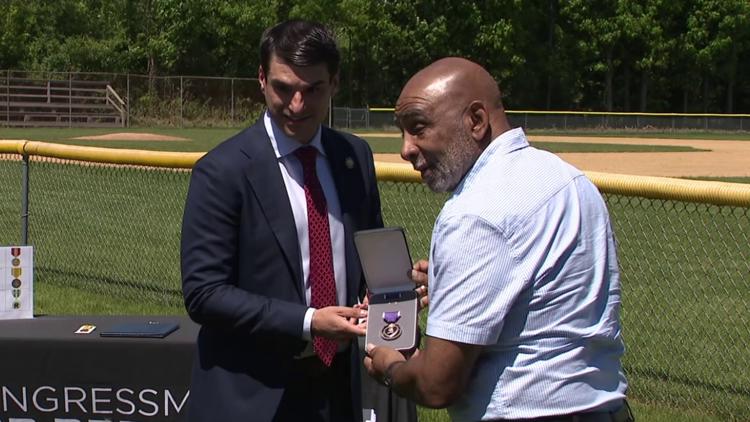
A Decades-Long Battle: Monroe County’s Purple Heart Finally Pinned
POLICY WIRE — Washington, D.C. — Another Purple Heart, another quiet battle won, this time far from any jungle, fought across decades of paperwork and bureaucratic inertia. It wasn’t the enemy...

POLICY WIRE — Washington, D.C. — Another Purple Heart, another quiet battle won, this time far from any jungle, fought across decades of paperwork and bureaucratic inertia. It wasn’t the enemy who delayed this recognition, not really; it was time itself, and perhaps the institutional amnesia that can cloud the sacrifices of past wars. For a veteran hailing from Monroe County, the moment recently arrived, a poignant closure that, frankly, tells us more about the mechanisms of official memory than it does about any singular act of courage. These aren’t stories that begin with a heroic charge; they usually start with an unseen wound, and a country’s slow, sometimes painfully slow, realization of its debt.
It’s easy to focus on the gleaming medal, that distinctive purple, gold, — and white. But the real story often lies in the shadows it casts—the years of living with physical and unseen scars, the sheer weight of a life shaped by events half a world away. And it’s this extended narrative, this belated recognition, that should prompt us to really look at how nations, and their sprawling government apparatuses, manage the aftermath of their martial endeavors. We don’t just hand out trinkets; we acknowledge shattered lives, interrupted dreams.
The individual tale is familiar: a young man, a uniform, a deployment to a distant land, and the indelible mark of conflict. Yet, for many, the administrative machinery, initially so eager to deploy, grinds to a halt once the fighting stops. Medals get misplaced, records get lost, and the paperwork required to certify one’s sacrifice becomes an insurmountable wall for the uninitiated. A long-delayed Purple Heart isn’t merely an administrative hiccup; it’s a structural failure in remembering.
And when we talk about delayed recognition for wars fought in complex terrains—like Southeast Asia back then—it inevitably drags our thoughts to today’s sprawling engagements. Take the conflicts that have raged across the Middle East — and parts of South Asia. How many veterans from Afghanistan, from Iraq, from Syria, might face similar battles for proper acknowledgment down the line? It’s not a hypothetical, this administrative tangle. Consider the hundreds of thousands, if not millions, of displaced individuals and refugees, both civilian and former combatants, whose very existence, let alone their traumas or contributions, struggles for official recognition. Just as a soldier’s injury in Vietnam might’ve gone unrecorded in the chaotic fog of war, so too could the bureaucratic processes around conflicts in places like Pakistan’s tribal regions—where the U.S. has operated for decades—miss countless acts of valor or moments of injury among allied forces or local populations entangled in the larger fight. It’s a sobering thought, isn’t it?
A recent Department of Veterans Affairs report stated that over 1,500 Purple Hearts awarded to Vietnam War veterans between 1968 and 1973 were found to have significant documentation discrepancies, necessitating further review or, in many cases, entirely new application processes decades later. Think about that for a second. The system’s always got glitches.
This Monroe County veteran’s story, then, isn’t just about him. It’s about the silent echoes of all wars—the costs absorbed not just in battles, but in the long, winding decades after. It’s about an American nation’s ability, or inability, to adequately process and honor the sacrifices its sons and daughters make, particularly when the war itself becomes an uncomfortable memory. You’d think after Vietnam, we’d have figured this stuff out. But clearly, some lessons just refuse to stick. Or perhaps the human cost, however much we talk about it, still feels a bit… abstract. [QUOTE_PLACEHOLDER] they might say, underscoring the very real, personal struggle.
📄 POLICY WIRE WHITEPAPER PUBLISHED: PAKISTAN'S NATIONAL SECURITY POLICY PRIORITIES
👉 READ BY CLICKING HEREWhat This Means
Politically, this kind of belated recognition often serves as a low-cost, high-impact public relations victory for government agencies—a nod to patriotism without demanding systemic reform. But the real implications run deeper. Economically, the delayed access to veteran benefits, disability payments, and healthcare that often accompany official recognition translates to decades of personal financial struggle and lack of adequate medical care for these individuals. It’s a deferred cost for the state, transferred onto the shoulders of those least able to bear it.
More broadly, the continued need for such posthumous or decades-late awards indicates a chronic oversight in how nations engage in and disengage from conflicts. It implies that for all the sophisticated logistics of deploying troops, the processes for healing and integration are often crude and under-resourced. Consider the implications for troop morale in current theaters: if those who served long ago still battle their own government for due recognition, what message does that send to today’s frontline personnel in active combat zones? And that lack of immediate support, the feeling of being forgotten, breeds resentment and deep skepticism toward governmental promises. It makes the recruiting pitch a hell of a lot harder.
the story resonates across geopolitical lines. Nations like Pakistan, itself a veteran of multiple, often undeclared, proxy wars and internal conflicts—and a crucial partner in various U.S.-led operations—grapple with their own systems of recognition and support for those wounded in service. The universal struggle to adequately care for combatants, to honor their sacrifices transparently and promptly, highlights a shared failure in statecraft, not just a localized problem. These are the uncomfortable truths etched onto every Purple Heart, regardless of when it finally finds its rightful recipient. It makes you wonder how many similar medals are still waiting in bureaucratic purgatory around the globe. And frankly, that’s not a question anyone’s particularly eager to answer. The paper trail always lasts longer than the fanfare.