

FIFA’s Time Cops: The Unseen War on Leisure at the World Cup
POLICY WIRE — Zurich, Switzerland — In a world increasingly fixated on efficiency, on every second being accounted for, even the beautiful game finds itself under the corporate microscope. You might...

POLICY WIRE — Zurich, Switzerland — In a world increasingly fixated on efficiency, on every second being accounted for, even the beautiful game finds itself under the corporate microscope. You might think football matches unfold organically, an ebb — and flow of athletic endeavor and tactical chess. But no, the global maestros of FIFA, those folks running the biggest show on Earth (sporting-wise, anyway), they’ve got other ideas. They’re convinced we’ve all been losing precious fractions of entertainment to player antics and—let’s be real—the referee’s indulgent gaze. Now, barely a fortnight from the massive 48-team tournament kickoff, they’re laying down the law. It’s less about fair play, more about optimizing the viewing experience, squeezing every drop of perceived value out of those ninety minutes, plus whatever comes after.
They want a snappier game. A tighter product. The message? Time’s money, literally, — and nobody’s going to waste it on FIFA’s watch.
It’s a bureaucratic offensive on slowness, really. Referees — and their officials, we hear, will be zeroing in on one central commandment: keeping things moving. We’re talking about taking those rule adjustments – the ones cooked up to curb the incessant clock-killing – dead seriously. But then, as ever, the plot thickens beyond mere speed. There’s a new layer of control over player-to-player banter, specifically how they say it and where their hands are positioned. Red cards will be dished out to any player who covers his mouth while talking to an opponent in a [QUOTE_PLACEHOLDER] Because, apparently, clandestine chat is fine, but clandestine confrontational chat is an existential threat to the game’s sanctity.
Pierluigi Collina, FIFA’s chief refereeing officer and chairman of the referees committee – a man whose very presence still sends shivers down the spine of any footballer old enough to remember him whistling – articulated the mission with typical crispness. [QUOTE_PLACEHOLDER] Ah, the tempo. The rhythm. The sanctity of the rhythm.
Other bits — and bobs the match officials will be keeping their eyes on:
- Players reacting badly to calls. If some hothead leaves the pitch in a fit of pique after a referee’s decision? Boom. Red card.
- The speed of set pieces gets a timer. Five seconds for goal kicks and throw-ins, a visual countdown. Fail to meet the deadline, and the opponent gets the ball – a corner for a botched goal kick, a throw-in for a flubbed throw-in. It’s almost Pavlovian. They’re calling it an extension of the existing eight-second goalkeeper rule.
- Substitutions are now a sprint. Players must be off the field in 10 seconds flat. Injuries or security issues? Fine, a pass. Otherwise, move it.
- VAR – the Video Assistant Referee, that great equalizer of cosmic injustice – also gets its rulebook tightened. It’ll check incorrect red cards from a second yellow or cases of mistaken identity. Also, wrongly awarded corner kicks are now on the menu for VAR scrutiny. FIFA said this themselves, a nod to fairness in even the most obscure decisions.
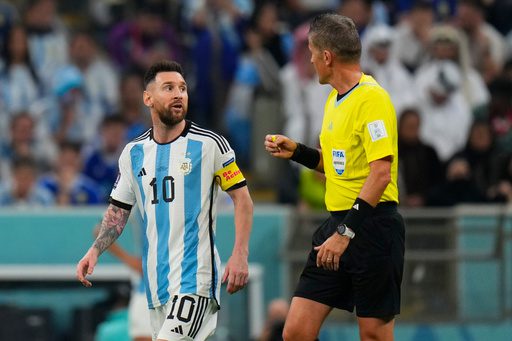
Now, about that mouth-covering thing. If players are caught shielding their chatter with a hand, arm, or shirt, and it’s not just a casual chinwag, it’s a red. If it’s not confrontational, Collina noted, it’s still permitted. But if it’s [QUOTE_PLACEHOLDER] Apparently, football can handle whispered insults, just not *strategically shielded* whispered insults when tempers flare. It’s a remarkably specific, almost theatrical, layer of policing on the players’ emotional expressions. One has to wonder if such decrees extend to the sometimes-fiery touchline theatrics of coaches.
📄 POLICY WIRE WHITEPAPER PUBLISHED: PAKISTAN'S NATIONAL SECURITY POLICY PRIORITIES
👉 READ BY CLICKING HEREVAR will also scrutinize offenses committed by attackers before a corner or free kick if it directly leads to goals or penalties. If an offense occurred before the ball was in play, FIFA confirmed, “the appropriate disciplinary action will be taken.”
But here’s the kicker: all this obsessive pursuit of efficiency, this minute-by-minute micro-management of the game’s tempo, won’t necessarily lead to quicker matches. Because, paradoxically, FIFA’s also instituting three-minute water breaks in the middle of each half. Go figure. So much for speed, eh? It’s a bit like buying a faster car — and then insisting on driving 30 mph everywhere.
What This Means
This isn’t just about football; it’s a window into the prevailing obsession with perceived inefficiency in every major global industry. For FIFA, it’s about controlling the product, maximizing television time, and ensuring a smoother, more palatable spectacle for a massive global audience. The World Cup, after all, isn’t just a sporting event; it’s a massive economic engine, a soft power instrument, and a cultural phenomenon all rolled into one. Consider this: the 2022 World Cup averaged over 3.2 billion viewers for its matches globally, according to data compiled by Statista. Every second of potential boredom or inaction on the field translates to a second of potential disengagement for those viewers, and thus, potentially, lost revenue or diminished appeal. For countries like Pakistan, where football’s popularity, while secondary to cricket, is on a significant upward trajectory among the youth, these nuances in refereeing are scrutinised with an almost academic fervor. Fans across South Asia crave not just exciting play but also perceived fairness; a sense that the global elite aren’t dictating the terms of engagement too arbitrarily. Any decision that seems to unfairly disadvantage a popular team or star player—perhaps an untimely red card for a mouth-covering infraction—could ignite outrage that transcends the sports pages, bleeding into broader political and social discourse regarding global institutions and fairness on the world stage. It touches on how these global sporting bodies project an image of absolute control — and order. When everything is counted, timed, and policed to the second, what does that say about the value of spontaneity, or even subtle human interactions, within such a highly commoditized domain?
It’s an effort to minimize controversy that isn’t about the play itself, but about the clock. This relentless push for an unbroken tempo suggests an underlying concern: that the audience’s attention span, fragmented by digital distractions, needs constant stimulation. It’s less about the spirit of the game — and more about serving up digestible, interruption-free content. A truly modern conundrum for the world’s most popular sport, wouldn’t you say? Especially when you remember soccer diplomacy often mirrors global rivalries.