


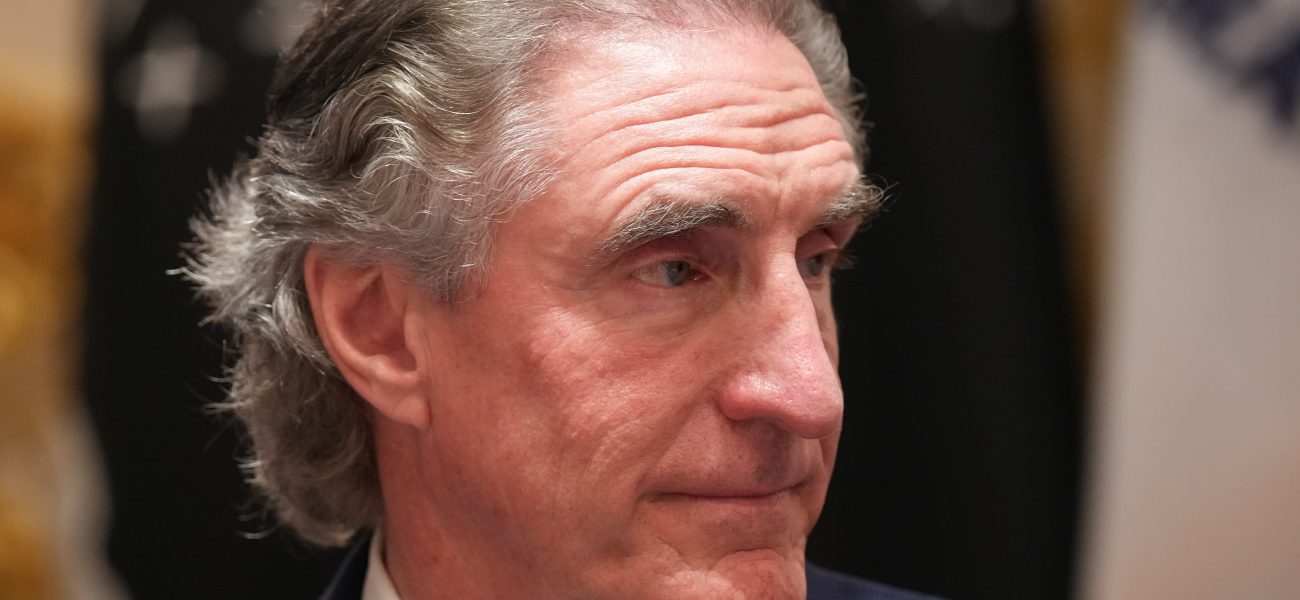
Burgum’s Bipartisan Bid: The 250th and America’s Fading Illusion
POLICY WIRE — Washington, D.C. — Imagine, if you will, an American future where national unity isn’t just a campaign slogan or a quaint historical relic, but a lived experience. It’s a noble...

POLICY WIRE — Washington, D.C. — Imagine, if you will, an American future where national unity isn’t just a campaign slogan or a quaint historical relic, but a lived experience. It’s a noble thought, one perhaps best suited for a distant galaxy, not the deeply fractured republic of today. Yet, former Trump Interior Secretary Doug Burgum recently floated precisely that — a vision of America’s upcoming 250th anniversary celebration in 2026, supposedly untainted by partisan rancor.
It’s an admirable, if somewhat startling, ambition from a figure deeply enmeshed in an administration that, by many accounts, perfected the art of the political wedge. Burgum’s sentiment regarding the national milestone suggests the commemoration of 250 years since the Declaration of Independence should somehow rise above the partisan muck, insisting the celebration is designed to be [QUOTE_PLACEHOLDER]. A nice sentiment, isn’t it? But, like trying to extract sunshine from a perpetual twilight, the practicalities seem, well, challenging. You’ve got to wonder if it’s an earnest plea for harmony or just another twist of the rhetorical knife in a country perpetually at odds with itself.
Because let’s be real, a call for unity coming from any corner of Washington these days, especially one associated with a president known for — shall we say — robust engagement, rings with a particular kind of irony. The notion of a wholly neutral national celebration in this political climate feels less like a forecast and more like a fever dream. The chasm separating red from blue isn’t a crack; it’s a continental divide. How do you square the circle when nearly every historical interpretation, every national symbol, every even remotely significant date, has become a political football?
And it’s not just the policy wonks or the Twitter warriors squaring off. This division cuts deep into the very fabric of American life. A recent Pew Research Center study (2022) revealed a stark truth: 72% of Americans believe political divisions have significantly worsened over the last decade. It’s hard to build a campfire with kindling soaked in distrust, let alone a grand national jubilee. But perhaps Burgum, now governor of North Dakota, believes in a residual magic inherent to such anniversaries — a kind of civic alchemy that temporarily overrides our baser political instincts. He may genuinely hold that America’s enduring narrative transcends momentary squabbles.
Still, the optics alone raise eyebrows. A nation struggling to agree on how to commemorate its past will undoubtedly find even more points of contention when defining its shared future. Think about it: every monument, every exhibit, every keynote speaker selection for the 250th is a potential minefield. Who gets to tell the story? Which narrative of American exceptionalism — or exceptional struggle — prevails? The former Interior Secretary, through the American250 organization, seems to envision a national observance focused on [QUOTE_PLACE_HOLDER] and reminding future generations about our story. But whose story are we really telling?
Abroad, these internal American debates don’t go unnoticed. In a country like Pakistan, where political stability often feels like walking a tightrope, the internal disarray of the U.S. is observed with a mix of fascination — and caution. Pakistani newspapers and media frequently highlight American political struggles, drawing parallels or contrasts with their own volatile landscape. The image of a deeply fractured America doesn’t exactly project an aura of unwavering democratic resilience, does it? When the standard-bearer for democracy struggles with basic civility, it offers little comfort or inspiration to nascent or challenged democracies worldwide. There’s a subtle but palpable global effect – a weakening of American soft power, an erosion of its moral authority on governance when its own house looks to be constantly in disarray.
For nations like Pakistan, navigating geopolitical currents often means calibrating their stance based on perceived U.S. strength and reliability. A truly nonpartisan U.S. celebration, showcasing a unified national identity, would send a vastly different message than what the world usually sees these days — one of relentless political bickering. But that kind of narrative consistency from the U.S.? It’s become a rare commodity. It often leaves partners like Islamabad in a quandary, weighing alliances against an unpredictable backdrop.
📄 POLICY WIRE WHITEPAPER PUBLISHED: PAKISTAN'S NATIONAL SECURITY POLICY PRIORITIES
👉 READ BY CLICKING HERESo, Burgum’s aspiration for a purely [QUOTE_PLACEHOLDER] 250th anniversary, while perhaps genuinely felt, clashes sharply with the political realities that have defined American public life for well over a decade. It’s an inconvenient truth that patriotism and partisanship have become so intertwined, it’s difficult to separate them. One man’s celebration of founding principles is another’s bitter reminder of historical injustices, — and vice-versa. And frankly, this isn’t a dynamic that resolves itself with a few heartfelt speeches or even a bipartisan committee meeting. It requires a fundamental shift in political culture, something far grander and more elusive than any anniversary commission can conjure.
What This Means
This push for a ‘nonpartisan’ 250th, even if sincere, carries significant implications. Politically, it’s a gamble. A unified national observance could theoretically serve as a much-needed pressure release valve, allowing a moment for collective pride amidst relentless tribalism. But failure to achieve genuine nonpartisanship risks exacerbating existing divisions, turning a celebration into another front in the culture wars. Imagine if controversies erupt over the messaging, the history presented, or the figures honored – it wouldn’t be unity; it would be yet another wound to the civic body.
Economically, there’s less direct impact beyond the substantial expenditure of planning such a grand event. However, a genuinely unified message about America’s founding principles, if delivered credibly, could bolster investor confidence by signaling a degree of political stability and a shared future vision. A fractured celebration, conversely, reinforces perceptions of instability, potentially discouraging long-term foreign investment and complicating trade relationships. When political energies are perpetually consumed by internal feuds, the ability to project economic power or craft coherent trade policies, for instance with partners in the Indo-Pacific, diminishes. The U.S. political theatre, often as dramatic as a professional wrestling narrative, doesn’t always instill confidence in the global financial markets. Ultimately, a nation consumed by its internal squabbles struggles to exert consistent, compelling influence abroad, leaving gaps for other powers to fill. And that, in the long run, costs everyone.