


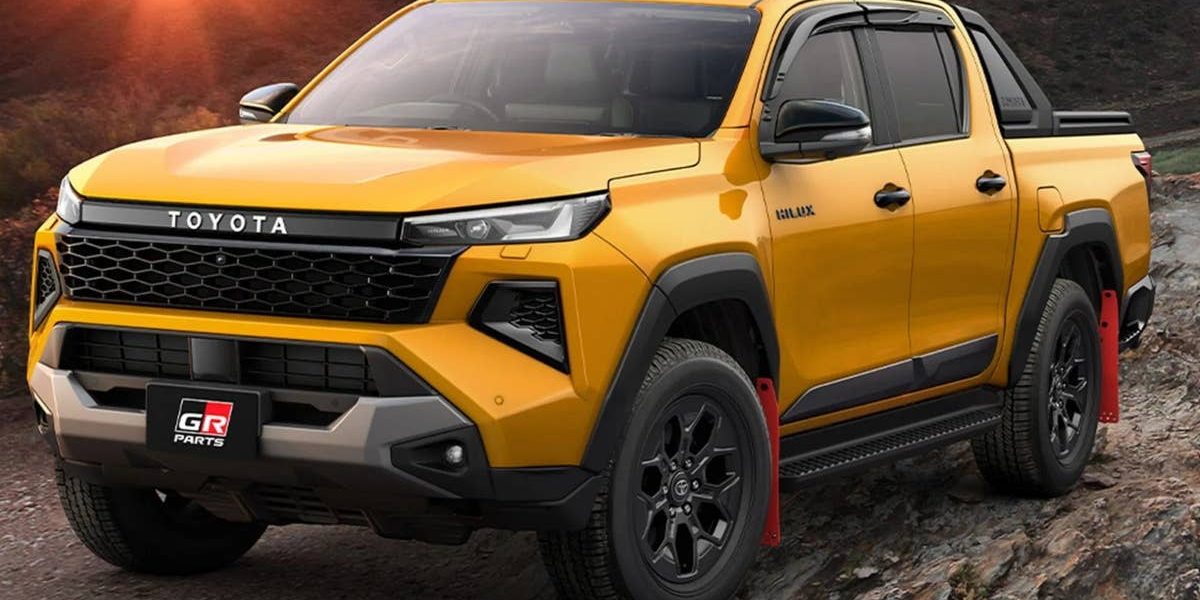
The Hilux Conundrum: A Global Workhorse Gets the Perks, Leaving American Tacoma Fans Adrift
POLICY WIRE — Tokyo, Japan — Sometimes, the quiet hum of an automotive factory in Thailand, or perhaps South Africa, reveals more about global economic policy and market disparities than a dozen...

POLICY WIRE — Tokyo, Japan — Sometimes, the quiet hum of an automotive factory in Thailand, or perhaps South Africa, reveals more about global economic policy and market disparities than a dozen trade summits ever could. It’s in the allocation of engineering prowess, the distribution of components—even the minor adjustments to a chassis—where you see the real priorities. Toyota, the undisputed king of reliability, is inadvertently illuminating a stark divide, best exemplified by its iconic pickup trucks.
It’s not about horsepower figures or flashy infotainment screens; this is about capability. About hardiness. About the very specific factory upgrades now landing in the lap of Toyota Hilux buyers across the world. Meanwhile, their brethren across the Pacific, devotees of the North American-market Toyota Tacoma, can only watch with a mix of longing and quiet indignation. And you’ve gotta wonder why. It seems a peculiar strategy—bestowing cutting-edge factory refinements upon the global workhorse while its North American cousin often lags in certain areas of mechanical evolution. They’re, for all intents and purposes, kissing cousins in the grand Toyota family, but they certainly aren’t being treated to the same Christmas gifts, are they? [QUOTE_PLACEHOLDER]
Because, make no mistake, the Hilux isn’t just a truck; it’s an institution in countless nations, the veritable backbone of commerce, agriculture, and even security operations. From the sun-baked plains of Balochistan to the sprawling gold mines of Australia, it’s the vehicle that doesn’t just get the job done; it *endures*. So, when whispers turn to concrete reports of upgraded suspensions, advanced four-wheel-drive systems, or perhaps more robust chassis reinforcements—straight from the factory line—for the Hilux, it speaks volumes. It speaks to a profound understanding of markets where vehicles aren’t just toys, they’re survival tools.
Toyota’s global strategy, particularly for its utilitarian vehicles, doesn’t just unfold in sleek showrooms. It’s often written in the dust of unpaved roads — and the grind of unforgiving daily labor. The Hilux, for instance, isn’t just popular in places like Australia and parts of Europe; it’s foundational across South Asia, Africa, and the Middle East. Consider Pakistan, a country where robust, reliable transport isn’t a luxury but a necessity for its diverse and often challenging terrain. The Hilux isn’t just common there; it’s ubiquitous, from the bustling streets of Karachi to the remote mountainous regions. It’s the kind of vehicle that businesses rely on, families pile into, and non-governmental organizations trust to deliver aid. Any factory upgrade enhancing durability, payload capacity, or off-road prowess isn’t a mere convenience; it’s an economic enabler.
This approach isn’t random. It’s a calculated response to incredibly demanding operating environments. The brand knows where its bread is buttered—and, perhaps more importantly, where its reputation for legendary reliability is truly forged. According to automotive market research firm JATO Dynamics, Toyota’s Hilux topped global pickup sales charts for 2022, excluding North America, underscoring its worldwide dominance outside the continent. This sort of data clearly drives decisions; it’s not about sentiment, it’s about market share — and utility.
But the curious consequence is a growing frustration among North American Toyota enthusiasts, many of whom regard the Tacoma as a direct descendent of the classic Hilux lineage. They see the factory improvements flowing to their global counterparts—and they want in. They’ve long pined for a ‘true’ global Hilux, a tougher, more resilient, and perhaps simpler machine than the increasingly plush and North Americanized Tacoma. The company, it seems, maintains a distinct design philosophy for each, tailored to the assumed preferences and regulatory environments of their respective primary markets. This is a common automotive strategy, but when one variant clearly gets the more rugged, more functional upgrades out of the box, well, that’s gonna raise some eyebrows.
📄 POLICY WIRE WHITEPAPER PUBLISHED: PAKISTAN'S NATIONAL SECURITY POLICY PRIORITIES
👉 READ BY CLICKING HEREOne might even suggest a certain patronizing paternalism is at play. The foreign markets, with their supposed greater need for sheer utility, get the ‘proper’ tools. North Americans, presumably, prefer softer suspensions for their commutes and perhaps larger cup holders for their supersized sodas. It’s an oversimplification, of course, but the perception gnaws. The grass isn’t just greener on the other side of the fence; it’s getting some rather exclusive, performance-enhancing fertilizer.
What This Means
This differential treatment for the Hilux and Tacoma, while seemingly a niche automotive topic, reveals deeper currents in global economics and manufacturing strategy. First, it underscores a persistent divide in what industrialized nations and developing economies demand from their foundational transportation. In many parts of the Muslim world and South Asia, a vehicle isn’t just personal transport; it’s a small business, a family’s lifeline, or a logistical solution for treacherous terrain. Therefore, investments in ruggedness and capability aren’t mere add-ons, they’re non-negotiables—often more so than advanced creature comforts or sophisticated emission controls found in Western markets. The choice by Toyota to prioritize certain factory upgrades for the Hilux demonstrates an acute understanding of these regions’ operating realities and, crucially, their economic potential as ongoing, high-volume markets for durable goods.
But there’s a secondary implication, especially for consumers in nations like the United States: a perceived two-tiered product offering. When enthusiasts observe that a model sold elsewhere appears to be getting ‘better’ or more functional engineering right from the assembly line, it can foster a sense of being underserved. This isn’t just about a truck; it’s about a company’s broader product philosophy. It reinforces the notion that American markets, for all their economic power, are often considered mature, perhaps even saturated, demanding incremental styling changes rather than substantial mechanical advancements in some utility segments. It also hints at varying regulatory burdens—environmental and safety standards—that often shape model development and upgrade pathways differently across continents. The unspoken message from such decisions echoes louder than any marketing campaign: different geographies, different needs, and perhaps, different levels of perceived engineering merit for their loyal customer base.
And so, while American buyers fret over incremental improvements in the next Tacoma, those in emerging markets continue to receive what they need—raw, unadulterated capability straight from the source. It highlights a critical understanding within large multinational corporations: genuine innovation often caters to the most demanding environments, not always the wealthiest. Or perhaps, sometimes the price of potential in a global market simply isn’t what it appears to be. For Toyota, it’s clearly a bet on the long haul, in places where the roads are toughest — and resilience sells. You can’t argue with that kind of logic, even if it leaves some consumers feeling like they’re missing out. It’s a pragmatic, if a touch brutal, truth about how global supply chains operate and how manufacturers prioritize markets based on necessity, not just disposable income. It’s an economic dance, a nuanced ballet where colonial comeback isn’t always the narrative.