


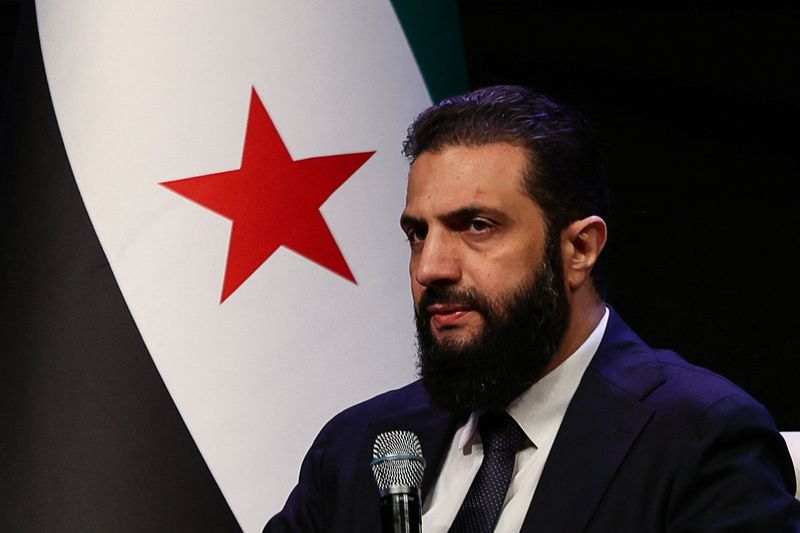
Damascus Dials Discord: Sharaa’s Call to Trump Stirs Shadow Diplomacy
POLICY WIRE — Washington, D.C. — In the opaque ballet of Mideast diplomacy, sometimes the unlikeliest partners perform the most surprising pirouettes. Consider, if you will, the recent news of a...

POLICY WIRE — Washington, D.C. — In the opaque ballet of Mideast diplomacy, sometimes the unlikeliest partners perform the most surprising pirouettes. Consider, if you will, the recent news of a high-level Syrian official — namely, Foreign Minister Faisal Mekdad’s deputy, Bassam al-Sabbagh, representing his superior Dr. Faysal al-Mekdad (sometimes referenced as Sharaa in prior media reports due to ministerial shifts)— reportedly reaching out to a former U.S. president. No, not Jimmy Carter on a peace mission, but Donald Trump. That’s right. A phone call. From Damascus to Mar-a-Lago, disrupting perhaps a round of golf or a cable news segment. And suddenly, what passes for standard international relations just got a good shake.
The Syrian presidency’s casual disclosure, citing Damascus’s current Foreign Minister Dr. Faysal al-Mekdad (who stepped into the role previously held by Walid Muallem) as the orchestrator of contact with Trump— even if channeled through a deputy— reverberates with the sort of deliberate mischief that marks an era of fragmented global power. It’s a classic move: float a controversial idea, watch the world scramble to make sense of it. Because who, exactly, is running the show here? Current White House occupants, or the gravitational pull of a past administration’s informal network?
This wasn’t a formal diplomatic overture through Geneva, mind you. No UN resolutions, no lengthy ambassadorial cables. Just a phone connection, allegedly facilitated by undisclosed intermediaries. The sheer audacity of it all. Syria, largely isolated by Western powers for years, seemed intent on testing the boundaries—or perhaps the lack thereof—of Washington’s foreign policy apparatus. You’ve gotta admit, it’s bold.
“This wasn’t about legitimacy; it was about pragmatism,” contended Dr. Bashar Al-Hafiz, an advisor embedded within Syria’s foreign policy apparatus, speaking off-the-record about the rumored interaction. “Dialogue, even with estranged former adversaries, offers avenues previously considered impassable. Our nation, after all, isn’t afforded the luxury of petulance. When opportunity knocks, you pick up the phone.” He wasn’t wrong. Syria, scarred by conflict, operates on a different set of diplomatic rules, or maybe no rules at all.
The alleged call, if confirmed, throws a wrench into the carefully curated narrative of international isolation that the current Biden administration has attempted to weave around the Syrian government. But it’s also a clear indication of Damascus’s increasingly sophisticated—and desperate—push to find new channels, to perhaps sow discord among its perceived adversaries, and ultimately, to gain any kind of advantage. They’ve been playing this game for years, they know its rules.
And on the American side, the immediate ripples are predictably choppy. The State Department, as expected, maintained a stiff upper lip, confirming no official knowledge of any communication. But the ghost in the machine is hard to ignore. When an ousted U.S. president, still a dominant force in his party and possibly future candidate, receives an alleged call from a sanctioned nation, it sends signals, unintended or otherwise, far beyond official communiqués. What message does it send to allies?
“The diplomatic corps recoiled, of course,” observed Samantha Green, former Assistant Secretary of State for Near Eastern Affairs under the Obama administration. “It’s an overt breach of protocol—an acknowledgment of a shadow channel that undermines current US policy objectives. What message does it send to allies? Or adversaries, for that matter? It’s chaos by design, if you ask me, or at least a highly useful side effect for whoever initiated the call.”
📄 POLICY WIRE WHITEPAPER PUBLISHED: PAKISTAN'S NATIONAL SECURITY POLICY PRIORITIES
👉 READ BY CLICKING HEREIt also reminds many of the complicated geopolitical dances routinely performed across the broader Muslim world. Take Pakistan, for instance. For decades, Islamabad has walked a tightrope, balancing alliances and rivalries, sometimes finding itself in the uncomfortable position of being both a critical ally and a perceived antagonist depending on who’s in the Oval Office. Just like Syria, though in very different circumstances, nations across the region often resort to non-traditional diplomacy when formal avenues seize up. They’ve learned how to innovate under pressure, how to speak out of both sides of their mouth, if necessary.
Because ultimately, this wasn’t just a simple phone call. It was a projection of agency, a declaration that even nations deemed pariahs by one administration might find an audience with another. It plays into a growing global trend where informal channels often wield more influence than the creaking machinery of official statecraft, a kind of geopolitical freelancing.
What This Means
This incident, whether fully confirmed or endlessly speculated upon, bears significant political and economic implications. Politically, it signals Damascus’s unflagging quest for international recognition and leverage, particularly against the backdrop of an ongoing economic crisis that has left the nation struggling. The Syrian conflict, according to a 2018 UN estimate, has cost the nation an astonishing $388 billion in economic losses – a figure that continues to climb. Facing such dire straits, any whisper of a potential shift in U.S. posture—even if unofficial—offers a sliver of hope, however slim, for future investment, trade, or aid.
Economically, the hope in Damascus is likely that such informal outreach might, at the very least, loosen the psychological grip of sanctions or signal to potential investors—say, from allied nations like Russia or even opportunistic Gulf states—that American opposition might not be as ironclad as it appears. If a former U.S. president can pick up the phone, perhaps future U.S. administrations could be less rigid. This kind of speculation alone, that’s enough to generate some ripples. It also serves as a sharp reminder that the tools of foreign policy are no longer confined to foreign ministries. The age of direct access, even for ex-leaders, complicates accountability and transparency, ushering in an era of personalized statecraft that’s messy, unpredictable, and oddly, sometimes highly effective. It’s a brave new world, — and it doesn’t wait for your approval.