


Florida’s Latest Roadside Fiasco: A Public Trust Short Circuit
POLICY WIRE — Tallahassee, FL — The real story isn’t just a misidentification; it’s the sheer velocity of modern digital shaming—a societal verdict rendered by a million scrolling thumbs....

POLICY WIRE — Tallahassee, FL — The real story isn’t just a misidentification; it’s the sheer velocity of modern digital shaming—a societal verdict rendered by a million scrolling thumbs. Not long ago, such roadside blunders faded into local police blotters, but today, they erupt, demanding global attention, exposing raw nerves in the relationship between citizenry and authority.
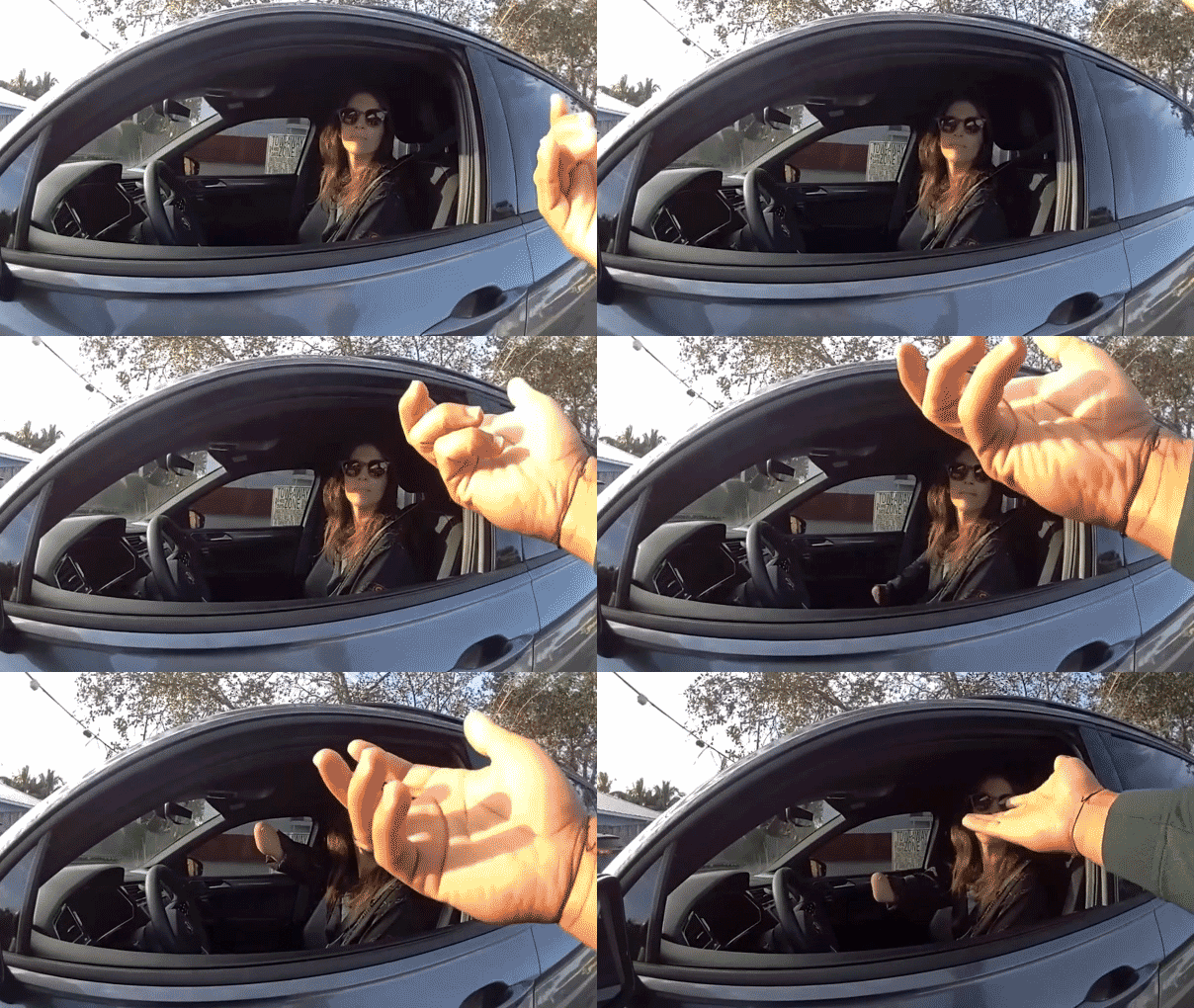
Down in Florida, where sunshine and unusual headlines often merge, a particular traffic stop became another viral testament to this new age of accountability. It started ordinarily enough, an officer approaching a vehicle. But then things swerved hard and fast, caught starkly by the deputy’s own body camera—footage that quickly ricocheted across the digital cosmos.
A Florida deputy, seemingly convinced of his observation, confronted a motorist. His accusation? That the driver was illegally on a cell phone. Problem is, the driver had but one arm, an obvious detail the deputy, for some inexplicable reason, appears to have missed—or maybe dismissed, depending on your cynical outlook. The resulting footage, quickly making the rounds online, showed the deputy repeatedly claiming to see a phone in the driver’s hand, despite visual evidence (and the driver’s vocal explanations) to the contrary. [QUOTE_PLACEHOLDER], the driver pleaded. The situation devolved into what can only be described as a public relations nightmare for the county sheriff’s department.
It’s an incident that doesn’t just raise eyebrows; it blasts open questions about discretion, perception, and implicit bias within law enforcement. We’ve become accustomed to the immediate, unvarnished playback that bodycams afford. And this time, what they showed was a stark mismatch between an officer’s certainty — and an evident reality. That driver, maneuvering their vehicle as best they could, was suddenly under the microscope of an uniformed power-holder, accused of something they physically couldn’t do—at least not in the manner suggested.
But the immediate incident, though jarring, serves as a digital flashpoint for bigger conversations. How do citizens, particularly those with disabilities, navigate daily interactions with state authority, especially when that authority appears to operate on assumptions rather than clear observation? It’s not a uniquely American predicament, mind you. Think about the bustling streets of Karachi or Lahore, where the public, quite often, approaches traffic police with a similar cocktail of trepidation and resignation. They’re often accustomed to arbitrary enforcement, too; it’s just got a different cultural flavor there.
Here, though, in the internet age, the humiliation isn’t confined to a dusty street corner. It’s instantly broadcast, creating a collective gasp that amplifies mistrust. It becomes an instructional video, not for police procedure, but for how rapidly an institution can lose face. According to a 2023 Gallup poll, just 48% of Americans express a great deal or quite a lot of confidence in the police, a figure that’s notably lower than in past decades and demonstrates a persistent public skepticism that these kinds of viral episodes only deepen.
📄 POLICY WIRE WHITEPAPER PUBLISHED: PAKISTAN'S NATIONAL SECURITY POLICY PRIORITIES
👉 READ BY CLICKING HEREAnd so, a local Florida kerfuffle morphs into an international case study. It’s not about policy on using a cell phone while driving, not really. It’s about the underlying mechanics of public trust—the gears grinding, sometimes breaking, under the weight of everyday power dynamics. Because what happened there, on that mundane patch of road, wasn’t just a bad stop. It was a symptom of something bigger, nastier even, brewing in the broader civic conversation.
What This Means
This incident, though seemingly small, packs a punch with considerable political — and social fallout. For local law enforcement, it means yet another struggle to manage public perception in an age where every interaction can become a global spectacle. It’s a public relations crisis wrapped in a bodycam, forcing departments to reckon with officer training on de-escalation, empathy, and disability awareness. The political implication is clear: officials responsible for police oversight will face renewed pressure from advocacy groups and the public to ensure officers are not just well-trained but also contextually aware—capable of discerning basic facts before making accusations.
Economically, such incidents indirectly affect local economies through decreased tourism (who wants to vacation where you might be unfairly stopped?) and decreased community engagement with police initiatives, which impacts everything from crime reporting to public safety campaigns. In the Muslim world, and specifically Pakistan, where social justice and perceptions of fairness are deeply ingrained, this incident—shared widely via social media—can further reinforce existing narratives about Western institutions and their handling of vulnerable populations, contributing to cross-cultural discussions about state authority. These sorts of viral episodes, they just erode confidence, like an invisible oil crisis that’s not about the gas pump, but about trust. It doesn’t help when you’re already fighting a shadow war for Western innovation—and then this happens.
The lesson for policymakers is stark: police professionalism isn’t just about rules and regulations; it’s about common sense and a baseline level of human understanding. And without that, well, you’ve got a viral problem on your hands. A costly one, too. Because ultimately, when public faith wavers, every institution pays the price. You just can’t afford that kind of breakdown.