


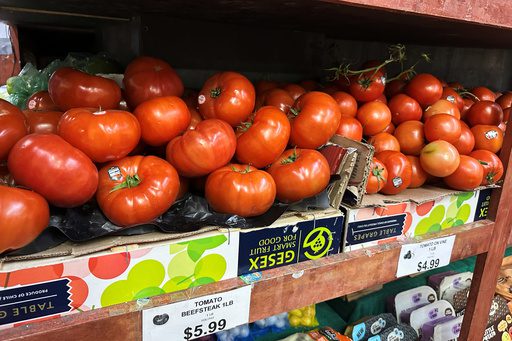
Tomato Turmoil: Red Orbs, Red Flags as Policy Snafus Squeeze Wallets
POLICY WIRE — New York, U.S. — The humble tomato, once a dependable fixture on dinner plates and fast-food trays across America, now arrives with a hefty side of political theater. It’s no longer...

POLICY WIRE — New York, U.S. — The humble tomato, once a dependable fixture on dinner plates and fast-food trays across America, now arrives with a hefty side of political theater. It’s no longer just a fruit (yes, technically a fruit); it’s a symptom. And man, is it a persistent one. For families already juggling increasingly tight budgets, the rising cost of this everyday staple has transformed it into a vivid, often infuriating, symbol of broader economic angst.
It’s not often that an agricultural commodity captures the public’s imagination, or ire, quite like this. But here we’re. This wasn’t some slow burn, either. Tomato prices, you see, have shot up about 40% over the last year, eclipsing almost everything else in the grocery aisle. Compare that to coffee (up 18.5%) or even beef roasts (up 17.8%), — and you start to get the picture. But this isn’t just about breakfast bagels — and barbecues. We’re talking about basic nutrition becoming a luxury.
“The tomato has become a symbol of something much deeper,” remarked Isaac Bernal Carbajo, a New York City chef who’s had a front-row seat to this culinary commotion. He lamented life’s “simplest pleasures” becoming victims of spiraling costs, pointing out that “Something as basic as buying fresh vegetables is starting to become a serious financial decision for many families.” He’s not wrong. Because when a core ingredient in literally hundreds of dishes suddenly costs an arm — and a leg, people notice. It cuts deep.
So, what the heck happened? You’d think good ol’ crop yields are the only factor here, but nope. Experts are pointing fingers, — and some of them land squarely on a former administration’s policy decisions. Specifically, two significant pillars attributed to President Donald Trump’s second-term policies: the Iran war and tariffs. That Mideast entanglement? It spiked gas prices, obviously. Which then cranked up shipping costs for everything. And then there’s the Mexico situation.
Because, fun fact: the U.S. relies on Mexico for most of its tomato supply. And back in July, Washington pulled out of a deal that let duty-free Mexican tomatoes flood—er, I mean, naturally flow—northward. American tomato farmers, naturally, cheered that move, hoping it’d revitalize their industry. For consumers, though, it’s been more of a stomach ache. The full impact wasn’t immediate, but when those Mexican tomatoes finally arrived later in the season, they got slapped with a hefty 17% tariff.
“Tariffs are undeniably a big driver of the price inflation,” Brett Massimino, a business professor from Virginia Commonwealth University, noted. And he’s not mincing words. Because of America’s heavy reliance on its southern neighbor for red, ripe spheres, “any changes in trade policy can have a large impact.” What kind of impact? According to federal data, the U.S. collected a mere $16,424 in tomato tariffs in 2024. This year? It’s skyrocketed to nearly $4.6 million. That’s a staggering 27,879% increase. Just imagine that for a minute. That’s the sort of number that should wake you up at night.
Usha Haley, an economist at Wichita State University, succinctly sums it up as “a perfect storm of trade policy, extreme weather and Mideast policy.” And who pays the price for this perfect storm? Well, everyone. From the bewildered shopper in the produce aisle filming their shock over what they claim are quadrupled prices—some are even swearing off store-bought entirely to plant their own—to the restaurant owners just trying to keep their doors open. Margins in the food industry are always thin, but when an essential ingredient like grape tomatoes leaps 65% in price in just a month (according to MarginEdge, which tracks restaurant costs), it becomes brutal.
Consider Snarf’s Sandwiches, for instance. They slap a slice of tomato into nearly every single sandwich they whip up. Wayne Humphrey, Snarf’s chief operating officer, watches cases of tomatoes jump from $27 to $93 within a year. Piled on top of rising bread — and beef costs, not to mention increased labor expenses. “That single ingredient now costs us more than $1.7 million in additional spend annually,” Humphrey explained. “The math is getting harder to ignore.” And it isn’t just America. Countries far beyond, particularly those like Pakistan in South Asia, where food price stability often underpins political stability, keenly feel the sting of global supply chain disruptions and capricious trade policies. The slight shudder in a Western grocery store can easily become an earthquake in regions reliant on a precarious balance of imports and affordable staples. Pakistan, for instance, frequently navigates volatile food prices driven by factors mirroring this ‘perfect storm’ – adverse weather impacting local yields, import duties, and global commodity price swings exacerbated by international conflicts, which can ignite social unrest with terrifying speed. In places already contending with fragile economies and external pressures, such price hikes aren’t just inconvenient; they’re incendiary.
So, when can we expect some relief from this red menace? Phillip Coles, a supply chain management professor at Lehigh University, offers a glimmer of hope: prices should eventually drop when domestically grown tomatoes hit their peak later in the year. And, as always, higher prices are meant to “induce farmers to increase planting to meet the demand, but this takes longer because of the lead time.” It’s the market working, eventually. But ‘eventually’ doesn’t help families stretch a paycheck today. And, well, politics always seems to muck things up for a bit, doesn’t it?
What This Means
This tomato imbroglio isn’t merely an economic footnote; it’s a political bellwether. The fact that a mundane food item can so clearly illustrate the downstream consequences of intricate policy decisions—tariffs, trade agreements, even regional conflicts—underscores the immediate, visceral connection between global geopolitics and the average household budget. For administrations, this translates to a clear vulnerability: ignoring the ripple effects of international policies on domestic prices invites voter backlash. Food inflation, particularly in staples, hits every demographic and is notoriously difficult for political leaders to spin positively. It strips away perceived economic stability, fostering a narrative of government disconnect — and policy overreach.
Economically, it highlights the delicate dance of trade-offs. Protecting domestic industries through tariffs, while seemingly beneficial to local producers, clearly demonstrates its cost to consumers and, surprisingly, to other domestic businesses reliant on those imports. The elasticity of demand for a staple like tomatoes isn’t huge, so the cost is largely absorbed, impacting disposable income and exacerbating the feeling of an ongoing [QUOTE_PLACEHOLDER] This incident serves as a sharp reminder that trade policy is rarely a zero-sum game, often producing winners and losers across various sectors. For global aspirant nations, grappling with development and food security, these market fluctuations offer stark lessons: over-reliance on a single import source, especially when coupled with unpredictable political landscapes, invites systemic risk. These are the echoes felt across international markets.