


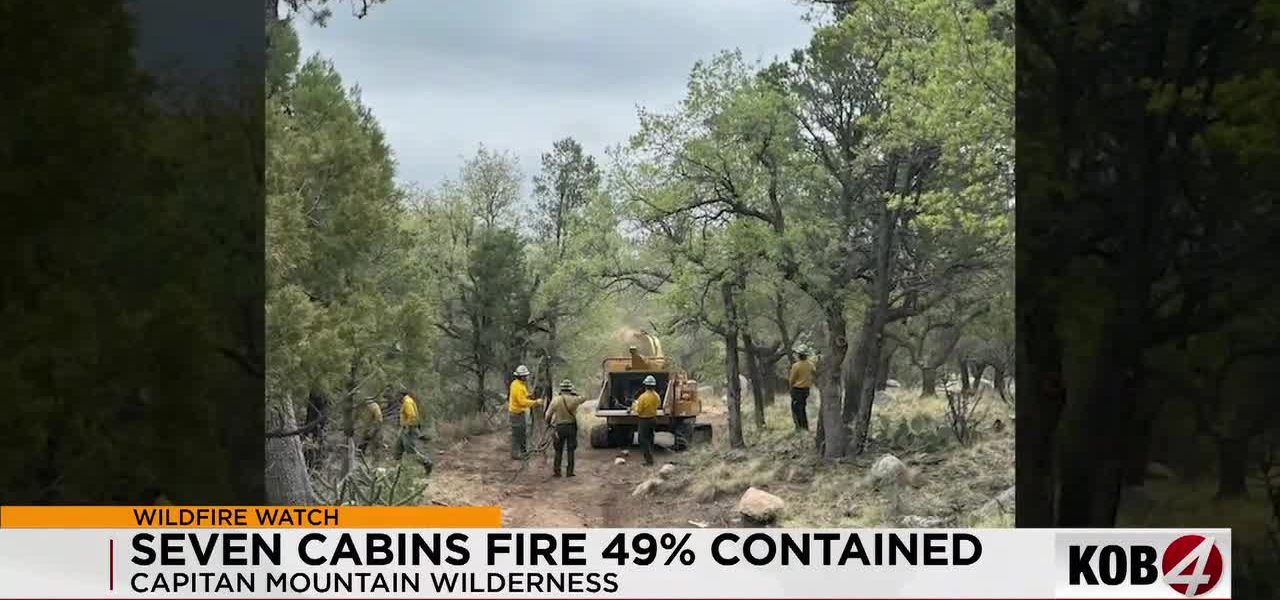
Inferno’s Steady Burn: New Mexico Fire Creeps as Crews Face Arid Future
POLICY WIRE — Washington D.C., USA — It’s a weary, familiar ritual playing out across America’s parched landscapes. While the headlines trumpet containment percentages, the truth is, the war...

POLICY WIRE — Washington D.C., USA — It’s a weary, familiar ritual playing out across America’s parched landscapes. While the headlines trumpet containment percentages, the truth is, the war against nature’s fury — often amplified by human folly — rarely sees a definitive armistice. New Mexico’s Seven Cabins Fire offers just such a theater, with a significant chunk of the conflagration now ‘contained’ but the grim, dry reality still holding dominion over the horizon.
No grand proclamations of victory here, only the measured grind of progress. Firefighters, an anonymous army clad in yellow — and green, have managed to declare 49% of the massive blaze cornered. That figure, provided by KOB.com, signals a hard-won gain, yet it’s a statistic delivered with the cold caveat that [QUOTE_PLACEHOLDER] It’s the constant push-and-pull, isn’t it? A half-step forward, with the ever-present threat of two steps back, all dictated by a capricious sky.
This particular beast, the [QUOTE_PLACEHOLDER] in the Capitan Mountain Wilderness, isn’t some ancient, unavoidable force of nature. It’s got fingerprints. It has consumed [QUOTE_PLACEHOLDER] a stark testament to its ravenous appetite and the vulnerability of the environment. Imagine, an area almost the size of San Francisco — or roughly half of Lahore, Pakistan, to give it some perspective — turned to ash and char. That’s a staggering loss, both ecologically and, for some, personally.
Over a thousand souls, [QUOTE_PLACEHOLDER] to be precise, are still wrestling with this fiery behemoth. They’ve been out there, an endless cycle of grueling shifts, battling against predictable adversaries. Firefighters and aircraft, we’re told, [QUOTE_PLACEHOLDER] And that qualifier, [QUOTE_PLACEHOLDER] well, it speaks volumes about the inherent dangers of this work. They’re nearly done with [QUOTE_PLACEHOLDER] and have [QUOTE_PLACEHOLDER] Small victories, incremental gains, each measured in sweat and exhaustion.
Some of these folks, having fought the good fight for weeks, are already heading home, a temporary respite perhaps before the next blaze calls. But those remaining aren’t getting off easy; [QUOTE_PLACEHOLDER] It’s Mother Nature’s relentless joke, playing cruel tricks. The brief mercy of [QUOTE_PLACEHOLDER] Oh, they always do. It’s almost a rule. Smoke, a constant, acrid companion, [QUOTE_PLACEHOLDER] Just a gentle reminder, then, of the inferno still lurking.
The practical fallout for those on the periphery remains severe. A rather expansive [QUOTE_PLACEHOLDER] And don’t forget Baca campground, because that [QUOTE_PLACEHOLDER] too. A familiar litany of loss. Stage 1 fire restrictions, meanwhile, [QUOTE_PLACEHOLDER] Meaning, no backyard barbecues. Not yet, anyway.
The skies above aren’t just for smoke. A [QUOTE_PLACEHOLDER] which sounds mundane until you consider the potential consequences. Because [QUOTE_PLACEHOLDER] One person’s errant toy, an innocent recreational flight, could literally jeopardize lives and critical firefighting efforts. The modern age, hey? Full of unexpected hazards.
But the biggest worry, for many, is the ever-present anxiety of displacement. [QUOTE_PLACEHOLDER] That means daily, agonizing uncertainty. Currently, [QUOTE_PLACEHOLDER] This state of heightened alert also [QUOTE_PLACEHOLDER] People in these zones aren’t just advised; [QUOTE_PLACEHOLDER] Because they must. And you’ve got to ask, what’s the mental toll of living with a packed bag by the door?
What This Means
This persistent wildfire isn’t just a local natural disaster; it’s a policy canary in the coal mine, echoing challenges felt far beyond New Mexico’s borders. The descriptor [QUOTE_PLACEHOLDER] isn’t just an observation; it’s an indictment, underscoring the pressing need for more effective public awareness campaigns and tougher environmental regulations that prioritize prevention over cure. And there’s a real political calculus here.
Because containing fires like this demands colossal resources—manpower, specialized aircraft, sophisticated logistical coordination. In an era of competing budgetary demands, federal — and state agencies must continually justify these expenditures. Each dollar spent on battling blazes is a dollar not invested in schools, infrastructure, or healthcare, a harsh but unavoidable brutal arithmetic of resource allocation. As these fires become more frequent and intense, particularly in arid regions facing extreme climate shifts, the strain on emergency services grows. What’s the tipping point for these agencies?
Consider the wider, global implications: in Pakistan, for example, which faces its own perennial struggles with natural disasters — from devastating floods driven by glacier melt to scorching heatwaves that also spark fires — the resource dilemma is even more acute. Developing nations often lack the advanced infrastructure — and deep budgets available in places like New Mexico. When their ‘human-caused’ incidents (or climate-accelerated ones) escalate, the political stability and economic output are far more profoundly affected. The allocation of just [QUOTE_PLACEHOLDER] to this one American fire might seem standard here, but it’s an unimaginable surge of skilled labor for emergency services in a much poorer nation grappling with similar—or worse—conditions. These are not merely weather phenomena; they’re political, economic, — and existential threats.