


Cincinnati’s Bold Gambit: Rebuilding the Bengals’ D-Line Amidst Soaring Expectations
POLICY WIRE — Cincinnati, Ohio — They say fortune favors the bold, but in the cutthroat world of professional sports, audacity often just makes for a better headline before an inglorious collapse....

POLICY WIRE — Cincinnati, Ohio — They say fortune favors the bold, but in the cutthroat world of professional sports, audacity often just makes for a better headline before an inglorious collapse. The Cincinnati Bengals, however, are banking on the former, not the latter, as they plunge millions into a calculated gamble—a sweeping overhaul of their defensive line designed to transform their Achilles’ heel into a cudgel. It isn’t just about winning games; it’s about safeguarding a multi-million-dollar investment in a generational quarterback and seizing a fleeting championship window. Because, frankly, waiting isn’t an option anymore when you’ve got Joe Burrow on the payroll.
For years, the story’s been clear: the Bengals had an offense potent enough to melt steel, a true terror for opposing secondaries. But on the other side of the ball, especially in the trenches, it’s often felt like they were sending a knife to a gunfight. And then some. Last season’s dismal performance — where the 2025 Bengals ranked dead last in pass rush win rate at a meager 28.8%, according to ESPN analyst Ben Solak — wasn’t just a statistical blip. It was a glaring vulnerability, a gaping wound that promised to bleed out any Super Bowl aspirations quicker than you could say “sack.” They had to act. But the scope of their action, trading valuable draft capital and shelling out big contracts for a full-scale rebuild, well, that got a lot of folks talking.
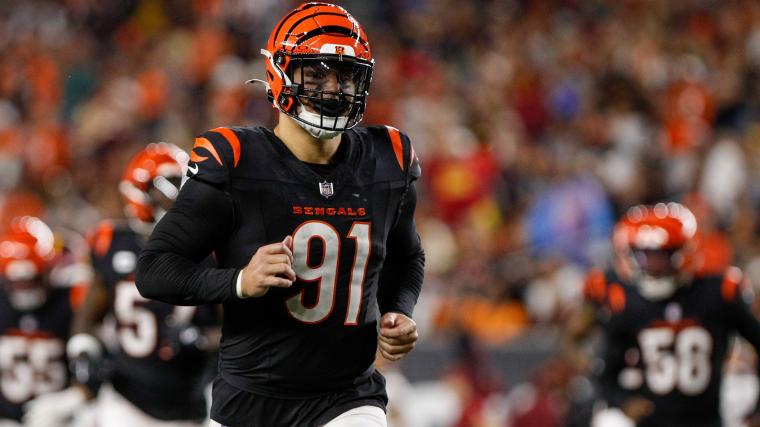
Think of it as a strategic rearmament, not unlike how a nation, eyeing rising regional tensions, suddenly decides its aging military hardware just won’t cut it. Say, a country like Pakistan, constantly calibrating its defensive posture in a volatile neighborhood, would eye new acquisitions and force strategic retirements to optimize its forces for future conflicts. The Bengals, staring down fierce AFC North rivals, made their own creative destruction play. They didn’t just tinker; they brought in Boye Mafe and Jonathan Allen via free agency, and then executed trades to acquire Dexter Lawrence II (for the No. 10 overall pick, no less) — and drafted Cashius Howell in the second round. Simultaneously, stalwarts Trey Hendrickson — and Joseph Ossai were sent packing to Baltimore and New York, respectively.
This wasn’t mere window dressing; it was a deep organizational decision. They weren’t just plugging holes. They’ve built an entirely new wall. And it didn’t come cheap. General Manager Duke Tobin, a man known for his cautious temperament, minced no words behind closed doors when reportedly stating, “Look, we weren’t just playing for wins; we were playing for legacy. And frankly, last year, that D-line was leaving more gaps than a broken fence. We fixed it. Period.” Such bluntness from a typically reserved executive speaks volumes about the internal pressure.
But how do these pieces fit? And can they really go from worst to, if not first, then at least respectable? Because NFL careers are short, quarterback primes are even shorter, and contracts — like Burrow’s — are monumental. This kind of high-stakes chess match demands immediate returns, not promises for a distant future. Even rivals acknowledge the shift. An AFC North scout, speaking off the record, reportedly quipped, “Cincinnati’s moved from contender to — what’s the word? — *intimidator*. They didn’t just tweak the defense; they performed open-heart surgery. It changes the entire AFC North landscape, full stop.”
What This Means
The financial outlay here is substantial, obviously. But the political implication within the locker room — and the organization can’t be overstated. This signals to star quarterback Joe Burrow, whose massive contract ties him to the franchise for the foreseeable future, that the front office isn’t just content to ride his coattails. They’re investing, heavily, in complementing his immense talent. It’s a vote of confidence that bolsters player morale but also significantly raises the stakes for head coach Zac Taylor and his defensive coordinator. You don’t get these kinds of resources, — and this much talent, to then underperform. There’s an unspoken mandate here, a clear directive: win, and win now.
Economically, this sort of high-value player churn impacts not just salaries but also ancillary revenue streams. Stronger teams mean better ticket sales, merchandise revenue, and potentially deeper playoff runs, all translating to bigger coffers. But if this defensive gamble doesn’t pay off? Then the franchise risks being stuck with significant cap liabilities, potentially having traded away valuable draft picks, and staring down a disheartened star quarterback. It’s a boom-or-bust scenario, really. A defining moment for Cincinnati’s trajectory.
It’s all about strategic alignment. You’ve got an elite passer, two top-tier receivers, — and an offensive scheme that can score from anywhere. The glaring disparity was defense. By funneling resources so aggressively into the D-line, they’re attempting to create a synergistic effect—a unit strong enough to get the ball back to the offense more often, faster, and with better field position. Will it work? Only time, and a whole lot of snaps, will tell if this defensive gambit was an act of genius or merely another expensive misstep on the road to gridiron glory. But they sure made their intentions known.