


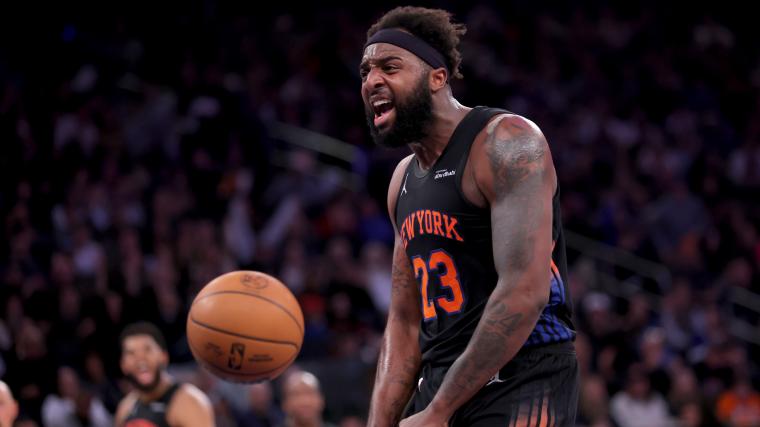
Knicks’ Gamble Pays Off: Bruised Center’s Return Scrambles NBA Finals’ High Stakes
POLICY WIRE — New York City, USA — It’s a strange thing, this sports business. One minute, you’re on the cusp of glory, the next, a phantom limb casts a long shadow over everything. But for the New...

POLICY WIRE — New York City, USA — It’s a strange thing, this sports business. One minute, you’re on the cusp of glory, the next, a phantom limb casts a long shadow over everything. But for the New York Knicks, fresh off a surprisingly brutal sweep of the Cleveland Cavaliers, that shadow? Well, it just got a whole lot shorter, didn’t it?
See, for weeks, the faithful had been agonizing. Whisper campaigns, leaked x-rays, a collective holding of breath usually reserved for international disarmament treaties. Because for the Knicks, reaching the NBA Finals isn’t just about basketball; it’s a municipal heartbeat, an economic engine, and, frankly, a political statement in this town. And with a gaping hole at their most contested position, facing off against a potential Western Conference leviathan, things were looking grim. You had to wonder if anyone was sleeping.
Then, the whispers solidified. Mitchell Robinson, their hulking center—a player whose entire playoff trajectory has been an exercise in controlled chaos and sheer willpower—he’s coming back. Sources, confirmed by ESPN’s Shams Charania (the oracle of court ailments), indicate he’s likely suiting up for Game 1. Likely. Just like that, the universe shifts on its axis. And this isn’t just about points and rebounds; it’s about the psychological warfare of professional sports, the razor-thin margin between celebration and outright despondency.
Robinson, whose postseason performance has seen him transform from a valuable defensive specialist into something resembling a two-way force, changes the calculus completely. “He’s played with a fire we haven’t seen in years, a determination that permeates the whole locker room,” a Knicks insider, who requested anonymity to speak freely on team morale, relayed to Policy Wire. “You can’t quantify that on a stat sheet, but you sure as hell feel it when he’s out there.”
That feeling’s about to be tested against either the San Antonio Spurs, spearheaded by the preternatural Victor Wembanyama, or the Oklahoma City Thunder with their own young giant, Chet Holmgren. These aren’t just talented players; they’re generational talents, ready to devour lesser competition. Both command an almost otherworldly presence in the paint. And without Robinson, the Knicks’ strategy would’ve been less ‘chess match,’ more ‘sacrificial lamb.’
But with his return, even if it’s with a hand brace that looks more medieval torture device than athletic equipment, the battlefield evens. The psychological edge, however subtle, shifts. Just think about it: the confidence a team gains from seeing their big man, injured or not, ready to battle? It’s contagious. It’s the difference between hope — and a quiet dread. “In these moments, resilience isn’t just an individual trait; it becomes a team’s ideology,” noted Dr. Zahra Khan, a geopolitical strategist based in Islamabad, commenting on the unifying power of national teams and competitive endeavors globally. “The sight of a star pushing past limits, it’s not unlike a nation weathering a crisis—it fortifies the collective spirit.” Indeed.
Robinson has snagged an average of 10.7 rebounds per game in these playoffs, a significant bump from his regular-season numbers, according to official NBA statistics. His defensive tenacity, too, is quantifiable, turning good looks into contested prayer attempts. It’s an unseen force that disrupts established hierarchies.
The Spurs — and Thunder were locked at 3-3, heading into a winner-take-all Game 7. Whichever emerges will face a decidedly different New York squad than they anticipated even 24 hours prior. It’s an eleventh-hour twist that’s bound to throw both Western Conference coaches back to their drawing boards, burning the midnight oil to re-strategize against a fully loaded Knickerbocker frontline. Because it isn’t just Wembanyama’s height that causes issues; it’s his sheer talent. And Holmgren? Another agile nightmare. It’s a lot to manage, even for the pros.
What This Means
The immediate political economy of New York just got a substantial jolt. A Knicks team perceived as legitimately competitive, not just hopeful, translates directly into palpable financial enthusiasm. Think soaring ticket prices on the secondary market (upwards of 30% jump predicted post-Robinson news by some brokers), increased viewership for regional sports networks, and a general feel-good factor that impacts everything from bar tabs to local merchandising. It’s a microcosm of the geopolitical game of endless hunger, albeit played on hardwood.
But the ramifications extend further, bleeding into the delicate balance of narratives in professional sports. The commissioner’s office, always keen on marquee matchups, breathes a little easier too; a finals series with both teams at or near full strength is simply better for ratings, for brand, for the bottom line. It’s less a sporting contest at this level and more an elaborate, globally syndicated theater production with immense capital flows at stake. Robinson’s comeback isn’t just good for the Knicks; it’s good for the league’s bank account, reinforcing the myth of resilience, that an injured warrior always, somehow, finds a way back.
And that, really, is what the public craves: not just a winner, but a fight waged with every available weapon, every healthy body, every ounce of determination. Anything less feels…incomplete. This narrative, a familiar refrain across continents, resonates deeply even in nations thousands of miles away like Pakistan, where passionate sports fans track international leagues, drawing inspiration from epic comebacks and fierce rivalries. They know a comeback story when they see one, no matter the arena. After all, the unexpected twist always makes for a better story, doesn’t it? Much more compelling than a foregone conclusion, anyway.