


The Slow Burn: Indonesia’s Two-Decade Mud Hell and the Corporate Echoes
POLICY WIRE — SIDOARJO, Indonesia — The sun beats down on what used to be a bustling, green village. Only now, it’s a shimmering, sulfurous lake of grey sludge. Folks pile onto an...

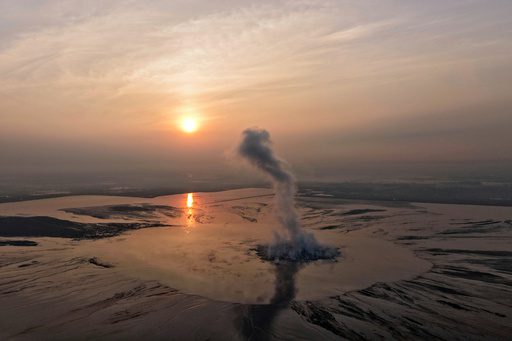
POLICY WIRE — SIDOARJO, Indonesia — The sun beats down on what used to be a bustling, green village. Only now, it’s a shimmering, sulfurous lake of grey sludge. Folks pile onto an ojék, a motorcycle taxi, for a rather unique tour. The driver, Sastro—fifty-five years old, weathered, but with eyes that have seen far too much—points toward the constantly billowing plumes. “Over there,” he murmurs, his voice a low rasp against the engine’s hum, “that’s where my house stood. My whole life.”
Twenty years have passed since the ground first split open in East Java, belching forth what became known simply as Lusi—the Lapindo mud volcano. This isn’t some ancient geological marvel, mind you. This is a human-made disaster, an enduring, ugly scar across the landscape and the collective psyche, an inescapable monument to industrial hubris and the lingering stench of impunity. It’s a wound that just won’t close.
Because today, two decades after the initial gush on May 29, 2006, Sastro and his displaced community aren’t just marking an anniversary; they’re still picking through the emotional and economic debris of what was and what will never be again. What began as a gas exploration misadventure by local mining company PT Lapindo Brantas mutated into Indonesia’s largest, most persistent industrial catastrophe. Initial governmental statements, quickly proven wrong by scientific consensus, insisted on natural causes. But pretty much everyone knows the drill: this wasn’t God’s work.
The mud swallowed everything. Factories, rice paddies, entire neighborhoods—all gone. Fourteen lives were snatched away directly, a stark number but one that hardly encapsulates the sheer depth of misery. Tens of thousands more were ripped from their ancestral lands, forced to build new lives elsewhere. They lost homes, jobs, graves. They lost a sense of belonging, — and you can’t put a price tag on that. More than 1,100 hectares—an area larger than 2,700 football fields—remain submerged beneath the simmering sludge, according to Indonesian Environment Ministry figures.
Sastro, once a factory worker, now chauffeurs visitors through this bizarre, boiling wasteland. It’s his new reality. He makes a living by guiding tourists to the place where his old life died. That’s the subtle, horrifying irony, isn’t it? The disaster has become its own warped attraction. “As far as I can tell, things have been really tough ever since the Lapindo incident,” he recently remarked, summing up two decades of unending struggle with characteristic Indonesian understatement.
Back then, promises were made. “While some might speculate on natural occurrences, we’ve always pressed for absolute corporate responsibility,” former President Susilo Bambang Yudhoyono stated, albeit years after the fact, reflecting an official position aimed at damage control and a semblance of justice. His administration did indeed order Lapindo Brantas to shell out over $400 million in compensation — and aid. But Lapindo’s contribution? A fraction. The bulk eventually fell to the Indonesian government, a bitter pill for taxpayers.
But the money—what little many received—doesn’t erase the consequences. Lucky Wahyu Wardana, from the Indonesian Forum for Living Environment (WALHI) in East Java, doesn’t mince words. “It’s not just the land that’s gone; it’s the very soul of these communities. Generations—they’ve lost their roots, their history. This tragedy—it screams a brutal warning against selling our future to extractive greed,” he lamented, pointing to ongoing health issues and legal limbo. This story isn’t just about East Java. It’s a grim echo across the wider Muslim world and other developing nations, from Balochistan’s contentious gas fields to Nigeria’s oil-stained delta, where communities often shoulder the toxic brunt of unchecked resource extraction, leaving a lasting trail of despair for paltry returns. And you see it everywhere.
What This Means
The Lapindo tragedy isn’t just a local issue; it’s a potent, bubbling symbol of accountability failure at multiple levels. Politically, it showcases the immense pressure governments face from powerful extractive industries and the difficult dance between economic development and environmental protection. For decades, Indonesian governments have favored resource exploitation, often sidelining environmental oversight for short-term gains. This disaster demonstrates that the long-term societal and ecological costs of such decisions aren’t borne by boardrooms, but by ordinary folks like Sastro. The protracted legal battles, the shifting blame, the inadequate compensation—they’ve eroded public trust and reinforced a cynicism about official promises.
Economically, Lusi serves as a stark reminder that extractive industries carry an immense, sometimes immeasurable, risk. The notion that such projects always benefit the local economy often overlooks the deep, persistent structural damage they can inflict. What economic benefits Lapindo Brantas might have promised for the region pale in comparison to the billions lost in property, productivity, and human potential over two decades. This enduring scar should inform national policy, pushing Jakarta to prioritize rigorous environmental impact assessments and implement stronger corporate liability laws. Otherwise, other communities, not just in Indonesia but across the entire Asia-Pacific, might find themselves facing their own version of a mud-filled eternity. The price, as Sastro’s weary gaze attests, is just too high.