


Digital Dustup: Old Mine Catastrophe Resurfaces as ‘Current Event’ in Social Media’s Hall of Mirrors
POLICY WIRE — Washington, D.C. — The internet, bless its algorithmic heart, recently decided to pull a vintage tragedy from the digital archives and rebrand it as breaking news. Folks on various...

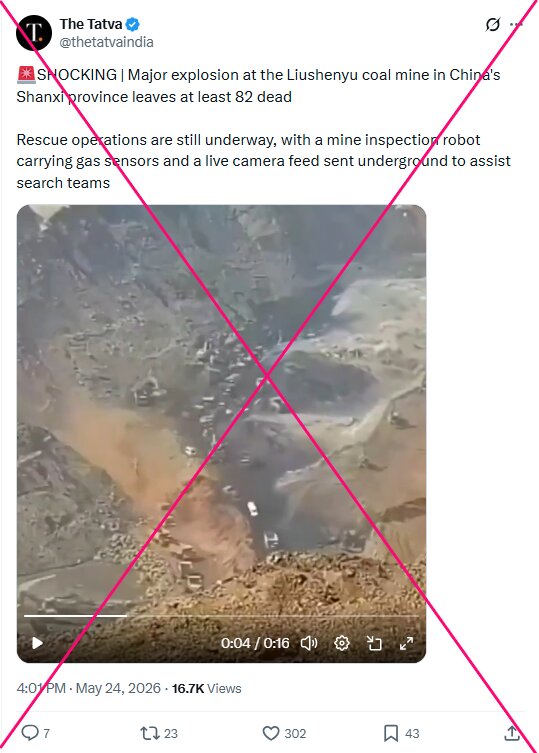
POLICY WIRE — Washington, D.C. — The internet, bless its algorithmic heart, recently decided to pull a vintage tragedy from the digital archives and rebrand it as breaking news. Folks on various social platforms have been sharing stark, often chilling, visuals of a mine collapse, labeling them as a fresh calamity striking somewhere in China. Only, the dirt — no pun intended — on these pictures is, well, old. Really old, in internet terms, tracing back to a devastating incident years ago. And what a tangled web we weave when we start believing everything a thumbnail promises.
It’s a curious thing, this modern-day archaeological dig for content. Someone, somewhere, probably stumbled upon these gut-wrenching images from a 2019 opencast mine collapse in Inner Mongolia. Or perhaps they were fed to them by an engagement-hungry bot. Either way, a narrative was stitched together—loose threads, of course—and pushed into the wild. And, because the digital highway is more akin to a wildfire than a carefully curated gallery, it spread like, well, you know. News travels fast; truth often has to catch a bus.
“The velocity of misinformation now regularly outstrips any credible effort to debunk it,” stated Dr. Lena Khan, a senior analyst at the Global Internet Policy Forum, speaking with characteristic bluntness. “It’s a race against virality, — and virality usually wins. Platforms aren’t built for truth; they’re built for traffic.” It’s a sobering thought, particularly when these fabricated narratives get picked up and weaponized. The implications aren’t just about making people feel unnecessarily sad; they can shift entire geopolitical conversations.
Think about it: in a world already on edge, an alleged major disaster in a nation like China, especially without immediate official confirmation, breeds suspicion. It feeds into the existing information vacuums that bad actors just love to exploit. But here’s the kicker: this isn’t an isolated incident. Not by a long shot. These recycled horrors—whether from floods, earthquakes, or mining accidents—get repackaged with startling regularity, often stripped of their context, or worse, given a new, malicious one. Just look at how often visuals from Syrian conflict zones get recycled for skirmishes half a world away.
Because, really, when you’re scrolling on your phone, do you stop to cross-reference every dramatic post? Most of us don’t. We’re too busy, or perhaps too accustomed to the deluge of hyperbole. This particular resurfacing of China’s mining woes serves as a potent reminder of the inherent frailty of digital truth in our ‘always-on’ age. The very algorithms designed to connect us can, — and often do, disfigure reality itself. It’s not just a flaw; it’s practically a design feature now, isn’t it?
Elias Siddiqui, a former diplomat specializing in South Asian affairs, didn’t pull any punches either. “Such distortions aren’t innocent mistakes; they frequently serve a narrative, sowing distrust or fanning the flames of existing grievances,” he observed, pointing to the delicate geopolitical balance. “In regions like Pakistan or other parts of the Muslim world, where global events, especially those involving major powers like China, are consumed with a specific lens—sometimes distrustful, sometimes deferential—these digital distortions can easily exacerbate existing tensions or be manipulated for political gain. It’s an easy way to paint a picture, whether true or not, that aligns with a certain worldview.” The line between legitimate news and orchestrated propaganda gets blurrier with every shared ‘shocking’ video.
And consider the sheer scale of the problem. A 2023 study by Pew Research Center found that 58% of Americans have little or no trust in national news media. Imagine what that number looks like when applied to the vast, unregulated expanse of social media platforms. It’s a gaping wound in our collective civic understanding, one where old wounds from distant lands are reopened and passed off as current affairs, usually without consequence for the perpetrator. Nobody’s really accountable, are they? Just like a ghost in the machine. Or like when you read about shadow economies on prediction markets, it’s all about leveraging perception.
What This Means
The deceptive recirculation of outdated tragedy isn’t just an inconvenience; it’s a persistent, nagging threat to informed public discourse and, by extension, global stability. Economically, this erosion of trust could impact trade, investment, — and international relations. False alarms about industrial accidents, for instance, might cause knee-jerk market reactions before facts have time to develop. Geopolitically, it creates a fertile ground for narrative warfare. State-sponsored or even freelance disinformation campaigns regularly use this tactic to manipulate public opinion, undermine rival governments, or even incite unrest.
The digital commons—it’s supposed to be a place of shared knowledge. Instead, it frequently feels like a Wild West town, with everyone hawking their own patent snake oil as a cure-all, or worse, as fact. Governments, media organizations, — and individual citizens each bear some responsibility for navigating this terrain. But ultimately, unless the platforms themselves get serious about algorithmic accountability—and frankly, they haven’t shown much zeal for it yet—we’re likely to see yesterday’s bad news repackaged and sold as today’s headline again and again. It’s an open season for confusion, a stark reminder that what you see online might just be history pretending to be news. What a world, eh?