
The Boss’s Ultimatum: Springsteen Channels Political Fury into Midterm Call to Arms
WASHINGTON D.C. — The Boss wasn’t mincing words the other night. From a Washington stage, bathed in stadium lights, Bruce Springsteen launched a broadside against the current administration,...

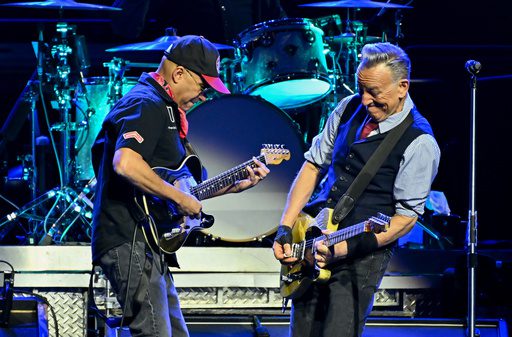
WASHINGTON D.C. — The Boss wasn’t mincing words the other night. From a Washington stage, bathed in stadium lights, Bruce Springsteen launched a broadside against the current administration, echoing a sentiment that seems to be hardening in concert venues and across political divides. It wasn’t just a concert; it was an declaration of war—a cultural one, anyway—complete with a multi-artist mobilization designed to shake things up just a month before the midterm elections.
You could’ve felt the charged air even from across the Potomac. Springsteen, alongside Rage Against the Machine’s Tom Morello, turned a Nationals Park performance into a veritable political rally. They weren’t just playing guitars; they were beating the drum for an entire movement, throwing down the gauntlet for a planned festival meant to rouse the populace. It’s a gamble, maybe, betting on rock — and roll to deliver voters. But it’s a strategy we’ve seen artists employ for decades.
And it seems Springsteen has, frankly, had enough. He pulled out the deep cuts Wednesday—songs like “American Skin (41 Shots)”—tunes that speak to systemic injustices. He played “Streets of Minneapolis,” too, a mournful nod to the deaths of Renée Good — and Alex Pretti. It ain’t subtle, this messaging, is it? Then came the rhetoric, sharp — and to the point: [QUOTE_PLACEHOLDER] Strong words. You don’t hear that every day from a rock icon who’s usually content letting his music do the talking.
He hammered the point home: [QUOTE_PLACEHOLDER] You could almost feel the weight of expectation on the audience, on every citizen. But then, doesn’t it always boil down to that? Political fate, decided by the collective will. “So join us and let’s fight for the America that we love. Do you hear me, Washington?” The question hung heavy, loaded with implication, undoubtedly aimed straight at 1600 Pennsylvania Avenue.
The plan is concrete: a one-day, two-stage shindig—the Power to the People festival, set for October 3 at Merriweather Post Pavilion in Columbia, Maryland. It’s being hyped as an ode to “freedom, justice, equality and rock ’n’ roll.” Foo Fighters, Dave Matthews, Brittany Howard, and Joan Baez are all onboard, names that still carry cultural currency. A portion of ticket sales will funnel into organizations like VoteRiders — and HeadCount. That’s practical, I guess—more than just noise, it’s aimed at putting boots on the ground, so to speak.
Morello weighed in, not with the fiery rhetoric, but a more philosophical take. He suggested, [QUOTE_PLACEHOLDER] Which sounds noble, doesn’t it? An incredible lineup, he promised, coming to the D.C. area for “a day that celebrates the spirit of activism, creativity, and hope.” Other acts like Dropkick Murphys, Jack Black, Serj Tankian, Killer Mike, Taylor Momsen and the Linda Lindas are set to join. That’s quite the eclectic mix; they’re casting a wide net, trying to catch anyone who’s listening.
And, let’s be real, Springsteen’s animosity towards President Donald Trump isn’t new. He’s been a consistent critic, a steady voice of opposition. Trump, never one to back down, had previously called for a boycott of Springsteen’s shows, dubbing him “a total loser who spews hate.” The feeling, as it turns out, is decidedly mutual. At the concert, Springsteen led the crowd in an “ICE out!” chant, a deliberate call to action, explicitly encouraging the audience to ensure their dissent reached all the way to the White House.
This isn’t just political theater; it’s a direct assault on the perceived corrosion of democratic norms. Springsteen didn’t sugarcoat it. “Our democracy, our constitution, our rule of law are being challenged right now as never before by a reckless, racist, incompetent, treasonous president and his ship of fools administration,” he declared. Such language—incendiary, unvarnished—certainly grabs attention. He wrapped up his fiery preamble with a benediction, almost, for those whose stories he’d highlighted: [QUOTE_PLACEHOLDER] Then he played “Chimes of Freedom.”
📄 POLICY WIRE WHITEPAPER PUBLISHED: PAKISTAN'S NATIONAL SECURITY POLICY PRIORITIES
👉 READ BY CLICKING HEREIn the broader global landscape, particularly in regions like South Asia, this type of celebrity-driven political mobilization probably looks, well, a little different. Take Pakistan, for instance, where the lines between music, art, and direct political action are often blurrier, and sometimes, the stakes are considerably higher. Artists there might express dissent, sure, but often with a far more immediate risk to personal liberty or even safety. It’s a context that makes Springsteen’s stage pronouncements feel both powerful within their American sphere and, simultaneously, a testament to a certain kind of political freedom not universally enjoyed. Because when you’re speaking out in Islamabad, the ramifications for an artist can easily go beyond a Twitter feud with a sitting president. It’s a nuanced dance, the one between art — and power, playing out globally in wildly disparate ways.
Statistically speaking, this isn’t just about sound — and fury. Voter engagement in midterm elections historically lags significantly behind presidential years. According to data compiled by the U.S. Elections Project, the 2018 midterm saw a 53% turnout among eligible voters—a respectable figure, and the highest in decades—but still a long way from general election participation. That’s a gap artists like Springsteen — and Morello aim to close. They aren’t just selling concert tickets; they’re trying to sell political participation. Whether they can actually move the needle on those numbers is the question. Money from events like this is key to getting organizations like VoteRiders and HeadCount—groups focused squarely on getting people registered and to the polls—the resources they need.
What This Means
This festival, spearheaded by figures as culturally significant as Springsteen, transcends mere entertainment; it’s a strategic maneuver designed to leverage celebrity capital for explicit political ends. Politically, it signals a consolidation of opposition forces within the entertainment industry, using their platforms to actively campaign against the incumbent administration and for a particular slate of candidates in the upcoming midterms. It’s not just endorsing; it’s *activating*. For a political party trying to energize its base, especially younger or less consistent voters, a rock festival offering both entertainment and a clear call to action can be far more effective than traditional stump speeches. The aim isn’t just to entertain; it’s to transform passive frustration into tangible electoral results.
Economically, the festival presents an interesting model of political fundraising. While the direct ticket sales benefit specific voter engagement organizations, the broader impact lies in the potential for significant media coverage and public discourse. This amplified message—cost-free for the political factions it favors—becomes an invaluable commodity. the very act of bringing together such an array of artists creates a powerful symbolic capital, presenting a unified cultural front against the administration. This isn’t about profit, really; it’s about political leverage. And don’t forget the implied boycotts or support of artists. That kind of pressure—even if only moral or cultural—can impact how some consumers spend their money, perhaps bolstering brands seen as aligned with the festival’s message, while subtly penalizing others.
For the political landscape, particularly as it pertains to upcoming elections, such events are an attempt to define the stakes beyond policy debates. They frame the election as a battle for the country’s soul, a fight for [QUOTE_PLACEHOLDER] This narrative, delivered through the powerful medium of music and live performance, bypasses traditional political media filters and directly taps into an emotional wellspring, a potentially potent catalyst for voter turnout. It suggests that, for many, the future of the nation feels like it hangs in the balance, and even The Boss himself thinks it’s worth taking to the stage—and calling out names—to ensure their preferred outcome. It’s high stakes, isn’t it?