


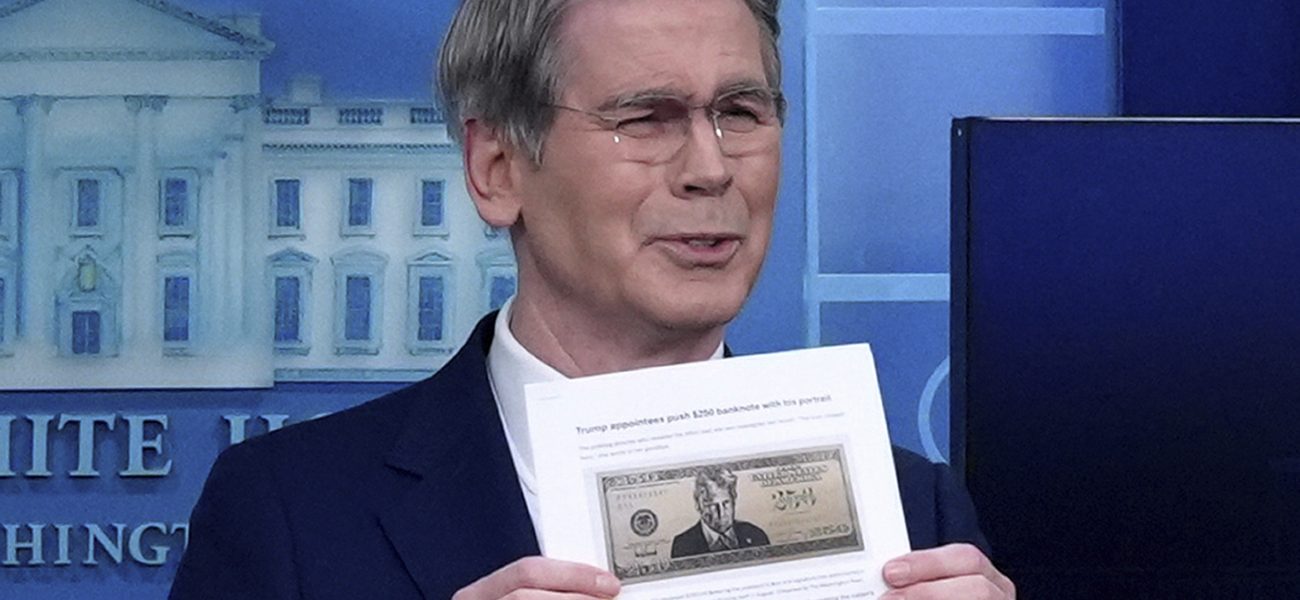
Inflationary Echoes? Treasury’s Quiet Nod to a Trump $250 Bill Stirs Monetary Pot
POLICY WIRE — Washington D.C., USA — Just when you thought the fiscal conversations couldn’t get any stranger, along comes the faint echo of a new, eyebrow-raising denomination. Forget your Ben...

POLICY WIRE — Washington D.C., USA — Just when you thought the fiscal conversations couldn’t get any stranger, along comes the faint echo of a new, eyebrow-raising denomination. Forget your Ben Franklins or even your seldom-seen Grover Clevelands. The U.S. Treasury, through Secretary Bessent, has reportedly given a quiet, almost reluctant nod to the theoretical exploration—the very earliest whispers, mind you—of a $250 bill potentially featuring none other than former President Donald J. Trump.
It’s a peculiar twist in the annals of American currency, one that feels less like prudent fiscal planning and more like a fever dream hatched in some particularly niche corners of the internet. For decades, our paper money has stuck to familiar faces — and manageable denominations. Now, with a wave of inflationary pressure pushing everything from groceries to gasoline higher, the very idea of a $250 bill, never mind its potential occupant, feels strangely symptomatic. It makes you wonder, doesn’t it?
Secretary Bessent, speaking off the cuff to a select group of financial reporters (and not looking entirely thrilled about it, one might add), seemed to walk a tightrope. She conceded that ‘exploring options to optimize our currency framework’ was an ongoing task for the Treasury. ‘Look, we’re just kicking the tires on this, aren’t we?’ she said, a faint smile playing on her lips. ‘It’s about evolving our monetary landscape, making sure our bills reflect… well, different economic realities. It’s not like we’re printing them tomorrow.’ Her team was quick to add context, describing the ‘exploratory discussions’ as hypothetical and largely procedural, divorced from any specific political figure.
But political figures, as always, rarely stay out of the money game. The notion immediately ignited a predictable firestorm across the political spectrum. Critics pounced. Senator Rebecca Goldstein (D-NY), a vocal proponent of fiscal restraint and a perennial thorn in the side of anyone seen to be ‘playing politics’ with national symbols, didn’t hold back. ‘It’s nothing short of a cheap trick,’ Goldstein snapped during a floor interview, ‘a brazen attempt to politicize the very fabric of our national economy for purely partisan ends. Our currency isn’t some campaign poster, it’s a statement of our shared values—and a former president facing numerous indictments doesn’t exactly embody those values to a majority of Americans.’
Indeed, American currency has largely been static since 1969, when denominations greater than $100 were phased out. Before then, we had $500, $1,000, $5,000, — and even $10,000 bills, but their utility faded. The question now isn’t just about the *face* on the bill, it’s the very *value* of such a denomination in a digitally advancing economy. Is it a practical measure, or an elaborate—if quiet—political stunt in the making? Perhaps both. Because in Washington, everything’s a little bit of both, isn’t it?
📄 POLICY WIRE WHITEPAPER PUBLISHED: PAKISTAN'S NATIONAL SECURITY POLICY PRIORITIES
👉 READ BY CLICKING HEREAnd what of the global implications? Nations like Pakistan, wrestling with their own formidable currency crises and often relying on the dollar as a bulwark against instability, watch these sorts of developments with keen interest—and perhaps a touch of bewildered amusement. While they grapple with their rupee’s volatility, struggling to maintain basic financial trust, America debates a $250 note featuring a controversial figure. The symbolism of currency, of national identity on a bill, is something they know well, but its trivialization, however subtle, can erode the very confidence others place in the greenback. The U.S. dollar, after all, accounts for a staggering 88% of all foreign exchange trades, according to the Bank for International Settlements’ 2022 survey, reflecting its perceived stability and prestige.
But how stable can that perception remain when monetary decisions flirt with pure political theater? It raises questions not just for Wall Street, but for the world’s bourses.
What This Means
The murmurs surrounding a potential $250 bill—and the deeply divisive figure tied to its rumored conceptualization—signals more than just a bureaucratic blip. Economically, such a denomination might seem like an answer to prolonged inflation, reflecting a de facto devaluation where more units are needed for transactions. But it’s also a highly unusual step, disrupting established monetary norms without a clear, overwhelming functional need for a quarter-grand note in an era of digital transactions. Politically, this discussion is loaded. It’s an unmistakable nod to a specific segment of the electorate, risking the further politicization of institutions meant to embody national unity, not partisan fealty. It implies a strategic gamble, a push to enshrine a political figure on federal tender, perhaps as a psychological benchmark for their supporters or a defiant statement against critics. Such moves invariably fuel domestic cultural wars and, arguably more significantly, may subtly—or not so subtly—chip away at the perception of the dollar’s unimpeachable, apolitical standing on the global stage. Nations that routinely deal in symbols of luxury and prestige in their own trade might start wondering if the U.S. is trading stability for spectacle. This isn’t just about printing money; it’s about printing a statement, for better or worse.