


Trump’s Midterm Map Meddling Hits Hard Wall in States
POLICY WIRE — COLUMBIA, S.C. — Imagine attempting to halt an election already underway. Picture thousands of citizens casting ballots, their democratic participation a quiet hum across a state, when...

POLICY WIRE — COLUMBIA, S.C. — Imagine attempting to halt an election already underway. Picture thousands of citizens casting ballots, their democratic participation a quiet hum across a state, when suddenly, a political firestorm erupts, threatening to erase their votes. That’s the rather bold — some might say brassy — move we saw play out in South Carolina recently. Because, sometimes, even the most formidable political ambitions collide with the stark, unyielding reality of process.
It was Tuesday, — and the state’s primaries were already rolling. People were doing their civic duty. Yet, a coordinated, high-stakes gambit by Republicans, strongly nudged along by former President Donald Trump himself, sought to jettison those ballots. Their plan? Scrap the existing congressional primary results, then schedule a new one. All of this to accommodate revised electoral districts engineered, quite plainly, to help the GOP solidify its hold in the upcoming midterms. South Carolina’s senators, however, wouldn’t play ball.
Many lawmakers weren’t just reluctant; they flat-out called it too late. Republican state Senator Richard Cash, not mincing words, put it this way: [QUOTE_PLACEHOLDER] It’s a sentiment that echoes a growing fatigue with what critics dub electoral contortionism, a game where districts morph faster than a politician’s principles. More than 55,000 ballots, for example, had already been cast on that primary day in South Carolina, a concrete marker of ongoing democracy.
But the Palmetto State’s rebuff wasn’t an isolated incident. It was part of a broader, more intricate dance unfolding across America – a frenetic, often messy effort to redraw electoral boundaries to partisan advantage. This strategy, undoubtedly catalyzed by Trump, aims to protect a slim House majority. The playbook leans heavily on a recent Supreme Court ruling that, many argue, diminished minority protections under federal voting rights legislation. And you can bet both sides are pushing hard.
Alabama delivered another jolt to Republican hopes on the same day. A three-judge federal panel didn’t just delay things; it issued a preliminary injunction, effectively blocking the state’s proposed Republican-drawn map. The court’s blunt assessment? The plan “intentionally discriminated based on race” by limiting Black-majority districts to just one. The judges then mandated the continued use of a court-imposed map featuring two districts with a significant Black population. Attorney General Steve Marshall, a Republican, naturally promised an immediate appeal, convinced of eventual triumph. Well, we’ll see, won’t we?
Not all the news was bleak for the GOP, though. They bagged some victories in other lower courts. Florida, for instance, saw a state judge decline to block new congressional districts passed by the Republican-led Legislature. Those new maps could mean as many as four additional seats for Republicans. Voting rights groups, which had challenged the map for alleged political intent violating Florida’s Constitution, are already appealing. Then there’s Tennessee. A federal court there sidestepped issuing a temporary restraining order against a new map accused of racial discrimination – a map that carves up a majority-Black district in Memphis, thus improving Republican odds for grabbing the state’s sole Democratic-held seat.
This redistricting saga, a ten-month slugfest, usually happens once a decade after the census. But Trump’s been urging states to revisit their maps now, as a counter-punch to the usual midterm headwinds that tend to cost the sitting president’s party seats. Republican strongholds like Missouri, North Carolina, Ohio, Florida, and Tennessee have already adopted new districts since Trump first goaded Texas last summer. They’re eyeing as many as 14 new seats from these changes; maybe even 15 if Alabama eventually goes their way. And it’s a tight race, isn’t it? Meanwhile, Democrats believe new, voter-approved maps in California could net them five extra seats, plus another from a court-imposed map in Utah. It’s a perpetual back-and-forth, each side striving for every single advantage.
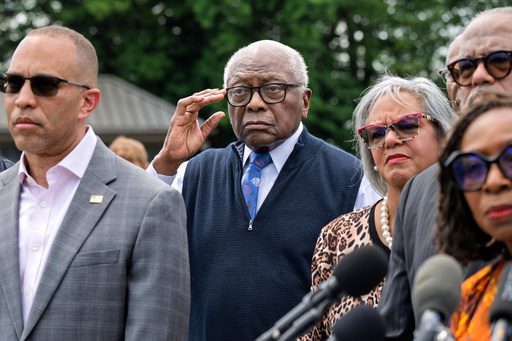
Representative Jim Clyburn, the Democrat whose district was a specific target in South Carolina, wasn’t about to back down. After casting his own early ballot, Clyburn remained defiant. “I’m OK if it’s Trump plus 20,” he declared, discussing the potential Republican tilt of a redrawn district. “I would be running where I live.” The Republican-led House in South Carolina had, in fact, passed a plan to reconfigure his district and void existing primary results. Trump had even personally phoned state Senate Majority Leader Shane Massey more than once, applying pressure to GOP senators.
Clyburn highlighted how different this current scramble felt. When maps were last redrawn after the 2020 census, he said, lawmakers spent months holding public meetings across the state. Though that process resulted in a 6-1 Republican advantage, Clyburn deemed it [QUOTE_PLACEHOLDER] His observation on the current national push was stinging: “When the map was challenged, the U.S. Supreme Court said, yes, this is constitutional. But now, this White House says, to hell with the process, to hell with the Constitution, just do what we want done.” The resistance, interestingly, came not just from Democrats, but also from some GOP senators wary of a backlash if aggressive redistricting inadvertently made their own seats vulnerable.
What This Means
This saga isn’t just about lines on a map; it’s a microcosm of the intense ideological trench warfare defining modern American politics. For starters, it clearly signals the limits of presidential influence on state-level legislative action, even for someone as potent as Donald Trump. He can cajole, he can harangue on social media, but ultimately, local politicians often heed their constituents and immediate political risks first. It’s a reminder that America’s federalist system, however unwieldy, often acts as a bulwark against centralized control, for better or worse.
Economically, this sort of electoral volatility breeds uncertainty. Corporations planning long-term investments in various districts are forced to contend with an unstable political landscape that could shift tax policy, regulatory frameworks, and labor laws dramatically with each election. A constantly redrawn map means a constantly renegotiated social contract, hindering steady economic growth that thrives on predictability. From a geopolitical lens, these domestic squabbles over fairness and representation don’t project an image of stability abroad. For burgeoning democracies, particularly in places like the Muslim world or South Asia, where electoral processes are frequently tested by ethnic or sectarian divides, America’s very public struggles with gerrymandering offer a rather concerning template. And for countries where faith in democratic institutions is fragile, such blatant partisan manipulation of voting boundaries only confirms cynicism, possibly emboldening non-democratic actors. It’s hardly the model of democratic robustness one would hope to project globally.
The core implication is a continued erosion of faith in the democratic process itself. When elections are perceived as rigged from the outset by how districts are drawn, voter apathy or radicalization inevitably follow. Both are bad news for any nation seeking sustained, equitable governance. The legal battles aren’t over. Not by a long shot. These court decisions are mere skirmishes in a protracted war over who gets to draw the lines, and, ultimately, who gets to wield power.