


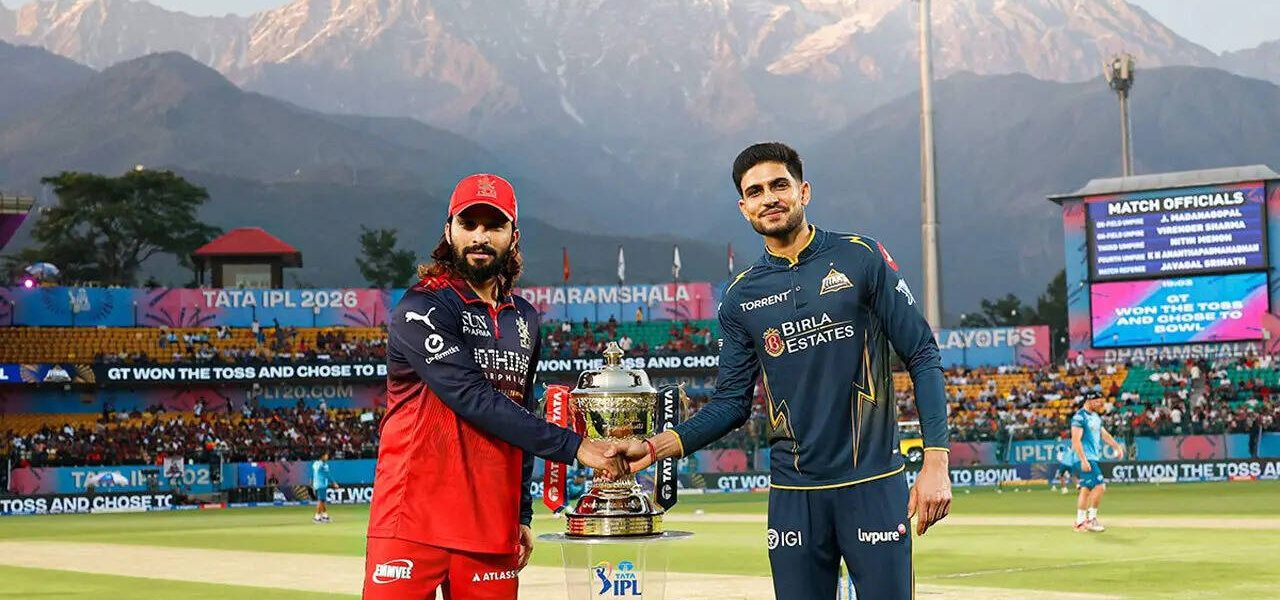
Dharamsala’s Quiet Hills Brace for IPL’s Commercial Fury as GT Seizes Initiative
POLICY WIRE — Dharamsala, India — Beneath the tranquil gaze of the Dhauladhar mountains, where Himalayan foothills whisper ancient tales, a modern gladiatorial contest quietly gears up. It’s...

POLICY WIRE — Dharamsala, India — Beneath the tranquil gaze of the Dhauladhar mountains, where Himalayan foothills whisper ancient tales, a modern gladiatorial contest quietly gears up. It’s not a border skirmish, nor a diplomatic pow-wow. It’s Qualifier 1 of the Indian Premier League’s 2026 season—a crucible of commerce, raw athleticism, and tactical brinkmanship—set in the picturesque Himachal Pradesh Cricket Association Stadium. This isn’t just about bat on ball; it’s about the relentless machinery of sports entertainment, where decisions made on a manicured patch of grass reverberate through digital economies and national psyches.
Gujarat Titans, helmed by the ostensibly cool-headed Shubman Gill, drew first blood in the psychological skirmish on Tuesday. He chose to field first, a move that typically sends pundits into paroxysms of armchair analysis. And he didn’t just stop there. Gill made a singular tweak to his starting XI, ushering in Kulwant Khejroliya at the expense of Arshad Khan. Because every minor adjustment, every calculated roll of the dice, can translate into millions of dollars or, just as significantly, collective elation or despair for a fan base that often seems more engaged than the electorate itself. [QUOTE_PLACEHOLDER]
Gill, sounding almost philosophical amidst the stadium roar, articulated his reasoning with a matter-of-fact certainty, a common trait in those entrusted with leadership. We’re gonna bowl first. It looks like a good wicket, you know, but we have seen and in this ground particularly, there’s a bit of dew in the second inning, so it’s always good to have a total on the board and a big win and then try to chase it down. I think, this match is all about taking the equation out of the game. We have been playing some really good cricket — and hopefully we’ll continue to do so,
he observed. This wasn’t just about strategy; it was about managing variables, about taming the unpredictable beast that a high-stakes sporting encounter inevitably becomes. He also let slip a personal connection to the venue. I’ve played a lot here in the under 14, under 16 days. I’ve spent quite a bit of time here, so yeah, hopefully it’s gonna be a good use of us. And yes, it’s one of the prettiest grounds, in the world. We have one change. Kulwant comes in in place of Arshad Khan,
he added. A nice touch of nostalgia, perhaps, in an otherwise mercenary endeavor.
Across the pitch, the defending champions, Royal Challengers Bengaluru (RCB), weren’t immune to the pre-game jitters or strategic contortions. Their captain, Rajat Patidar, also offered his insights, though perhaps with a smidgen more deference to the playing surface. I think, to be honest, the wicket looks pretty good. It’s pretty hard. It will come nicely on the bat, so I think it won’t change in 40 overs. So we’ll try to put a good total on the board — and keep them under pressure. I think the first qualifier game is, I think it’s a nice game to go straight in the final after winning this game, but we’re just taking this one game at a time. We’ll give our best in this game,
Patidar stated. Their changes saw Jacob Duffy come into the lineup, another cog in the intricate machinery of squad management in professional sports.
It’s all about confidence, really. Patidar emphasized their team’s inward focus, a mental gambit meant to ward off the pressure cooker environment. I think we’ve played good cricket and we’re just focusing more on our strength, rather than focusing more on the opposition. So yeah, focusing more on the strength is our motto this year. I think the surface looks pretty good. It’s pretty hard. There’s no grass cover on it, I think so. It will be nice to bat on,
he reassured, possibly himself as much as the press. Such declarations are standard fare, of course. Yet, one can’t deny the colossal stakes. The winner books a direct flight to the final; the loser gets a stay of execution, a chance to claw back in Qualifier 2.
📄 POLICY WIRE WHITEPAPER PUBLISHED: PAKISTAN'S NATIONAL SECURITY POLICY PRIORITIES
👉 READ BY CLICKING HEREThe playing elevens were, naturally, scrutinized with surgical precision: Gujarat Titans brought out Sai Sudharsan, Shubman Gill(c), Jos Buttler(w), Washington Sundar, Nishant Sindhu, Jason Holder, Rashid Khan, Kulwant Khejroliya, Kagiso Rabada, Mohammed Siraj, and Prasidh Krishna. Royal Challengers Bengaluru countered with Venkatesh Iyer, Virat Kohli, Devdutt Padikkal, Rajat Patidar(c), Jitesh Sharma(w), Tim David, Krunal Pandya, Bhuvneshwar Kumar, Jacob Duffy, Josh Hazlewood, and Rasikh Salam Dar. Each name isn’t just a player; it’s a brand, a narrative, a potential hero or villain in the drama unfolding on global screens. And the impact players, the tactical substitutions waiting in the wings—like Romario Shepherd for RCB or Rahul Tewatia for GT—speak to a game increasingly mimicking chess, but played at blistering speed and under the glaring lights of intense public scrutiny.
What This Means
This single IPL Qualifier game, happening miles away from the buzzing metropolises, encapsulates several broader implications for South Asia, not least of which is the colossal economic engine that cricket has become. The IPL, for example, generates billions. Industry analysts reported its brand value surpassed $10.7 billion in 2023, according to Kroll, making it a financial powerhouse far beyond mere sporting entertainment. But it’s more than just money.
The presence of players like Afghanistan’s Rashid Khan in the Titans’ lineup highlights the league’s role as a bridge—a soft power projection that transcends borders. While political tensions often simmer, and often outright boil, between countries like India and Pakistan, the cricketing world, particularly its franchise format, offers a different narrative. Young hopefuls across Pakistan — and other Muslim-majority nations in the region view the IPL as the pinnacle, a dream. This informal integration, driven by the spectacle and the financial opportunity, sometimes accomplishes what decades of diplomatic maneuvering can’t: a shared passion. It’s a testament to the fact that even in competitive sports, there’s an underlying thread of regional solidarity, an understanding that excellence on the field is a universally appreciated currency. This cultural phenomenon subtly shapes economic policy—consider how broadcasting rights impact media industries—and social norms, making cricketers bona fide influencers in a region with immense youth populations. For more on the complex interplay of sports and policy in the region, one might examine archived pieces on Asian economic dynamics or the geopolitics of sport.