
California’s Narrow Escape: Chemical Tank Drama Lingers, Revealing Global Supply Chain Fragility
POLICY WIRE — GARDEN GROVE, California — The sizzle of barbecue grills and the chatter of Memorial Day festivities across Southern California masked a far more volatile simmer in Garden...

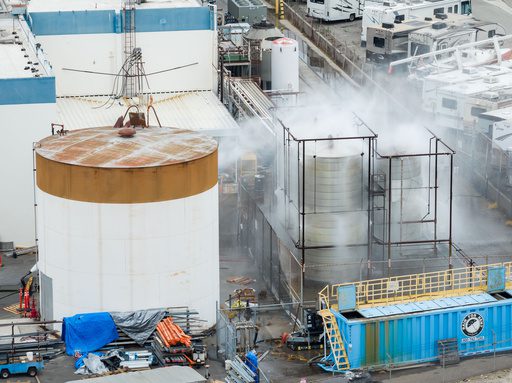
POLICY WIRE — GARDEN GROVE, California — The sizzle of barbecue grills and the chatter of Memorial Day festivities across Southern California masked a far more volatile simmer in Garden Grove this week. For days, the slow burn of uncertainty — quite literally — hovered over a community gripped by the specter of a chemical blast, all thanks to an overheated tank at a nondescript industrial plant. While officials finally allowed tens of thousands of residents to return home, declaring the immediate catastrophe averted, the incident rips back the curtain on how dangerously close local communities often live to global industrial hazards.
It wasn’t the relieved sigh from returning families that dominated the immediate aftermath for emergency crews, though. No, the real story here was the frantic, precise dance around 6,000 to 7,000 gallons of methyl methacrylate — highly flammable stuff — stubbornly trapped in a GKN Aerospace tank. Authorities confirmed Monday that an overnight evaluation showed internal temperatures dropping to 93 degrees Fahrenheit, a notable retreat from a hair-raising 100 degrees just a day prior, according to the Orange County Fire Authority.
But let’s be real: dodging one bullet doesn’t mean the clip’s empty. “It’s not over yet. We still have work to do,” admitted Craig Covey, a division chief with the Orange County Fire Authority. “We still have to mitigate a fire and very small explosion concern, and also a spill potential.” That’s the cold, hard truth of it. And folks were holding their breath, just wishing for normalcy.
Nearly 34,000 residents — about two-thirds of those initially displaced — got the green light to head back to their neighborhoods, packing up makeshift shelter arrangements in the glow of the holiday. But for some, like Kim Yen, living two blocks from the plant, the ‘all clear’ felt a bit premature. “I am happy and many of us are happy but, still, we’re still on our evacuation,” Yen reportedly said, summing up the lingering unease. And who could blame her? The air might be deemed safe, but a chemical that transforms into plastic and requires an academic expert from Purdue to explain its phase changes is hardly comforting.
Regina Chinsio-Kwong, Orange County Health Director, worked overtime trying to project an aura of calm, particularly about what wasn’t in the air. “There was no contamination. There were no fumes. There were not vapors that came from this incident,” she declared. But she sounded almost too insistent, leaving many to wonder if ‘not yet‘ was the unspoken caveat. Because when an Environmental Protection Agency fact sheet warns of potential serious respiratory and neurological problems, a little reassurance goes only so far.
The company, GKN Aerospace, a British behemoth supplying critical components for aircraft worldwide — everything from cockpit windows to military jet canopies — issued its standard corporate apology. They’re “sorry for the ongoing disruption,” you know, the kind that forces 50,000 people from their homes. Their website boasts 16,000 employees across 32 sites in 12 countries. Which means an issue here in Garden Grove has ripples. Long, uncomfortable ripples, too, given the firm already agreed in 2025 to pony up over $900,000 to state regulators for previous violations concerning recordkeeping and emissions, per the South Coast Air Quality Management District.
📄 POLICY WIRE WHITEPAPER PUBLISHED: PAKISTAN'S NATIONAL SECURITY POLICY PRIORITIES
👉 READ BY CLICKING HEREWhat This Means
This incident, thankfully contained, acts as a sharp reminder of the tightrope industrial societies walk. It’s not just about a leaky tank; it’s about the intricate, sometimes terrifyingly fragile web of global supply chains that undergirds our modern lives. The methyl methacrylate produced here in Garden Grove is just one cog. Disruptions at this one plant could send tremors through the aerospace industry, a sector notorious for its reliance on a small number of specialized suppliers. And if aircraft production hits a snag, it isn’t just North American airlines feeling the pinch.
Consider the aerospace ambitions in emerging economies — say, Pakistan’s push for a more indigenous aerospace manufacturing base, or the expansion of commercial fleets in Saudi Arabia. They depend on the predictable flow of parts from facilities just like GKN’s. A breakdown in Garden Grove today could mean delays in new aircraft deliveries to Karachi tomorrow, slowing down trade and connecting economies in ways most folks don’t even consider. It also puts a harsh spotlight on corporate responsibility and regulatory oversight; when multi-national companies operating in heavily regulated Western nations still face these kinds of issues, it makes you wonder about industrial safety benchmarks elsewhere, doesn’t it?
But the political angle is clearer: incidents like these force policymakers to balance industrial growth with community safety. Who pays when things go wrong? And how do we ensure transparency from global corporations whose reach often exceeds local regulatory grasp? You’ve got to protect both the jobs — and the people who live near these places. And it’s not a simple equation. Because when a single crack — or rather, a *needed* crack, in this case, that dropped tank pressure — could dictate the fate of a town, that’s a policy challenge with very real, explosive consequences. the focus on immediate crisis management often overshadows the long-term environmental monitoring promised by officials — an issue seen far too often in industrial accidents around the world, from the American Midwest to industrial zones outside Delhi.
And then there’s the human element. The residents, many of them having endured mandatory evacuation notices since Thursday, spent a holiday weekend stewing in uncertainty, or worse, worrying about the first responders. These aren’t abstract policy discussions when it’s your backyard on fire. That’s the takeaway from Garden Grove. They can cool the tank, sure. They can lift the evacuation. But the subtle, unnerving question of ‘what if?’? That hangs heavy in the Southern California air.