


Knicks’ Decades-Long Dirge Ends: Empire State Awakens as Finals Berth Secures Global Spotlight
POLICY WIRE — New York City, USA — It wasn’t the eruption everyone predicted—no, not really. This was more of a collective exhale, a sigh so deep it must’ve rattled foundations all the...

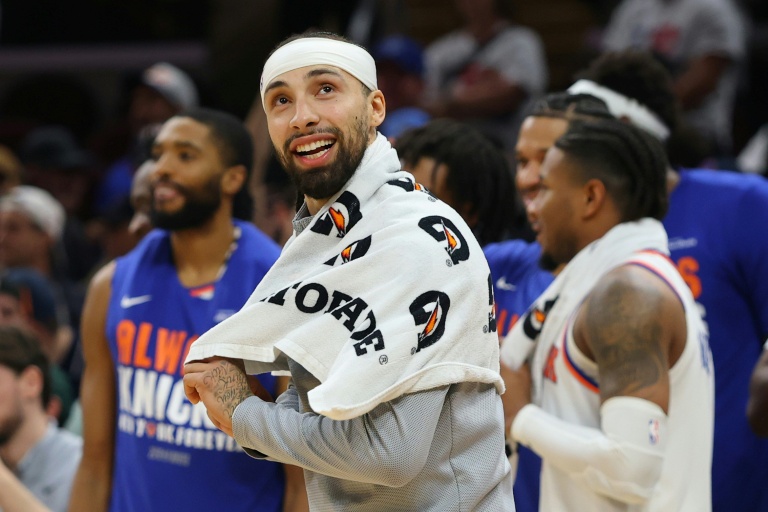
POLICY WIRE — New York City, USA — It wasn’t the eruption everyone predicted—no, not really. This was more of a collective exhale, a sigh so deep it must’ve rattled foundations all the way from Queens to the furthest reaches of Karachi. For nearly three decades, Madison Square Garden, the alleged ‘Mecca of Basketball,’ had been little more than a mausoleum of missed expectations, a spectral echo chamber where hopes withered on the vine. Then, seemingly out of nowhere, the New York Knicks didn’t just win; they eviscerated the Cleveland Cavaliers 4-0 in the Eastern Conference Finals, securing their first NBA Finals appearance since 1999.
It was a methodical dismantling, a professional clinical job. You had to respect it. On Monday night in Cleveland, the Knicks sealed their dominant performance with a resounding 130-93 victory. This win didn’t just punch a ticket to the big dance; it extended a team-record playoff win streak to an astonishing 11 games. Forget the fanfare; this was an organizational statement, a collective refusal to settle for mere contention.
The statistical assault was relentless. Karl-Anthony Towns anchored the paint with a sturdy 19 points — and 14 rebounds. O.G. Anunoby quietly added 17, — and then there was Landry Shamet. That name—remember it. Coming off the bench, Shamet put up 16 points, hitting all four of his three-point attempts. Sometimes, the unsung ones etch their names deepest. Shamet, ever the pragmatist, offered a glimpse into the locker room’s mindset: “We’re going to enjoy it for a day or two, but we’ve got a larger goal here, and we’ve got to start locking in.” No confetti hangovers here, it seems.
This isn’t just about New York City. You see, the NBA, much like Premier League football, possesses a truly global pull. These Knicks, now a compelling storyline, are capturing eyeballs and imaginations not just from Westchester to Walla Walla, but — surprisingly, perhaps — even in places like Lahore, where expatriate communities keenly follow the league. Because this team isn’t just a collection of players; it’s an ideal, an archetype of how sustained effort and teamwork can overcome even the most entrenched futility. It’s a compelling narrative, even for those whose primary loyalties lie with the Pakistani national cricket team.
The Knicks will now face either the Oklahoma City Thunder or the San Antonio Spurs, with the Western Conference Finals series currently deadlocked at 2-2. They’ve tasted the glory before, snatching titles in 1970 — and 1973. But this is different; this team is rewriting a quarter-century of sour history. Towns, speaking with a weary conviction after the Cleveland rout, didn’t shy away from the effort required: “We knew our team was capable of doing this. All we had to do is put the work in — and continue to believe in each other. That’s what we did, and that’s why we’re here.” It’s hard to argue with results.
Jalen Brunson, rightly lauded as the series MVP, provided the driving force, averaging 25.5 points, 7.8 assists, and 3.3 rebounds per game. He was two years old the last time the Knicks played in the Finals—his father, Rick Brunson, was actually a guard on that team. Imagine the family legacy now, being forged anew. “It means a lot, but I wouldn’t be here without my teammates, the belief they had in me,” Brunson stated, a classic leader’s deferral, but heartfelt nonetheless. He just turned 29, so it’s not just a youthful exuberance; it’s a maturity you rarely see in a superstar’s prime.
Knicks coach Mike Brown, a man known for his unflappable demeanor, called his players a “heck of a group.” And frankly, you’d be hard-pressed to disagree. “Every single one of the guys on the team has sacrificed,” Brown observed. “Every single one of the guys on the team has competitive spirit. Every single one of the guys on the team is connected. Every single one of the guys on the team believe in each other and the process and they all hold me and each other accountable.” That sounds like a winning formula, doesn’t it?
📄 POLICY WIRE WHITEPAPER PUBLISHED: PAKISTAN'S NATIONAL SECURITY POLICY PRIORITIES
👉 READ BY CLICKING HERECleveland, naturally, was left to lick its wounds. Donovan Mitchell fought admirably with 31 points in the losing effort. Cavaliers coach Kenny Atkinson didn’t sugarcoat the bitterness, a frank acknowledgement that no one goes into these things planning for an early exit. “It’s always a tough pill, particularly when you’ve invested so much – you just don’t anticipate such a categorical dismantling,” Atkinson conceded, his voice tight. “Our objective now is a rigorous post-mortem, to understand where the fissures appeared under pressure. We owe our city that much.” An honest appraisal, at least.
A staggering 15% increase in local viewership across playoff games has been reported in the New York metropolitan area compared to last year’s early round exit, according to Nielsen data for the Eastern Conference semi-finals—demonstrating a ravenous hunger for success the city hasn’t seen in a very, very long time.
What This Means
The New York Knicks reaching the NBA Finals isn’t merely a sports headline; it’s a palpable civic event, an economic ripple, and a subtle cultural barometer for a city that, post-pandemic, yearns for collective joys. For New York, a deep playoff run injects millions into the local economy through increased foot traffic for bars and restaurants around MSG, merchandise sales, and even a temporary, albeit modest, bump in tourism. It represents a victory of urban resilience, a proof-of-concept that sustained investment (even with past missteps) can eventually pay off, energizing a diverse population.
Beyond the local ledger, the narrative of the Knicks’ improbable rise, and that 27-year drought finally quenched, resonates far beyond conventional sports markets. In an age saturated with often bleak geopolitical news—conflicts, economic instability, the persistent challenges facing regions like the Indo-Pacific—a shared cultural experience like a beloved sports team’s triumph offers a temporary, yet potent, unifying force. It’s a testament to the simple, almost innocent, power of sport to cut across divisions, giving disparate communities a common thread, a shared moment of relief and celebration in an otherwise fractured global landscape. And for one fleeting moment, perhaps, the world collectively remembered what it felt like to believe again. A silly little sentiment for hard-nosed journalism, I know, but sometimes it just is what it’s.