


The Maverick and the Mogul: How a Discarded Player Upended NBA’s Cold Calculus
POLICY WIRE — Oklahoma City, USA — There’s a particular kind of schadenfreude that bubbles up in professional sports, an unvarnished joy in seeing a rejected talent — an apparent cast-off —...

POLICY WIRE — Oklahoma City, USA — There’s a particular kind of schadenfreude that bubbles up in professional sports, an unvarnished joy in seeing a rejected talent — an apparent cast-off — rise from the ashes to haunt the architect of their dismissal. And right now, few spectacles in the National Basketball Association are quite as delicious, or as politically charged, as the incandescent ascent of Jared McCain.
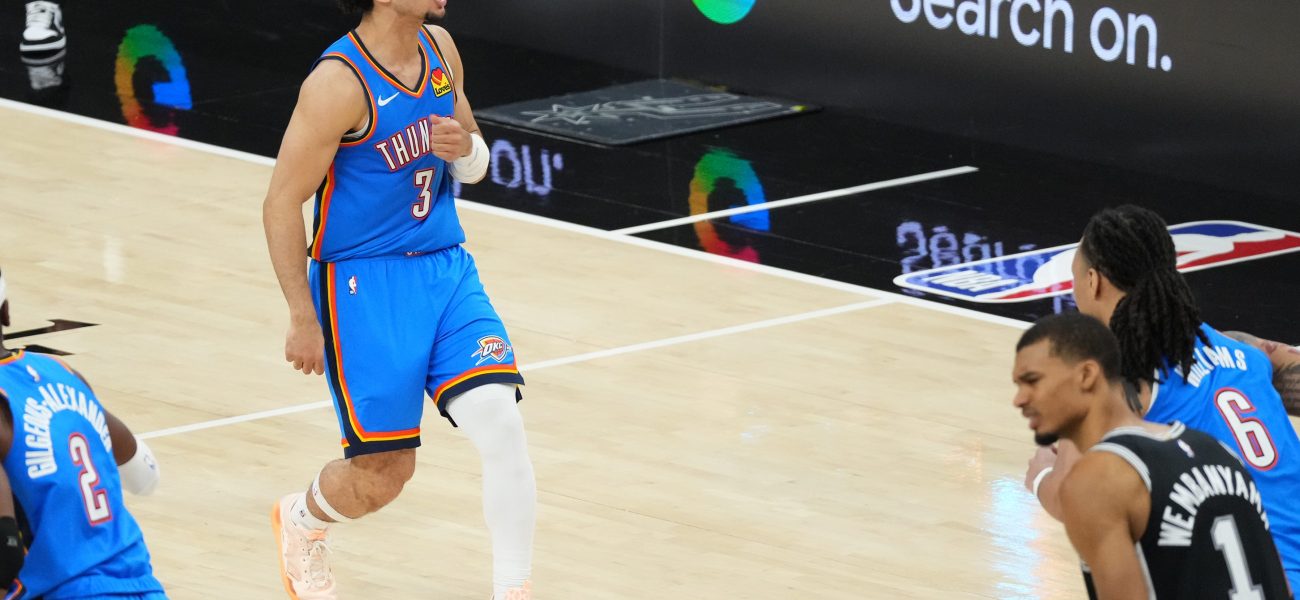
It wasn’t supposed to happen this way. Just five months ago, McCain was toiling in the G-League, a professional purgatory for many. Fast forward, and he’s not just on the floor, he’s flat-out dictating terms in the Western Conference Finals against the San Antonio Spurs, dropping 24 points in Game 3, a decisive 123-108 Thunder victory that gave OKC a critical 2-1 series lead. That’s more than basketball, folks; it’s a living repudiation of front-office calculus, a pointed whisper across league executive suites: maybe you don’t always know what you’ve got.
The Thunder, crippled by injuries to key rotational players Jalen Williams — and Ajay Mitchell, needed a jolt. What they got was a supernova. McCain, a lanky guard whose journey to this moment was anything but linear, stepped up like he owned the place. He squared up against Julian Champagnie, then Victor Wembanyama — a truly singular talent, that Frenchman — in the paint. He pulled up, drained the shot, stretched the lead beyond a two-score game for good. What a gut punch, right? Especially when much of his scoring, a hefty 16 points in the second half, came inside the arc, because, well, sometimes the outside shot just isn’t there, and a professional adapts.
The backstory here is just gold for us grizzled journalists. McCain was drafted by the Philadelphia 76ers, nurtured, then unceremoniously shipped off to the Thunder in a mid-season reshuffle. Daryl Morey, the Sixers’ President of Basketball Operations and something of a high-wire artist with roster construction, made the call. It probably seemed shrewd at the time. An acquisition, a realignment of assets. Now, it looks, shall we say, a touch shortsighted? But McCain, bless his heart, doesn’t seem to be playing for vengeance.
“It’s never to prove anybody wrong,” McCain mused recently, his voice steady despite the postseason pressure. “A lot of my stuff is that I try to keep a positive outlook. I like proving my support system right.” And for a kid playing his guts out in the biggest games of his career, you just gotta admire that approach. Even when the collective NBA universe — and every second-guessing sports analyst with a Twitter account — wants to connect every McCaim highlight reel to Morey’s strategic blunder.
📄 POLICY WIRE WHITEPAPER PUBLISHED: PAKISTAN'S NATIONAL SECURITY POLICY PRIORITIES
👉 READ BY CLICKING HEREOklahoma City head coach Mark Daigneault has a knack for cutting through the noise. He’s often trotted out this neat analogy about players ‘hopping on a moving train’ when they join a contending team mid-season. “From the second he’s gotten here, this is obviously a high-level team,” Daigneault observed, almost casually, after the Game 3 fireworks. “He hasn’t flinched. He’s jumped right on the train. He’s been inside the team.” It’s a rare quality, that seamless integration, that unflappable moxie.
And because these narratives reverberate globally, beyond the slick courtside advertising or the multi-million-dollar sponsorships, McCain’s story offers a curious echo in places you wouldn’t expect. Consider Pakistan, for instance, a nation more accustomed to cricket diplomacy — and regional power plays. Yet, the NBA’s global reach means young players, sometimes from families tracing heritage through the Muslim world, become symbols of hope, tenacity. McCain’s own background might not be directly from South Asia, but the idea of a less-heralded talent finding a platform on a global stage — a stage where every basket translates to a highlight reel shared from Lahore to London — it’s not lost. The league, in fact, recorded a staggering 1.8 billion engagements across its social media platforms during the 2023 playoffs alone, a stark illustration of how universally these underdog stories resonate.
This isn’t about just one game, you know. It’s a career trajectory redefined in just a handful of months, from an uncertain draft pick (he was chosen 16th overall, a specific data point from the league’s economic census of talent) to a legitimate playoff performer. McCain took 20-plus shots in that critical third game, a confidence vote few unproven players ever receive in the conference finals. But still, the player remains measured. “Daryl’s still the guy that drafted me,” McCain affirmed, the sort of professionalism you don’t always get in this cutthroat business. “I always have love for him for that. He trusted me.” That’s a sentiment that rings of a particular grace, isn’t it? It complicates the narrative, makes it richer. The business of basketball, it seems, isn’t always just business.
What This Means
McCain’s late-season surge and playoff heroics aren’t simply a feel-good sports story; they represent a significant policy headache for any front office reliant solely on predictive analytics and static roster evaluation. This isn’t some outlier anymore. It’s a reminder that player development — the belief in human capital over initial scouting reports — can swing multi-million-dollar valuations. For the Thunder, a franchise operating in a relatively small market, these moments of unexpected output from seemingly ancillary players are pure gold, both on the court and at the ticket office. It also creates a dynamic tension between the perceived transactional nature of the modern NBA and the enduring power of human narratives. A General Manager might prioritize asset accumulation — and trade value above all else, but fans? They root for redemption stories, for the underdog who proves the experts wrong. And for players, it sends a clear signal: you are not just a line item on a balance sheet. You can, through sheer force of will, alter the very economic — and strategic landscape of your sport. This tale, perhaps, also holds lessons for organizations beyond sports, hinting at the broader policy challenge of retaining and cultivating talent in an increasingly competitive, globally observed marketplace. After all, the cost of overlooking a talent can be a championship, or a more subtle but equally painful wound: watching a rival thrive on your mistake. We see this dynamic in everything from venture capital investments to international aid — a bet on overlooked talent, and the potential returns can be astronomical. For another lens on how player value impacts strategy, see The Scarcity Premium: Watford’s Uneven Season Highlights Hardscrabble NBA Economics.