

Beyond the Veil: Iraq’s Invisible War Against an Environmental Calamity
POLICY WIRE — Baghdad, Iraq — The sun, a vague memory for days, struggled to penetrate the sickly orange shroud hanging over Baghdad. It wasn’t fog. Not smoke. It was sand, gritty — and...

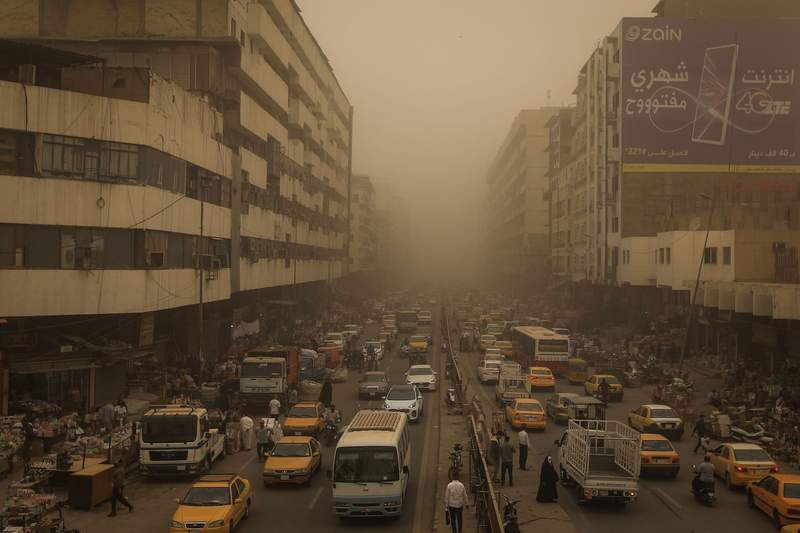
POLICY WIRE — Baghdad, Iraq — The sun, a vague memory for days, struggled to penetrate the sickly orange shroud hanging over Baghdad. It wasn’t fog. Not smoke. It was sand, gritty — and relentless, invading every crease, every breath, every corner of this ancient city. Life here, already a precarious balancing act of geopolitics and scarce resources, has found itself pitted against an antagonist both microscopic and utterly overwhelming: the very earth beneath its feet, now airborne.
It isn’t just about a bit of dust. This isn’t your grandma’s mild pollen count. This is a country, already worn thin by decades of conflict and corruption, being systematically buried alive, one abrasive particle at a time. The sand storms — more accurately, regional dust super-events — have become so frequent, so severe, that they’re no longer just news; they’re an expected, unwelcome calendar entry, shutting down airports, hospitals, and whole swaths of the economy with startling regularity. Think of the misery. The grit. That feeling of always having something in your teeth.
Hospitals, underfunded — and understaffed, report soaring admissions for respiratory ailments. Children — and the elderly are particularly vulnerable, their lungs simply giving up the ghost under the assault. But it’s not just the immediate health crisis that worries officials. Because, honestly, who can plan a nation’s future when you can’t even see your hand in front of your face for days on end? This creeping desertification and the accompanying atmospheric hell aren’t just environmental phenomena; they’re direct threats to state stability.
“We’re not just fighting dust; we’re fighting a ticking clock,” stated Jasim Al-Falahi, Iraq’s Minister of Environment, a man who, you’d imagine, spends a good deal of his day looking skyward with a weary sigh. “The neglect of previous decades, the rapid climate shift, it’s all conspiring against us. We’re developing plans, sure, but the scale of the challenge demands a global response. We can’t plant an entire desert by ourselves.” His words, delivered during a rare media appearance after another ground stop at Baghdad International, carried the weight of a leader watching his country literally fade from view.
And this isn’t an isolated problem, unique to Iraq. Across the region, from the choked arteries of Lahore to the windswept plains of Iran, the atmospheric forecast has turned decidedly grim. Pakistan, for instance, faces its own persistent battle with air quality, often battling smog exacerbated by industrial emissions and vehicular traffic. But the phenomenon of sand and dust storms (SDS) is an escalating threat across the broader Middle East and South Asia, pushing millions of people to the brink. It’s a shared struggle, this battle against airborne earth, a quiet calamity that often gets less attention than rockets or regime changes.
Dr. Sadiq Karim, a Baghdad-based economic analyst with a keen eye for the invisible costs, puts it bluntly: “It’s an invisible tax on everything—health, infrastructure, trade. Every time a storm hits, flights are grounded, construction stops, markets empty out. You can’t put a figure on every sneeze or every cancelled meeting, but the collective impact is devastating.” He’s right, of course. The financial toll alone is staggering. The United Nations Economic and Social Commission for Western Asia (UNESCWA) estimated that sand and dust storms caused over $13 billion in annual losses across the Middle East. That’s thirteen billion, a figure that ought to shock even the most jaded among us.
The situation isn’t entirely without attempts at mitigation. Iraq has joined regional initiatives, some bordering on the quixotic, to increase green spaces and curb desertification. There’s talk of ‘great green walls’ — and modern irrigation techniques. But these aren’t quick fixes, — and the storms seem to intensify with every passing year. It’s an uphill slog—more like a straight up-cliff climb—against forces that feel insurmountable.
What This Means
This environmental onslaught isn’t merely an inconvenience; it’s a political hot potato and an economic anchor weighing heavily on Iraq’s fragile recovery. Constant disruptions due to sandstorms erode public trust in government’s ability to provide even basic security and normalcy. Investment, both foreign and domestic, is understandably hesitant to put roots down in a landscape so prone to such dramatic atmospheric chaos. But hey, it’s always easier to focus on geopolitical skirmishes or digital drama than the slow, choking death of arable land and public health, isn’t it?
Economically, Iraq’s already struggling oil-dependent economy takes hit after hit. Production facilities often have to scale back or shut down, transportation becomes a nightmare, and the agricultural sector, once a regional breadbasket, is progressively decimated. It pushes more people into poverty, fueling social unrest—which Baghdad hardly needs right now. Internationally, it puts Baghdad in a difficult position, perpetually seeking assistance for a problem whose root causes are vast and diffuse. But it also highlights a sobering reality: environmental collapse isn’t a future problem for some faraway country. It’s here, now, gritty and palpable, demanding immediate and sustained action before entire regions become literally uninhabitable.
But the true cost isn’t measured in dollars or flight delays; it’s in the diminished quality of life for millions, the constant threat to public health, and the gnawing uncertainty about what fresh hell tomorrow’s winds will bring. The Iraqi government, already wrestling with myriad internal and external pressures, finds itself on the front lines of a global climate crisis. It’s a cruel twist, perhaps, for a nation sitting on such immense fossil fuel reserves to be one of the first and hardest hit by the downstream effects of carbon emissions, and not just locally, but regionally too. Think of how difficult it must be for them, especially with state carriers in other Asian nations facing their own challenges, often linked to rising fuel prices. The whole region’s tied together in this.