


Wembanyama: The Relentless March of a Market Mover Towards Dominance
POLICY WIRE — San Antonio, United States — It’s rarely about the slam dunk itself; it’s about the seismic ripples that follow. When Victor Wembanyama, the long-limbed French phenomenon,...

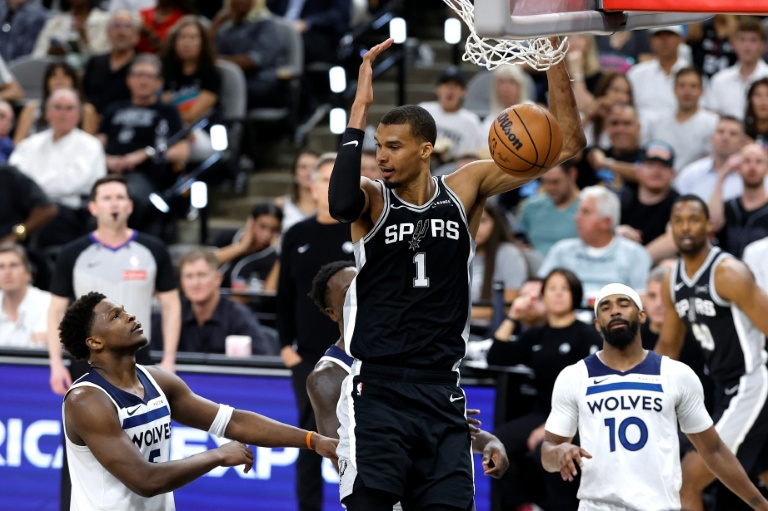
POLICY WIRE — San Antonio, United States — It’s rarely about the slam dunk itself; it’s about the seismic ripples that follow. When Victor Wembanyama, the long-limbed French phenomenon, asserted his absolute will over the Minnesota Timberwolves this past Tuesday, it wasn’t merely a basketball game. It was a stark, almost brutal, display of a market force in full, terrifying motion—a talent singularity dictating terms, reshaping a landscape overnight. You watch him, this seven-foot-four improbable athlete, and you don’t just see points; you see capital in motion, power consolidating.
Minnesota, bless their hearts, were left reeling, flattened not just by Wembanyama’s sheer numbers, but by the relentless inevitability of his presence. His 27 points, 17 rebounds, five assists, — and three blocks were just the accounting. The true story lay in the crushing psychological weight he imposed, rendering established stars like Anthony Edwards into desperate supplicants. And perhaps that’s the real takeaway here, for anyone observing global markets or regional hegemonies: sometimes, one disruptive entity can simply rewrite the rules.
The young Spurs star, fresh off what many viewed as a questionable reprieve from a Game Four suspension (a rather vigorous elbow to Naz Reid’s throat—a debatable, though ultimately forgiven, transgression), came back with the calm fury of a man who knew he’d been given a second bite at the apple. He scored 16 points in the first quarter alone, immediately putting the Timberwolves on their heels, much like an emerging economy leveraging its distinct advantage to corner a new sector. The Spurs galloped to a 24-9 lead, setting a tone that—even a late Minnesota surge couldn’t fundamentally alter.
Because that’s what happens when you’re dealing with a genuine anomaly. And Wembanyama? He’s certainly that. After the win, which put San Antonio a mere single game away from the Western Conference finals, the Frenchman kept it surprisingly level, almost business-like. “We did what we were supposed to do at home,” Wembanyama told reporters. “We had to set the tone, we knew it was going to be a physical game. We won, so that’s the point. But the job’s not finished. We’ve got one more game to get to the conference finals.” A conqueror acknowledging unfinished business. Very corporate, actually.
For Minnesota, the sentiment was a bit more… exasperated. Their own star, Anthony Edwards, whose talent is undeniable, could only describe the frustrating encounter with a touch of grim realism after the drubbing. “Look, you face giants, you fight. But this… this is different. It’s not just skill, it’s a whole damn presence. We didn’t quit, not ever, but there’s a point where you’re just slamming against a wall built too high.” It’s the lament of any established power trying to compete with a phenomenon that seems to defy the known physics of the game, or the market, or frankly, the world. Even after trailing by a dozen points at halftime, Minnesota found a spark—a 14-2 run to begin the third quarter, momentarily knotting the score at 61. But San Antonio, perhaps channeling the calculated resilience of a seasoned geopolitical actor, regrouped. They closed the quarter 91-73 — and didn’t look back.
And it wasn’t just Wembanyama, of course. The Spurs leveraged their collective, a crucial reminder that even an absolute star needs a competent supporting cast. Six players finished in double figures, with Keldon Johnson adding 21 points, mirroring the diversification of assets any shrewd entity employs. They ran away with the fourth quarter, outscoring Minnesota 35-24. For a Timberwolves team that ended the season leading the league in defensive rating at 108.9 (Source: NBA.com’s statistical analysis reports), this offensive eruption was, quite frankly, an embarrassment—a strategic failure that calls for a significant reassessment.
What This Means
Wembanyama’s ascent isn’t just sports news; it’s a case study in global economic power dynamics. His raw market value—as a player, as a brand, as an international draw—surpasses the sum of his on-court actions. This single individual is drawing unprecedented capital and eyeballs globally, from the American Midwest to burgeoning basketball fan bases in South Asia and the broader Muslim world, where youth are increasingly captivated by international sports heroes who symbolize global aspiration and success. This isn’t just about athletic prowess; it’s about the concentrated, almost disruptive, nature of singular talent. Governments and corporations everywhere are constantly looking for their ‘Wembanyama’—that one asset or policy or innovation that utterly transforms their standing.
The Spurs’ performance also reminds us that sustained dominance requires more than a single extraordinary factor; it demands an intelligent, flexible system. They absorbed Minnesota’s counterpunch and pivoted, not unlike how robust economies navigate austerity measures or geopolitical shocks. For a team so young, this isn’t just basketball; it’s a masterclass in strategic resilience. The Timberwolves, meanwhile, represent the inherent danger of relying too heavily on existing strengths without adapting to the game-changing presence of a new paradigm. They’ll need to figure out how to counter a force that seems, right now, beyond countering. This kind of brutal accounting has wider implications for the calculus of contention in any field, whether sports or statesmanship. It’s not just a game; it’s a cold, hard lesson in power.