


Detroit’s Glimmer of Grit: The Accidental Maverick Who Dared to Defy Expectation
POLICY WIRE — Detroit, Michigan — In a league obsessed with stratospheric salaries and carefully cultivated stardom, the story of the Detroit Pistons’ protracted misery usually writes itself in...

POLICY WIRE — Detroit, Michigan — In a league obsessed with stratospheric salaries and carefully cultivated stardom, the story of the Detroit Pistons’ protracted misery usually writes itself in headlines of draft lotteries and roster turnover. But late one Monday night, amidst the familiar ache of a season gone awry, something quietly shifted. Not a win, mind you—the Cavaliers still rolled—but a subtle, defiant murmur emanating from an unlikely source: Paul Reed, the team’s undersized, third-string center, affectionately known as “B-ball Paul.”
It wasn’t the narrative the bigwigs wanted. Everyone expects the franchise’s redemption to arrive draped in All-Star potential, signed to a max deal, perhaps after yet another strategic tank. Instead, a flash of genuine, unscripted basketball electricity erupted from a player perpetually teetering on the edge of the rotation, a forgotten cog suddenly humming. It’s an inconvenient truth for a league that often prioritizes physical prototypes and established reputations over raw, disruptive output. But there Reed was, bucking trends.
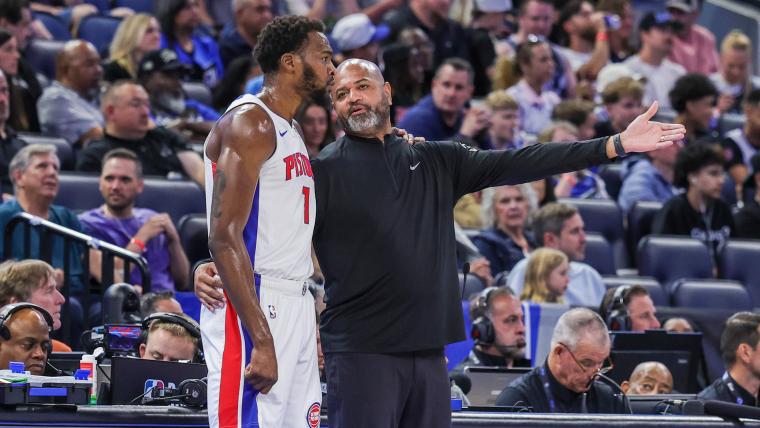
The Pistons, by most accounts, were being ground into dust. Donovan Mitchell, a force of nature, was running amok, stacking up points like they were spare change. Then came the dreaded 23-0 run. That’s a canyon, not a deficit—a yawning chasm where most teams simply curl up and call it a night. Not Paul. Coach J.B. Bickerstaff, visibly exasperated by the collapse, had precious few levers left to pull. So, he threw the third-stringer in. And the unthinkable, or at least the highly improbable, began to happen.
Reed, standing just 6-foot-9 in a league of 7-footers, got to work. He’s not a bruiser like his bulkier teammates, Jalen Duren or Isaiah Stewart. No, he’s more of a quick-twitch problem, a blur of motion where defenders expect a wall. In a mere 14 minutes, he bagged 15 points. He dropped 7-of-9 shots—a staggering 77.8% efficiency, per NBA.com analytics—even swishing a three-pointer. And he didn’t stop there: 4 rebounds, 2 assists, a steal. It was the kind of do-it-all frenzy that analytics nerds swoon over, a tiny hurricane in the midst of a perfect storm of failure.
“We’re not exactly in a position to ignore anything that provides a spark. Sometimes, you just gotta roll the dice with the guy who’s playing with his hair on fire,” Coach Bickerstaff confided post-game, exhaustion etched on his face. He didn’t sound elated, but resigned to exploring all avenues. General Manager Troy Weaver, whose long-term strategy has been critiqued fiercely by the Detroit faithful, hinted at a tactical re-evaluation. “The metrics on Paul have always been interesting, but seeing that translate in high-pressure minutes, that changes the calculus for us, big-time. It’s about value, and frankly, we need all the value we can get.” Weaver’s voice carried a hint of surprise, perhaps even a grudging admission that established blueprints might sometimes need revision.
Because, really, what’s left to lose? The Pistons have stumbled. Their traditional centers, despite their heft, have seen Cleveland adapt. This is about discovering latent energy, an untapped resource beneath the official pecking order. You see it across the globe, too: from innovative, community-led initiatives in Punjab revitalizing local economies with overlooked traditional skills, to the unexpected electoral breakthroughs of outsider candidates in emerging democracies—where established frameworks fail, improvisation often lights the way. It’s the perennial challenge for under-resourced entities fighting for relevance, be it a struggling basketball team or a nation like Pakistan navigating complex global economic currents—finding strength not just in size or capital, but in agility, spirit, and smart deployment of what’s available.
📄 POLICY WIRE WHITEPAPER PUBLISHED: PAKISTAN'S NATIONAL SECURITY POLICY PRIORITIES
👉 READ BY CLICKING HEREDetroit needs a new recipe. Maybe it involves smaller, quicker lineups, forcing the game into chaos where Paul Reed can thrive. They’ve gotta explore. And, what a concept for an organization that’s often felt mired in predictable, costly errors: the solution might just be hiding in plain sight, on the deepest reaches of the bench.
What This Means
The Pistons’ inadvertent discovery of Paul Reed’s utility isn’t just a sports footnote; it’s a policy parable. For long-suffering Detroit, and indeed for any organization or government stuck in a rut, the political and economic implications are clear. The traditional, large-scale, capital-intensive solutions often fail, not because they’re inherently bad, but because they breed complacency and overlook agile, cost-effective alternatives. Just like Detroit can’t buy their way out of this current quagmire, developing economies or struggling democracies often find their grand schemes stifled by global market realities or entrenched interests.
The lesson here is one of resource optimization — and tactical flexibility. Reed represents a highly efficient asset, producing significant impact with minimal investment (in terms of minutes, salary, and draft capital). Governments could take note; sometimes, the path to meritocracy or national revitalization lies not in massive infrastructure projects or top-down mandates, but in empowering overlooked segments of society, in fostering local innovations, or in simply changing the rules of engagement. This isn’t about abandoning long-term strategies entirely, but about integrating micro-wins and unexpected sparks into the grand design. It’s a move toward strategic pragmatism, accepting that sometimes, the future looks nothing like the blueprint—it looks like a third-string player, making all the right moves.